Account-to-Account Payments Explained for Growth Teams
Learn how account-to-account payments work, when they beat cards, and how to orchestrate A2A for lower costs and resilient recurring revenue.
A checkout can appear healthy until a bank declines a card, a subscription rebill fails, or a processor outage disables every saved payment method. Revenue loses conversion, engineering handles another incident, and operations absorbs support tickets and reconciliation work.
Account-to-account payments provide another payment rail. The customer sends money directly from a bank account to the merchant or payee through bank infrastructure, rather than through a card network. That makes A2A a strategic choice, not a universal card replacement. Use it where direct settlement, lower acceptance costs, disbursements, bill payment, or recurring billing matter more than card familiarity and card-based protection.
The market now warrants a deliberate operating model. A Juniper Research forecast projects global consumer A2A transaction value rising from $1.7 trillion in 2024 to $5.7 trillion by 2029, with transaction volume increasing from 60 billion to 186 billion. The forecast describes this as a 230% increase in transaction value. Capgemini expects instant payments to reach 22% of global non-cash transaction volume by 2028, according to its World Payments Report 2025 release.
For founders, payment leads, growth teams, engineers, and revenue operations, the decision is practical: identify where A2A improves payment economics or resilience, then keep cards and wallets where they deliver stronger conversion or customer protection.
FloPay has not launched A2A payments. It has no live merchant integrations, proprietary A2A authorization benchmarks, or client case study for this product. Its position remains exploratory and strategic. Merchants should therefore design for portability now, with payment orchestration that can add or replace rails without rebuilding checkout, reconciliation, and reporting.
Table of Contents
- What Account to Account Payments Are and How They Work
- The A2A Ecosystem and Rails Behind Every Transfer
- When Account to Account Payments Beat Cards and Wallets
- Integrating A2A and Orchestrating for Acceptance and Cost
- Cross Border Scale and Operational Realities to Plan For
- Next Steps for Resilient Account to Account Payments
What Account to Account Payments Are and How They Work
At its simplest, an account-to-account payment moves money between bank accounts without using a card network as the payment rail. The customer's bank, the merchant's bank or payment service provider, and the relevant payment scheme coordinate the transfer.
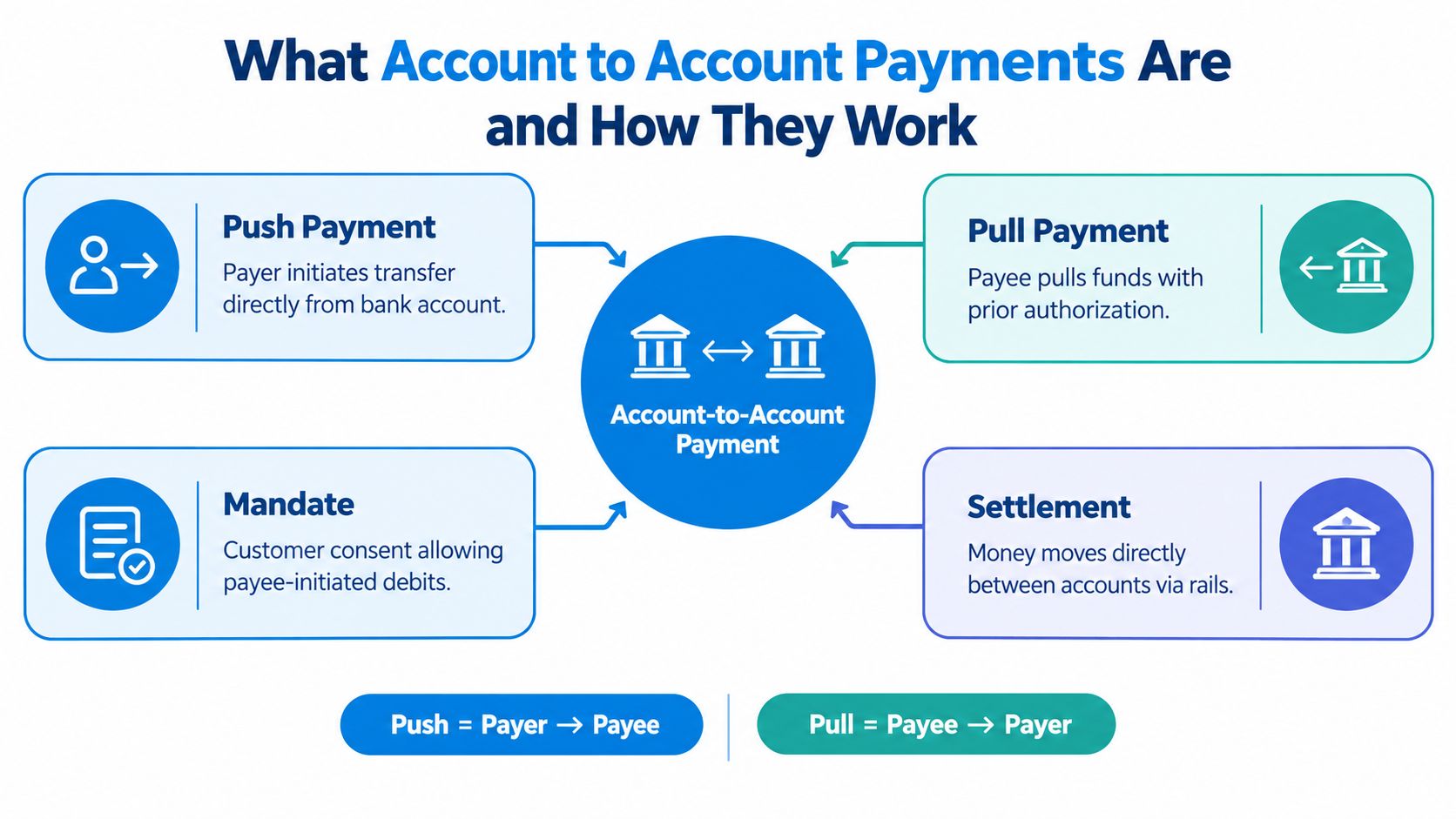
The first distinction is push versus pull.
- Push payment: The payer approves and initiates the transfer from their bank account.
- Pull payment: The payee initiates the collection after the payer has granted permission.
- Mandate: A record of the customer's consent that allows the payee to initiate future debits.
- Settlement: The point at which the payment reaches the recipient's account and the transaction state becomes financially meaningful.
A card checkout usually asks a provider to request an authorization against a card account. A pay-by-bank flow typically sends the customer to their bank or banking application, where they authenticate and approve a transfer. That distinction affects both user experience and risk. The customer may trust their bank interface, but the merchant must handle redirects, bank availability, payment status, and reconciliation correctly.
Open banking and customer authentication
Open banking lets an authorized provider connect to a customer's bank account through regulated interfaces. The provider can use that connection to initiate a payment or confirm account information, depending on the market and permission model.
In Europe, A2A payments rely on bank rails and open-banking infrastructure rather than card networks. Strong Customer Authentication, or SCA, is the requirement for customers to verify certain payments using approved authentication factors under the Payment Services Directive 2 regulatory technical standards. The European model is designed to reduce dependence on intermediaries while giving banks a central role in payment approval. The European account-to-account payments analysis explains this regulatory and protocol difference.
Think of a card payment as asking a card network to vouch for a transaction. A bank transfer is closer to handing cash directly to the recipient through a controlled banking channel. Once the recipient has the money, reversing the transaction isn't the same as canceling a card authorization.
For recurring billing, the distinction matters. The European Central Bank's SEPA direct debit explanation describes a direct debit as an account-to-account payment initiated by the payee after the payer provides consent through a mandate. Subscription teams therefore need mandate creation, storage, status tracking, cancellation, and exception handling, not just a payment button.
For a broader explanation of checkout sequencing and payment states, see how the ecommerce payment process works.
The A2A Ecosystem and Rails Behind Every Transfer
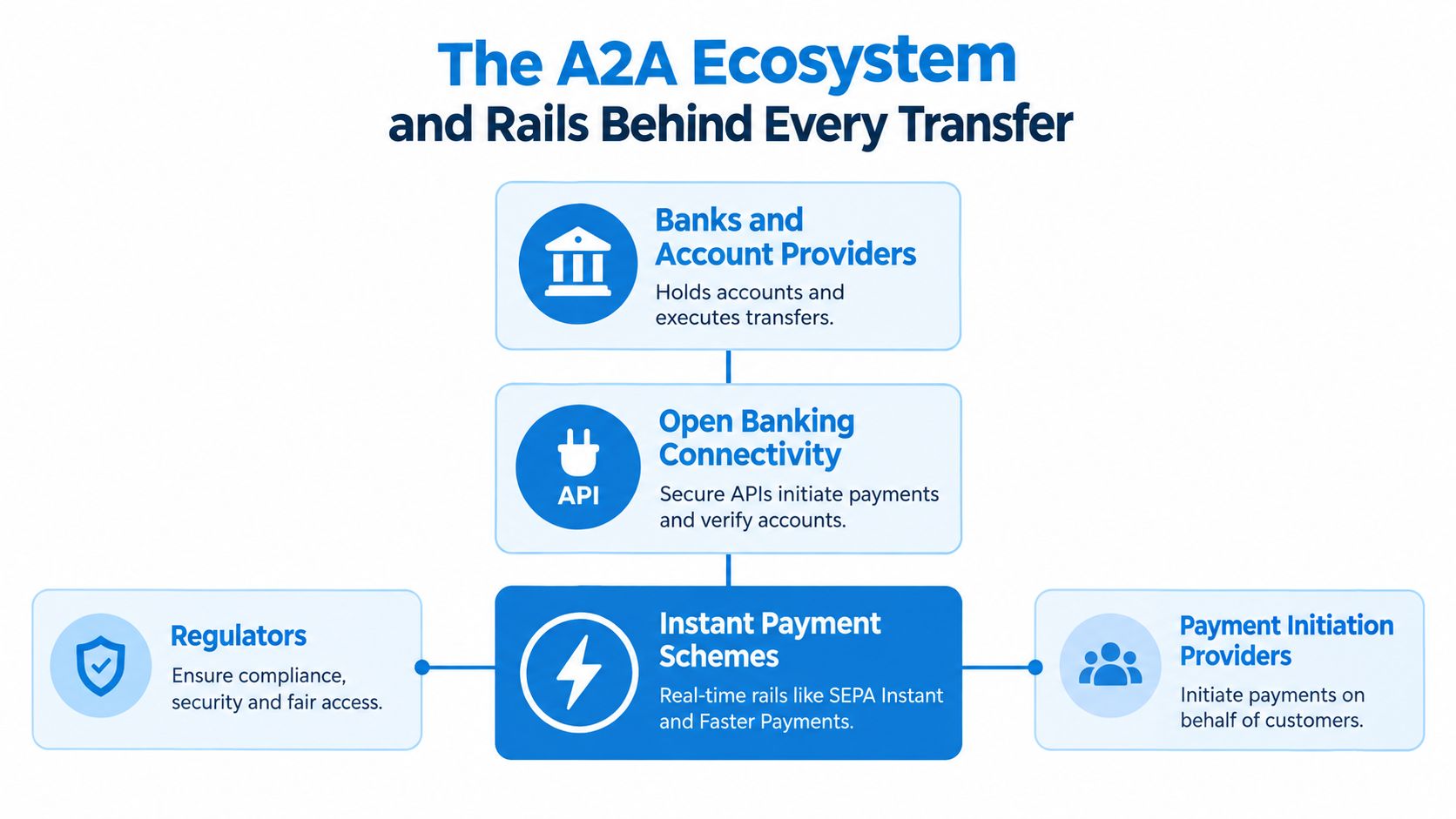
A2A is a coordinated payment stack, not a single product or network. The customer sees one checkout option, while banks, connectivity providers, payment initiators, schemes, and regulators determine whether funds move, how quickly the merchant receives confirmation, and how the transaction is reconciled.
The participants and their jobs
Banks and account providers hold the customer's account and execute the transfer. They control access, authentication, balance checks, and the final movement of funds. If a bank interface fails or authentication cannot be completed, the merchant cannot solve the problem with retries alone. That failure can interrupt checkout and delay revenue recognition.
Open-banking connectivity providers provide the regulated connections between a payment initiation provider and the customer's bank. Their responsibilities include bank coverage, consent handling, redirects, status updates, and technical normalization across institutions. Coverage and uptime directly affect the number of customers who can complete payment.
Payment initiation providers convert a merchant's request into a bank-authorized transfer. They present the payment journey, send the customer to the correct bank, receive status information, and return a usable outcome to the merchant's systems. The provider's quality affects conversion, support volume, and the accuracy of order fulfillment.
Instant payment schemes supply the underlying rails. Europe uses schemes such as SEPA Instant, while the UK uses Faster Payments. Names vary by market, but merchants need the same operating result: quick confirmation, reliable status, and defined handling for failures, returns, and exceptions.
Regulators set requirements for access, authentication, consumer rights, screening, and scheme participation. Europe's early A2A adoption grew from PSD2 and its open-banking infrastructure. The market has become a major source of A2A demand, but merchants should choose an architecture that remains portable across providers and rails.
Why instant payments change the baseline
The European Union's Instant Payments Regulation requires banks offering regular euro transfers to offer instant payments at the same price. It applies to euro-area providers from October 2025, with wider EU implementation continuing through mid-2027. The framework also includes free Verification of Payee and harmonized sanctions screening, as described in the European payments industry overview.
Regulation improves rail availability, not operational execution. Providers still handle different bank journeys, authentication results, fraud decisions, returns, and reporting formats.
Build A2A behind an abstraction layer. Keep initiation, status normalization, reconciliation, and routing separate from checkout code. Stripe can remain a card processor, but Stripe-only architecture creates processor concentration risk. A gateway-independent payment layer lets FloPay and its merchant partners test A2A at the exploration stage while preserving the option to change providers, add cards, or route transactions differently as the commercial case develops.
When Account to Account Payments Beat Cards and Wallets
A2A works best when moving money directly between bank accounts creates more value than card convenience. Cards and wallets remain the stronger choice when customers expect familiar checkout, stored credentials, broad acceptance, and established dispute processes. Treat A2A as a rail choice, not a card replacement.
Prioritize A2A for bill pay, disbursements, account funding, and recurring payments. An invoice payer already expects to send a known amount from a bank account. A marketplace can pay sellers directly without forcing every payout through card infrastructure. A subscription business can use a mandate for customers who prefer bank-based collection.
Retail checkout requires sharper selection. Poor bank journeys, weaker purchase protections than cards, and trust concerns can reduce completion. QR-led A2A journeys have gained traction in markets such as India and Brazil, but a flow that performs well there may still underperform cards in another market or product category. Test the journey against completed revenue, not payment-method adoption alone.
A practical decision matrix
| Use Case | Best Fit | Why It Wins | Watch Out For |
|---|---|---|---|
| Digital retail checkout | Cards or wallets, with A2A offered selectively | Familiar approval flow, saved payment methods, and consumer protections support conversion | Bank redirects, authentication friction, and trust can reduce completion |
| Utility or invoice bill pay | A2A | Customers already expect to pay a known amount from a bank account | Reconciliation must match the transfer to the correct invoice |
| Marketplace disbursements | A2A | Direct bank movement suits payouts and seller settlement | Account verification, sanctions screening, and exception handling need ownership |
| Subscription collection | A2A mandate or card-on-file, depending on market | A mandate supports payee-initiated collection, while cards offer familiar recovery tools | Insufficient funds, cancellations, unauthorized returns, and mandate lifecycle issues |
| High-value transfers | A2A, subject to risk controls | Direct account settlement can fit larger payments better than card acceptance | Fraud and irrevocability raise the cost of a bad approval |
| Mobile or assisted checkout | Wallets, cards, or QR-led A2A | The right method depends on device context and customer trust | Don't force a bank flow where a wallet already converts |
Commercial rule: Offer A2A when the customer has a clear reason to use a bank account. Keep cards and wallets available when they provide the more familiar or reliable path.
Orchestrate both rails. Use cards and wallets where they maximize conversion, add A2A where its economics or payment context are stronger, and design the integration for provider portability. FloPay's exploration-stage position makes that portability a commercial requirement. Measure each rail by completed revenue, support burden, settlement quality, recovery performance, and the cost of changing providers later.
Integrating A2A and Orchestrating for Acceptance and Cost
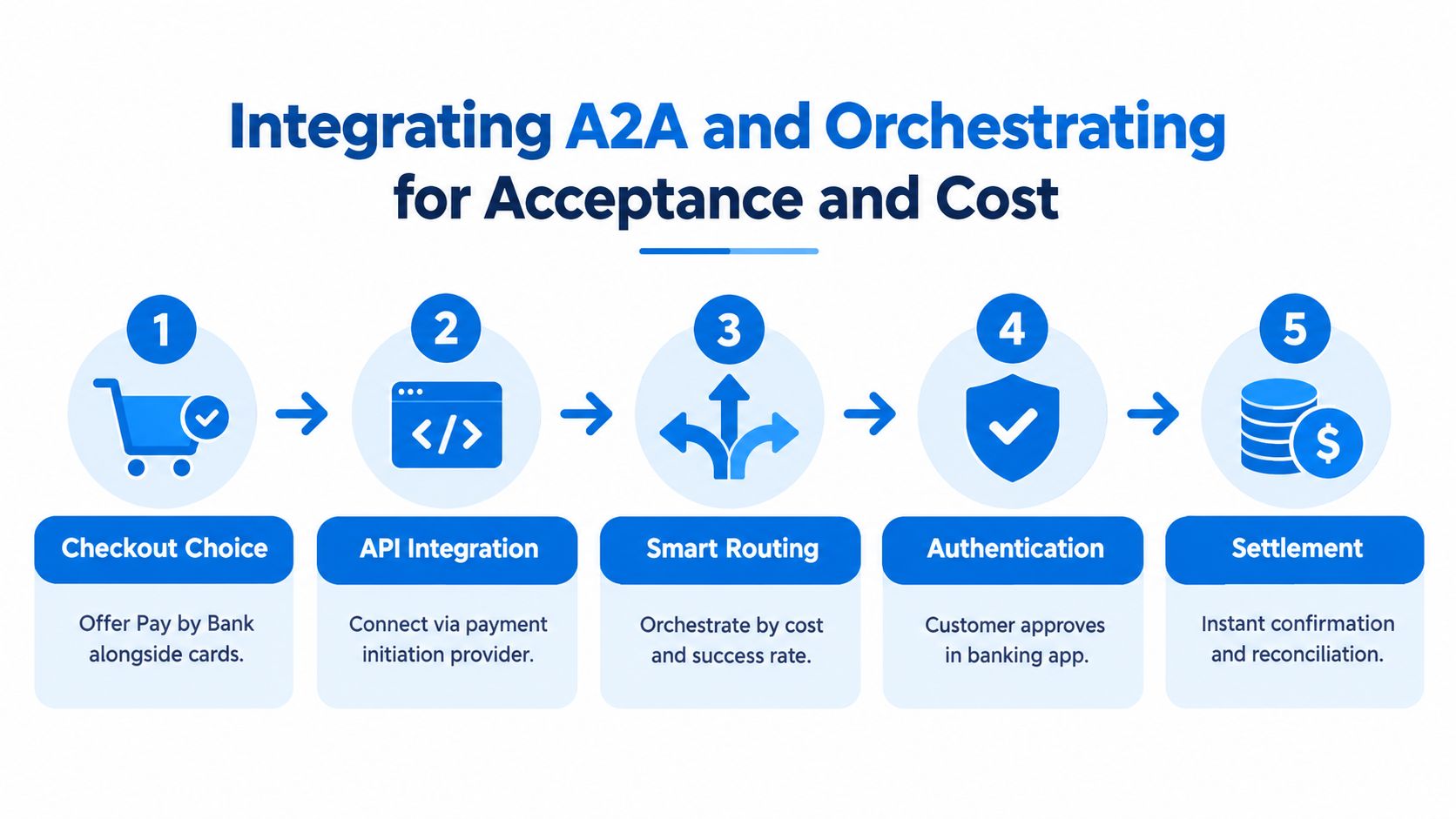
The safest integration pattern is to add A2A beside existing payment methods, not to rebuild checkout around it. Present “Pay by Bank” when the market, customer segment, transaction type, and risk policy make it useful. Keep cards and wallets visible when they're likely to produce a better customer outcome.
Build the payment flow around status, not assumptions
A strong A2A integration separates the customer experience from the final financial state. The customer may approve a transfer, but your order system still needs a trusted confirmation before releasing goods or granting access.
Use a provider that can:
- Create a payment intent: Define amount, currency, customer, order, and expiry before bank authorization.
- Handle bank authentication: Send the customer to the appropriate bank journey and return them safely to checkout.
- Normalize statuses: Translate provider-specific states into clear internal states such as pending, confirmed, failed, expired, or returned.
- Reconcile independently: Match bank confirmation to the order, invoice, payout, or subscription event.
- Replay payment events: Preserve an auditable event trail so missed webhooks do not become missed revenue.
The same principle applies to recurring billing. A card-on-file layer manages saved payment methods and merchant-initiated transactions, while an A2A mandate manages permission for payee-initiated debits. Those are different objects with different failure modes. Treating them as interchangeable creates confusing retry logic and poor customer communication.
Orchestration should decide more than price
Payment orchestration is the control layer that connects checkout to multiple providers and payment methods. It can route based on geography, currency, method, risk signals, provider availability, or prior outcomes. The objective isn't to retry every failure. It's to choose a sensible next action.
A card might fail because of an address verification mismatch, while an A2A attempt might fail because the customer abandoned bank authentication. Those failures need different recovery paths. A subscription retry after insufficient funds shouldn't look like a retry after an account closure or an unauthorized return.
Read payment orchestration software guidance before choosing an integration model. Keep the data model portable, store provider references separately from your order identity, and make the ledger or reconciliation layer the source of truth.
FloPay is currently exploring A2A rather than offering live merchant A2A integrations. It has no deployed A2A performance data or merchant adoption to report. Its existing payment orchestration and processor-neutral vaulting direction is relevant to the planning problem because merchants can keep Stripe as a processor without making Stripe the entire continuity strategy. Flo Vault provides a processor-neutral, PCI-compliant card-on-file layer for portable saved payment methods across supported providers, while future agent-assisted flows should require explicit permission delegation or keep a human in the loop.
Engineering recommendation: Design your order, customer, mandate, and payment-event models so a new rail can be added without rewriting revenue logic.
Cross Border Scale and Operational Realities to Plan For
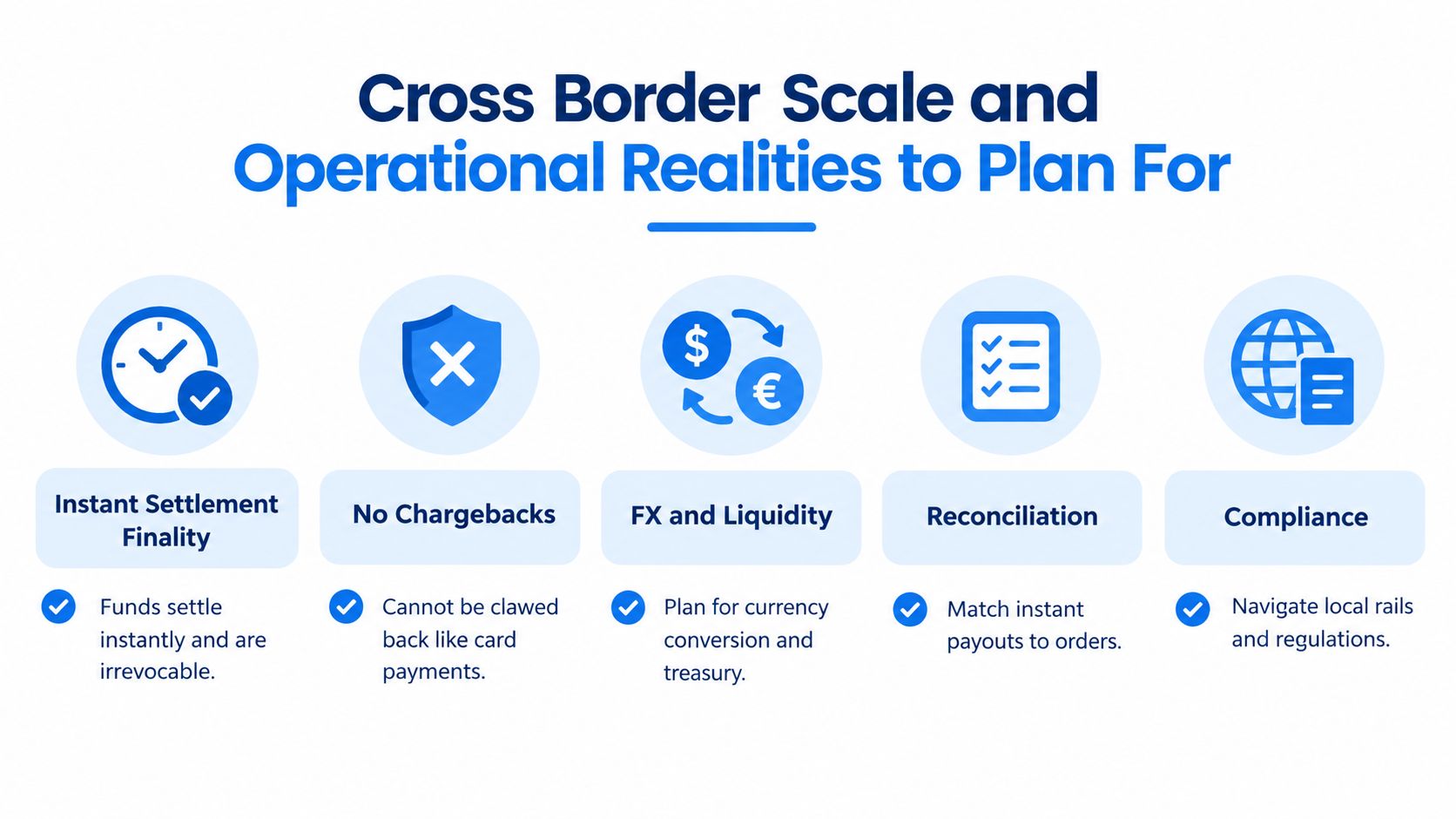
Instant A2A payments compress the time available for validation, fraud checks, routing, and reconciliation. They also change what happens after approval. Funds can settle within seconds and are effectively final once credited, so the merchant can't assume the transaction is as reversible as a card authorization.
That speed creates a clear risk trade-off. The European Banking Authority's fraud opinion found that instant credit transfers had fraud rates about 10 times higher on average than conventional credit transfers in reported first-half 2022 data. The figure doesn't mean every merchant will experience that rate. It does mean a faster rail needs stronger pre-transaction controls.
The operating checklist
Settlement and refunds: Decide when goods, access, or payouts become available. Build refunds as a separate operational flow. A refund may require a new bank transfer rather than a card-style reversal.
Fraud and customer verification: Use transaction context, customer history, account verification, payee verification, and sensible limits. Don't treat successful bank authentication as proof that the underlying purchase is legitimate.
Liquidity and foreign exchange: Cross-border flows can create currency conversion and treasury requirements. Map where funds settle, which entity receives them, and how finance teams forecast available cash.
Reconciliation: Match payment identifiers to orders and invoices automatically. Manual monitoring is one of the most common operational failures. Publishing bank details in customer emails, checking incoming transfers by hand, and waiting for staff to process weekend payments all create avoidable delays.
Returns and recovery: Track insufficient funds, customer cancellations, unauthorized returns, expired mandates, and provider-specific exceptions. Recovery messaging should explain what happened and offer an appropriate alternative, such as a card or wallet.
Local compliance: Bank rails differ by market. Account access, sanctions screening, consent, data handling, and consumer protections need local review before launch.
A2A growth makes these controls more important because scale magnifies small operational gaps. Juniper Research projects global A2A transaction value will reach $195 trillion by 2030, while its 2025 market data points to 54 billion A2A transactions in 2025 and 83% growth through 2030, as reported in the payments research release. Those projections describe market potential, not FloPay performance. They also justify building monitoring and recovery before A2A becomes material to recurring revenue.
For broader cross-border routing considerations, see international payment gateways.
Next Steps for Resilient Account to Account Payments
Treat A2A as a rail choice, not a religion.
Use it where direct bank movement solves a real commercial problem, such as bill pay, disbursements, account funding, or selected recurring-payment journeys. Keep cards and wallets where familiarity, protection, stored credentials, and checkout conversion matter more. Then connect both through an orchestration layer that gives revenue and engineering teams visibility into payment outcomes.
Your implementation priorities should be practical:
- Map the use case: Identify the transaction types where customers already expect to pay from a bank account.
- Separate payment state from order state: Don't release value based only on a redirect or client-side success message.
- Design mandate operations: Track consent, expiry, cancellation, failed collection, and customer communication.
- Automate reconciliation: Match transfers to orders, invoices, payouts, and refunds without manual monitoring.
- Plan for portability: Keep provider tokens, bank references, and internal customer identities separate so one gateway doesn't become a single point of failure.
- Test recovery: Model insufficient funds, abandoned authentication, unavailable banks, fraud holds, returns, and refund exceptions.
- Prepare for agent-assisted commerce: Require explicit permission delegation for agent-initiated transactions and maintain a human review path for sensitive actions.
FloPay hasn't launched A2A, so merchants shouldn't interpret its strategic interest as live A2A capability or a promise of measured uplift. The immediate lesson is architectural. A processor-neutral card-on-file layer, gateway-independent routing, clear payment events, and explicit permission controls give businesses more resilience today and a better foundation for multi-rail and agent-assisted payment flows tomorrow.
Start by checking where your saved payment methods live, whether they're portable across supported providers, and how your systems would reconcile a bank transfer that settles quickly but fails differently from a card payment.
FloPay provides payment orchestration, embedded checkout, secure vaulting, routing, retries, and failover across supported payment providers, including Stripe, cards, wallets, and alternative methods. Visit FloPay to review how a processor-neutral payment architecture can support recurring revenue today and prepare your payment stack for additional rails tomorrow.