Best Payment Orchestrator Guide 2026
Learn how to choose the best payment orchestrator for multi-provider routing, vaulting, and recurring revenue stability in 2026.
A subscription business can lose recurring revenue without a checkout outage. A processor can decline renewals, a fraud rule can change, or a gateway account can become unavailable. If every saved payment method and every retry depends on that one provider, the commercial impact arrives before the engineering team has time to respond.
That's why choosing the best payment orchestrator isn't a feature-comparison exercise. The right layer helps merchants route transactions intelligently, recover eligible failures, keep saved payment methods portable, and maintain control when a processor underperforms. The wrong one adds another dashboard without improving revenue, resilience, or operational visibility.
Table of Contents
- Why Payment Orchestration Matters for Subscription Revenue
- The Three Criteria That Actually Matter
- Stripe-Only Risk and Multi-Processor Resilience
- How Routing and Vaulting Protect Recurring Revenue
- Building for Agent-Assisted Commerce
- What to Check Before Choosing Your Orchestrator
Why Payment Orchestration Matters for Subscription Revenue
A SaaS company with one processor often discovers its payment architecture during a renewal incident. The first payment attempt fails, the billing system retries through the same gateway, and the customer receives a cancellation notice even though the underlying card may still be usable elsewhere. The finance team sees involuntary churn, customer success handles complaints, and engineering starts investigating provider logs instead of shipping product.
A payment orchestrator changes the position of that failure. It sits between checkout and payment providers, giving the merchant one control layer for routing, retries, state transitions, and failover. A renewal can be sent to the provider with the strongest historical performance for that transaction type, while a temporary provider problem can trigger a controlled fallback instead of a dead checkout.
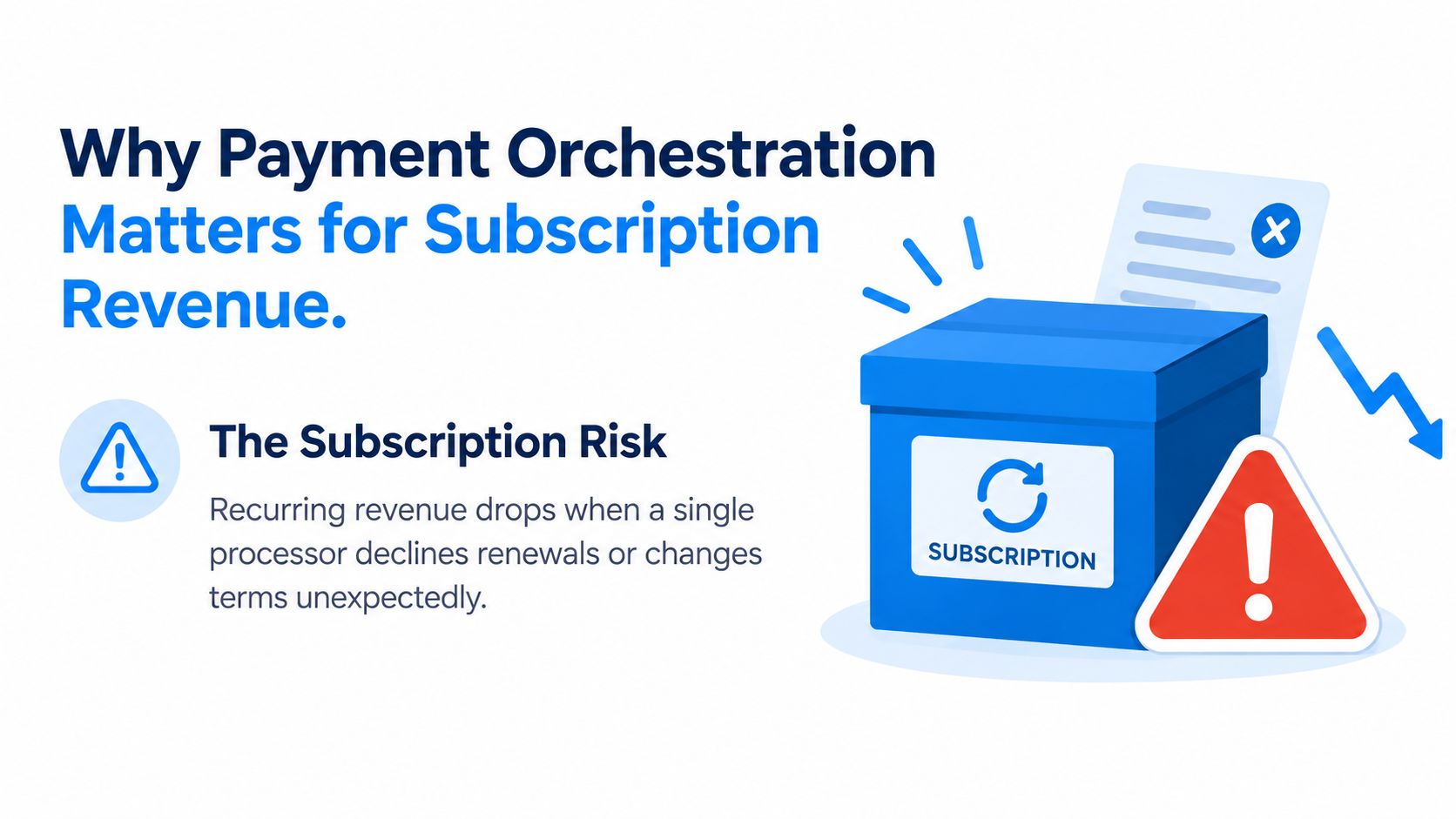
From gateway connection to control layer
A basic gateway integration answers one question: how does the application send a payment request? An orchestration layer answers harder questions:
- Which provider should receive this transaction?
- Should the system retry, and if so, when?
- Is the failure temporary or permanent?
- What happens if the provider times out after the customer has submitted payment?
- Can the merchant route a future renewal through another acquirer without rebuilding checkout?
The routing decision can use signals such as the card BIN, which identifies the issuing bank and card type, issuer country, currency, amount, and merchant category code. Those signals matter because provider performance varies across transaction cohorts. A merchant may find that one acquirer performs well for domestic recurring card payments while another handles cross-border transactions more effectively.
The category has moved well beyond niche infrastructure. One market estimate puts payment orchestration platforms at USD 2.65 billion in 2025, with a projection of USD 7.27 billion by 2031 at an 18.31% compound annual growth rate, or CAGR. The same estimate says cloud deployments represented 77.20% of market share in 2025, large enterprises held 63.30%, retail and e-commerce generated 59.10% of revenue, and North America accounted for 37.70% of share, according to this payment orchestration platform market estimate.
What subscription merchants should protect
The best payment orchestrator doesn't just send more transactions through more gateways. It protects the continuity of billing.
That means separating three concerns that are often bundled into one processor account:
- Checkout acceptance, where customers enter a card, wallet, or alternative payment method.
- Payment decisioning, where the merchant selects a provider and manages recovery.
- Saved payment methods, where a subscription business stores the secure reference needed for future merchant-initiated transactions.
If those concerns are locked together, a provider problem becomes a revenue problem. If they're independently controlled, the merchant can keep checkout live, add a backup provider, and change routing without forcing customers to re-enter payment details.
The Three Criteria That Actually Matter
Most vendor comparisons start with connector counts and payment-method lists. Those details matter, but they don't tell you whether an orchestrator will improve commercial performance. A practical evaluation starts with three capabilities: routing intelligence, portable vaulting, and disciplined retry logic.
Intelligent routing
Routing should reflect actual payment performance, not a simplistic country rule. The platform needs to evaluate transaction context and send each cohort to the acquirer most likely to approve it. That can include the BIN, issuer geography, currency, amount, card brand, and whether the payment is an initial checkout or a merchant-initiated subscription rebill.
Industry coverage reports that enterprises using multi-rail orchestration and smart retries see 5 to 8 points of approval-rate lift on average, while predictive routing can add 2 to 5 points in specific corridors, as described in this enterprise payment orchestration playbook. Treat those figures as directional, not universal. Performance depends on issuer behavior, network health, local payment mix, and the merchant's starting point.
A useful orchestrator also lets teams inspect the reason behind a route. If a rule sends German Mastercard transactions to one provider, the payments team should be able to see that configuration, measure the cohort, and reverse it without waiting for a custom engineering release.
Portable vaulting
A vault stores tokenized payment methods so the merchant's systems don't need to handle raw card numbers. Portable vaulting adds an important commercial property: the saved payment method can support charging through eligible providers rather than remaining trapped inside one gateway.
This is critical for subscriptions. A card saved only in one processor may work perfectly for the original checkout, yet provide little resilience when that processor experiences an outage or account disruption. A processor-neutral card-on-file layer gives the merchant more options for future retries, provider changes, and regional routing.
Configurable retries
Retry logic should be selective. A temporary timeout, issuer-unavailable response, or soft decline may justify another attempt. An invalid card number or a clearly hard decline usually shouldn't trigger blind repetition.
A neutral explanation of payment orchestration architecture describes the layer as a control plane for routing, retries, state transitions, and timeout-driven failover. That's the standard to look for. The platform should support retry limits, cooldown intervals, issuer-specific timing, and provider degradation rules, rather than just hammering the same gateway.
Practical rule: An orchestrator earns its place when every routing or retry decision can be connected to recovered revenue, lower dependency, or clearer operations.
Stripe-Only Risk and Multi-Processor Resilience
Stripe is a strong processor, and many businesses should keep using it. The problem isn't Stripe. The problem is allowing any single provider to become the entire payment continuity strategy.
A Stripe-only setup can be efficient while transaction volume and payment complexity are modest. It becomes a concentration risk when the same provider handles checkout, stored payment methods, recurring billing, routing decisions, and operational recovery. A policy change, account interruption, outage, or regional performance issue can affect every payment path at once.
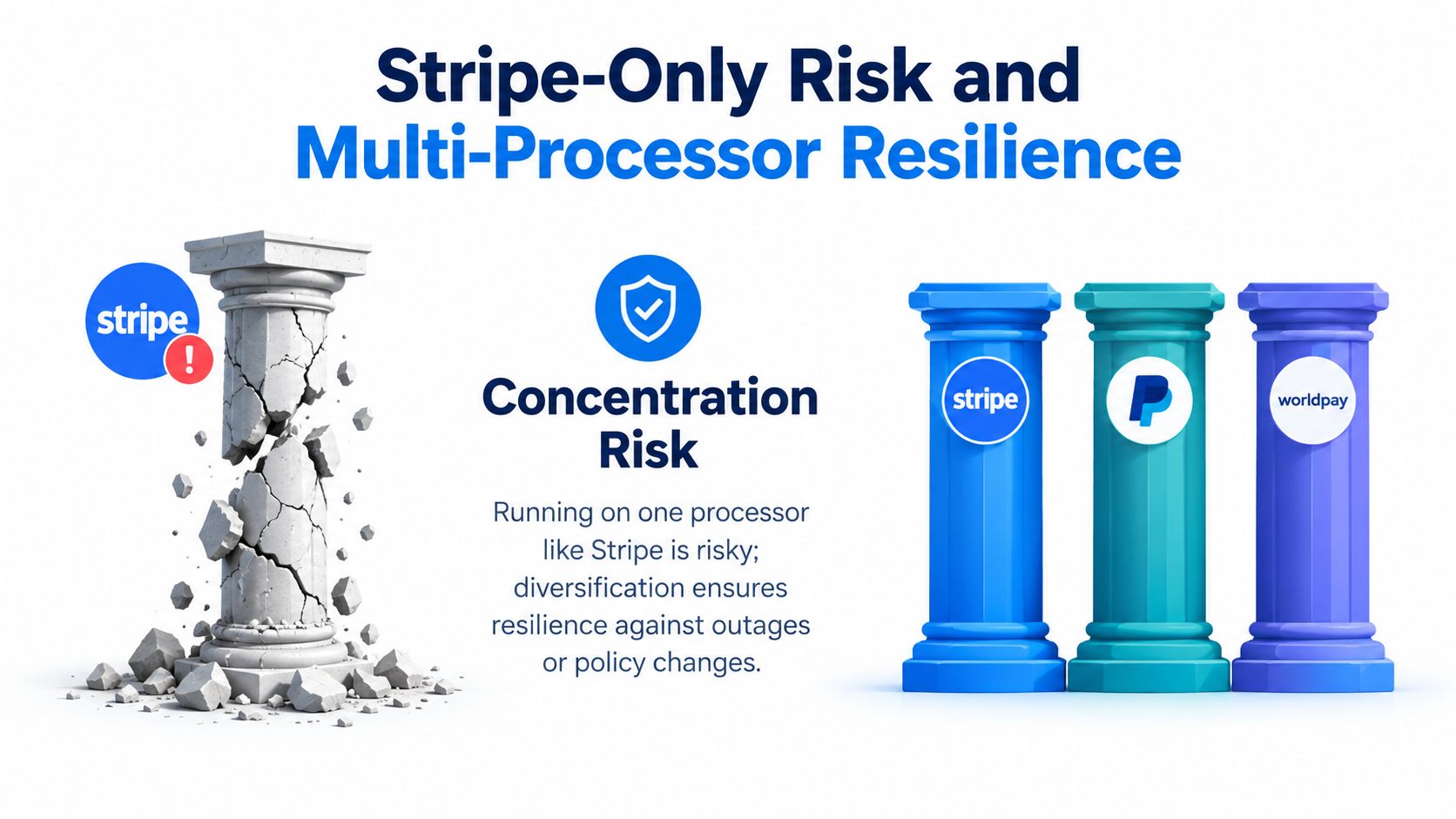
Three architectures compared
| Architecture | Strength | Commercial weakness |
|---|---|---|
| Stripe-only | Fast to launch and straightforward to operate | Creates gateway dependency and a single point of failure |
| Multiple providers without independent vaulting | Adds processor choice for new payments | Existing saved cards may remain tied to the original gateway |
| Vault-backed orchestration | Combines routing flexibility with portable saved payment methods | Requires deliberate migration, testing, and operational governance |
The middle option is often misunderstood. Adding another provider doesn't automatically protect recurring revenue if the merchant can't use existing card-on-file references with that provider. New customers may have a fallback path, while existing subscribers remain exposed.
A processor-neutral vault separates the payment method from the gateway that first processed it. That creates a foundation for multi-provider readiness, although portability still depends on supported token formats, provider agreements, compliance controls, and a properly tested migration path. Merchants should ask exactly how tokenization works, which providers are supported, and what happens when a saved payment method is used for a merchant-initiated transaction.
Teams should also document their merchant identifiers and account structure. A clear explanation of what a merchant ID means helps finance and engineering teams understand how provider accounts, settlement, and routing decisions connect.
Keep Stripe as a processor. Don't make Stripe your entire payment continuity strategy.
The best payment orchestrator doesn't require a merchant to abandon a good provider. It lets the merchant keep strong processors in the mix while reducing processor concentration risk. That's a better architecture than treating provider diversification as a reaction to the next incident.
How Routing and Vaulting Protect Recurring Revenue
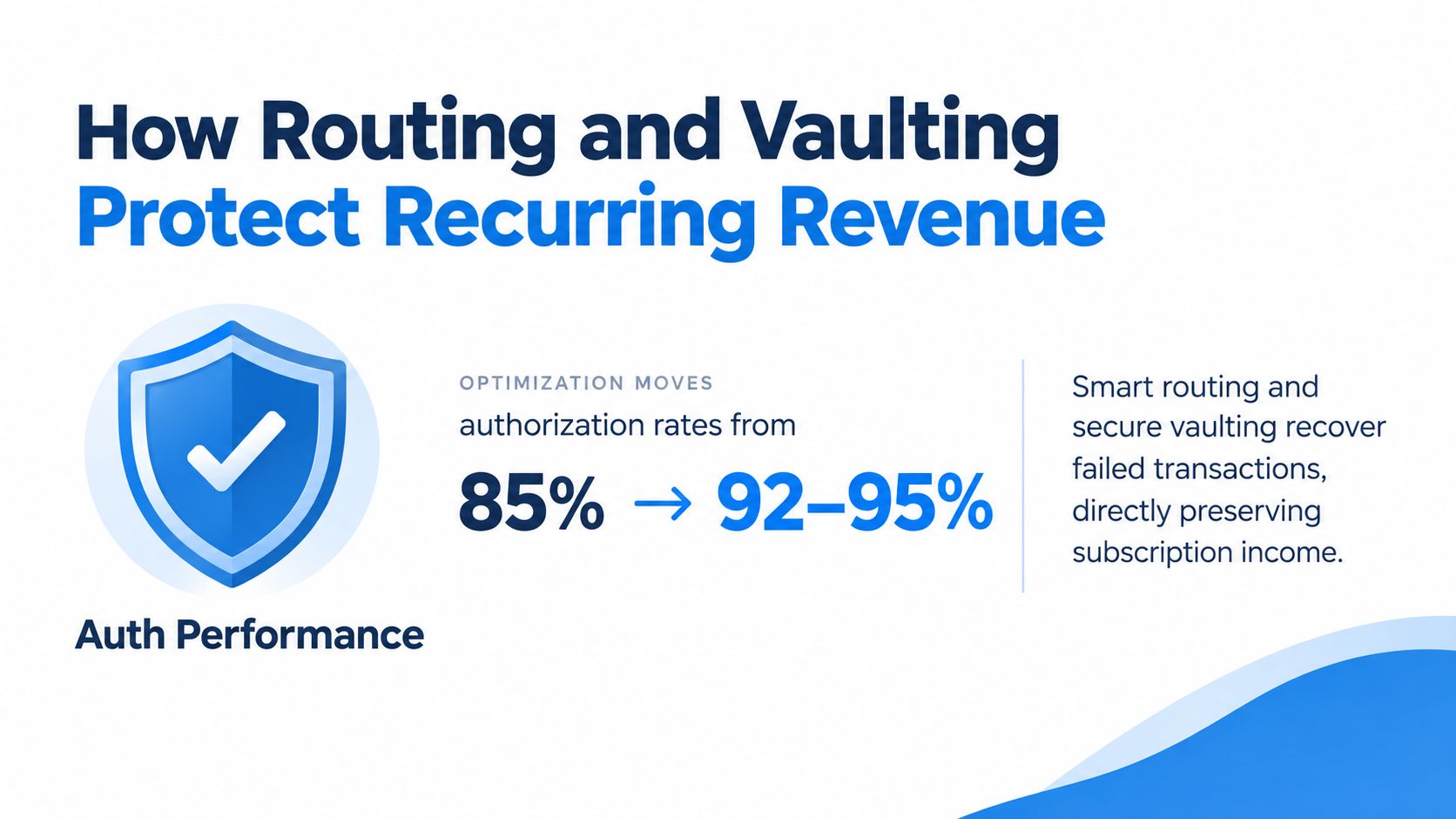
Authorization performance is a revenue metric, not a vanity dashboard number. It measures authorized transactions divided by total payment attempts, so a decline in the rate can represent customers who tried to pay but never reached a successful charge.
Payment analytics guidance places a well-optimized authorization rate in the 92% to 95% range, with top-quartile e-commerce merchants reaching 94% to 97%, according to this payment analytics guidance. Those ranges aren't targets every merchant can copy. They're useful benchmarks for asking whether performance is being measured by market, issuer, provider, payment type, and billing event.
A recovery path that respects failure types
A sound recurring-payment flow looks like this:
- Classify the response. Separate hard declines from soft declines, timeouts, authentication failures, and provider errors.
- Select the next action. A hard decline may require customer action. A temporary provider error may justify another acquirer.
- Apply the right cadence. Use cooldown periods and retry limits rather than repeated immediate attempts.
- Change the route when appropriate. A portable saved payment method lets the system try an eligible provider instead of repeating the same failing path.
- Record the result. Store the route, response, retry reason, and final outcome so revenue and engineering teams can measure recovery.
Automatic retries can capture 25% to 35% of soft declines on the first attempt, while a five-attempt cadence can recover 60% to 70% of soft declines when it stays within card-network guidelines, according to this payment recovery analysis. The number of attempts isn't the strategy by itself. Timing, decline classification, issuer behavior, and customer communication determine whether retries help or create more friction.
Vaulting matters because routing is useless for saved payments that cannot move between providers. A secure, processor-neutral card-on-file layer can support recurring charges across eligible gateways while keeping raw card data out of merchant systems. Merchants should still validate PCI responsibilities, token portability, network-token behavior, and the treatment of expired or replaced cards.
Chargebacks need a separate control
Authorization recovery doesn't remove dispute risk. Mastercard says a quarter of its chargebacks are driven by recurring transactions, often because customers are trying to cancel a subscription or don't recognize the purchase. It also notes that retrying disputed recurring payments can add fees and make future re-subscription harder, as explained in its subscription chargeback guidance.
That makes clear descriptors, cancellation handling, authentication records, and controlled dunning as important as route selection. The best orchestrator supports payment recovery without treating every failed renewal as a reason to keep charging.
A useful product walkthrough should show the complete event trail, not just a successful checkout.
Watch the walkthrough on YouTube
For a deeper explanation of saved payment references, see this guide to credit card on file payments.
Building for Agent-Assisted Commerce
Human customers aren't the only actors entering payment flows. AI assistants can already help users discover products, compare options, prepare carts, and support assisted sales. As those workflows become more capable, merchants will need payment infrastructure that can distinguish an authorized agent action from an untrusted automated request.
Agentic commerce doesn't eliminate the fundamentals of payments. It makes them stricter. The system still needs a secure payment method, a defined amount and merchant context, clear authorization, fraud controls, auditability, and a reliable result returned to the merchant's order system.

The same architecture supports people and agents
A useful agent payment design should provide:
- Scoped authority, so an assistant can act only within an approved purchase context.
- Vault-backed handling, so the agent doesn't receive raw card details.
- Provider abstraction, so the merchant can route the transaction without exposing processor complexity to the agent.
- Human escalation, for authentication, unusual amounts, or risk decisions.
- Traceable events, so operations teams can see who initiated the payment, what was authorized, and which provider processed it.
Routing, vaulting, and recurring-revenue resilience connect in this space. A merchant that stores payment methods in a portable, secure layer today has a better foundation for agent-assisted checkout tomorrow. It won't need to redesign every payment path when a customer asks an assistant to purchase, renew, or upgrade on their behalf.
The right approach isn't to build an elaborate autonomous payment system before customers need one. Start with clean payment states, explicit consent, provider-independent tokens, and strong webhook handling. Then expose carefully controlled capabilities to sales agents, support teams, and approved AI workflows.
FloPay combines checkout, payment routing, secure vaulting, and provider connections through a single SDK and API, with tooling intended for both current merchant flows and agent-assisted payment interactions. Evaluate that type of architecture on its controls and portability, not on futuristic language.
What to Check Before Choosing Your Orchestrator
Choose control over convenience. A low-friction integration is useful, but it won't compensate for a vault that traps saved cards, routing rules that nobody can inspect, or reporting that can't explain why a renewal failed.
Use this checklist during vendor demos and technical due diligence.
Routing flexibility
Ask whether the team can add a provider, change a route, or introduce a fallback without rebuilding checkout. The platform should support rules based on meaningful transaction signals, provider health, payment type, geography, and recurring status.
Test a real scenario. Send an initial card payment to one provider, simulate a timeout, and verify that the platform can handle the next action without creating duplicate orders or ambiguous payment states.
Vault portability
Find out whether saved payment methods are processor-neutral or gateway-scoped. Ask how the platform handles PAN, the full card number, without exposing raw card data to merchant systems, and how it supports tokenized payment methods across eligible providers.
A vendor should explain migration, token lifecycle, network tokens, expired cards, and merchant-initiated transactions in plain language. If the answer is just “the cards are stored in our gateway,” you haven't solved processor dependency.
Retry configuration
Look for configurable cooldowns, retry limits, decline classification, issuer-aware timing, and provider failover. A system that retries every failure immediately is not intelligent recovery.
Run cases involving a wrong ZIP or postcode, an AVS mismatch, a 3DS authentication failure, a prepaid card that approves the first payment but fails a rebill, and a transaction_not_allowed response. The platform should show what it does and why.
Measurement clarity
You need reporting by provider, issuer geography, BIN, currency, payment method, initial payment, renewal, retry, and dispute outcome. You should be able to trace a transaction from checkout through routing, response, fallback, settlement, and webhook delivery.
Use FloPay's comparison page as one reference point, but judge every platform against your own payment data and failure patterns. The best payment orchestrator is the one that proves incremental value in your corridors, not the one with the longest feature list.
Final test: If a capability can't be tied to fewer failed subscriptions, lower dispute exposure, faster recovery, or reduced provider dependency, question why you're paying for it.
Start with an audit of your current stack. Identify where saved payment methods live, which processor handles each recurring charge, how retries are classified, and what happens during a provider outage. Then choose an orchestrator that gives your revenue, engineering, and operations teams measurable control over those risks.
FloPay brings checkout, secure vaulting, multi-provider routing, retries, and failover into one payment orchestration layer, helping merchants protect recurring revenue while keeping payment methods portable. Visit FloPay to review the platform, explore the developer tools, and decide whether it fits your payment resilience plan.