Dispute Prevention: A Practical Guide for Modern Merchants
Learn how dispute prevention works in 2026, from alert networks and evidence capture to billing descriptors and agent-led commerce.

A chargeback is no longer just a support ticket with a fee attached. Worldwide chargeback losses are projected to reach $33.79 billion in 2025 and $41.69 billion by 2028, while dispute volume is expected to rise from 261 million transactions to 324 million over the same period, according to Sift's dispute data. For online merchants, dispute prevention is now a revenue discipline, not a back-office clean-up exercise.
The practical definition is simple. Dispute prevention is any process, signal, or control that stops a customer complaint from becoming a formal card-network chargeback. That includes clearer billing descriptors, faster refunds, stronger subscription consent records, real-time alerts, selective authentication, and evidence captured before anyone has to reconstruct the transaction manually.
The merchants that perform best don't wait for a chargeback report. They connect checkout, billing, fulfillment, customer support, fraud controls, and payment routing into one operating process. That gives revenue, payments, engineering, and operations teams a shared view of what happened and a chance to resolve the issue while the customer can still be helped.
Table of Contents
- Why Dispute Prevention Matters More in 2026
- The Dispute Lifecycle and Where Prevention Actually Wins
- High-Leverage Prevention Controls You Can Ship This Quarter
- Alert Networks, Evidence Capture, and the Orchestration Layer
- Prevention as a Customer Experience Problem
- Agent-Assisted Commerce and the New Prevention Surface
- A Subscription Merchant Story From Chaos to Recoverable Signal
- Practical Takeaways and Next Steps
Why Dispute Prevention Matters More in 2026
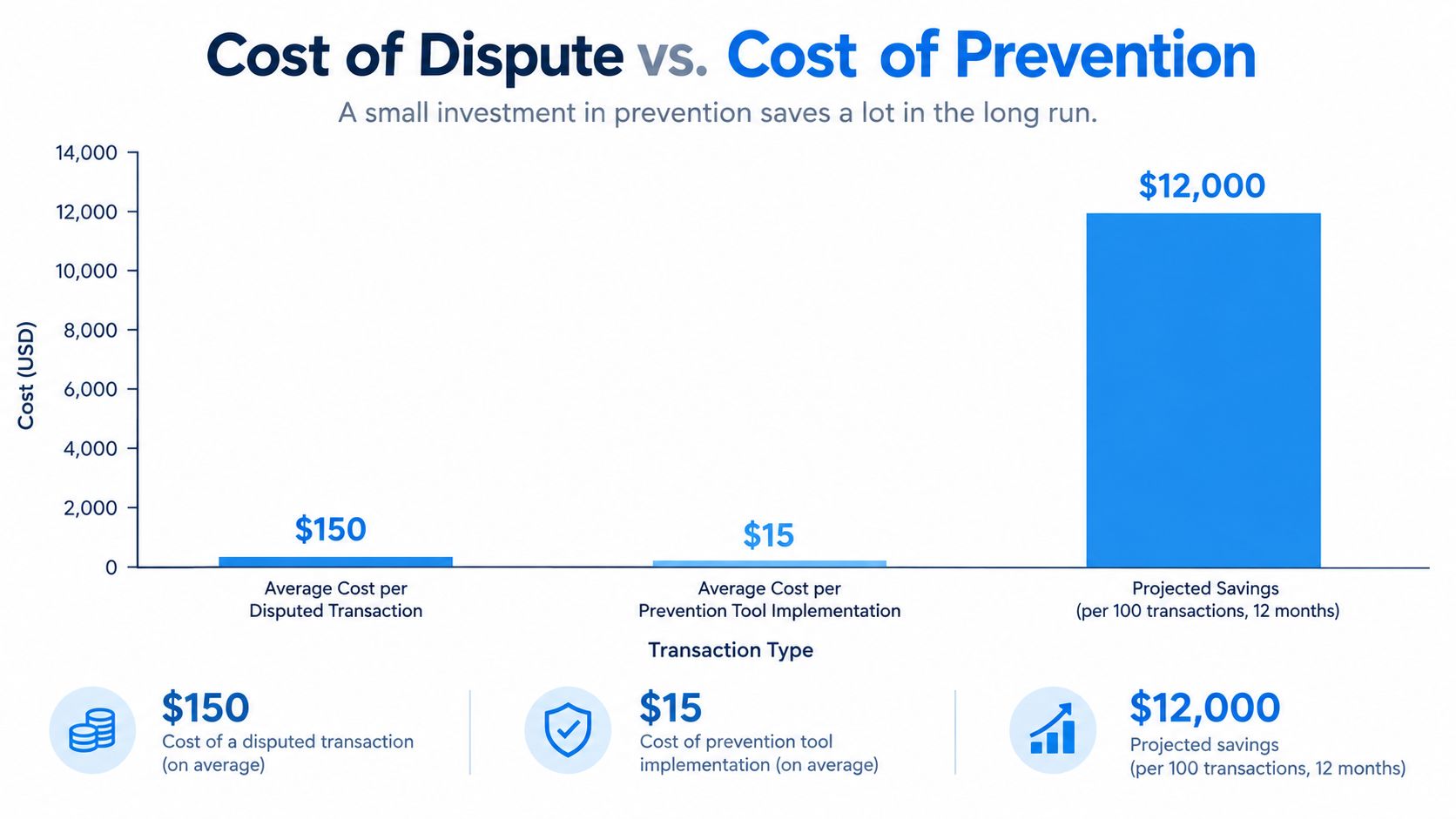
The cost of dispute prevention failure is larger than the amount refunded to the customer. Online merchants also absorb investigation time, representment work, operational disruption, potential monitoring pressure, and the commercial damage caused when an acquirer sees a pattern it can't explain.
Card-not-present payments now represent 63% of merchants' transactions, which helps explain why online businesses face more dispute pressure than card-present environments. U.S. merchants also lose an estimated $4.61 for every $1 in chargebacks, making prevention a direct profit-protection measure rather than a way to reduce administrative inconvenience, as Sift's 2025 dispute index reports.
The pressure is structural
First-party and third-party fraud now account for roughly 45% of merchant dispute volume, according to the same Sift analysis. That matters because not every dispute begins with a stolen card. Some begin with a customer who doesn't recognize the merchant name, forgets a recurring renewal, misunderstands a cancellation policy, or uses the bank as the fastest route to a refund.
A fraud filter can't solve those problems. It may approve a perfectly valid transaction and still leave the merchant exposed to a dispute caused by unclear post-purchase communication.
Commercial rule: If your prevention program only evaluates the transaction at checkout, it starts too late and ends too early.
Chargeback pressure at a glance
| Metric | Figure |
|---|---|
| Global chargeback losses | $33.79 billion in 2025, rising to $41.69 billion by 2028 |
| Global dispute volume | 261 million transactions in 2025, rising to 324 million by 2028 |
| Card-not-present share of merchant transactions | 63% |
| Cost to U.S. merchants per dollar in chargebacks | $4.61 |
The right response is orchestration, not another isolated fraud rule. A merchant should be able to connect the checkout event, authentication result, descriptor, fulfillment record, customer conversation, refund action, and processor outcome. The ecommerce payment process should make those records accessible to the teams responsible for revenue and customer retention.
The Dispute Lifecycle and Where Prevention Actually Wins
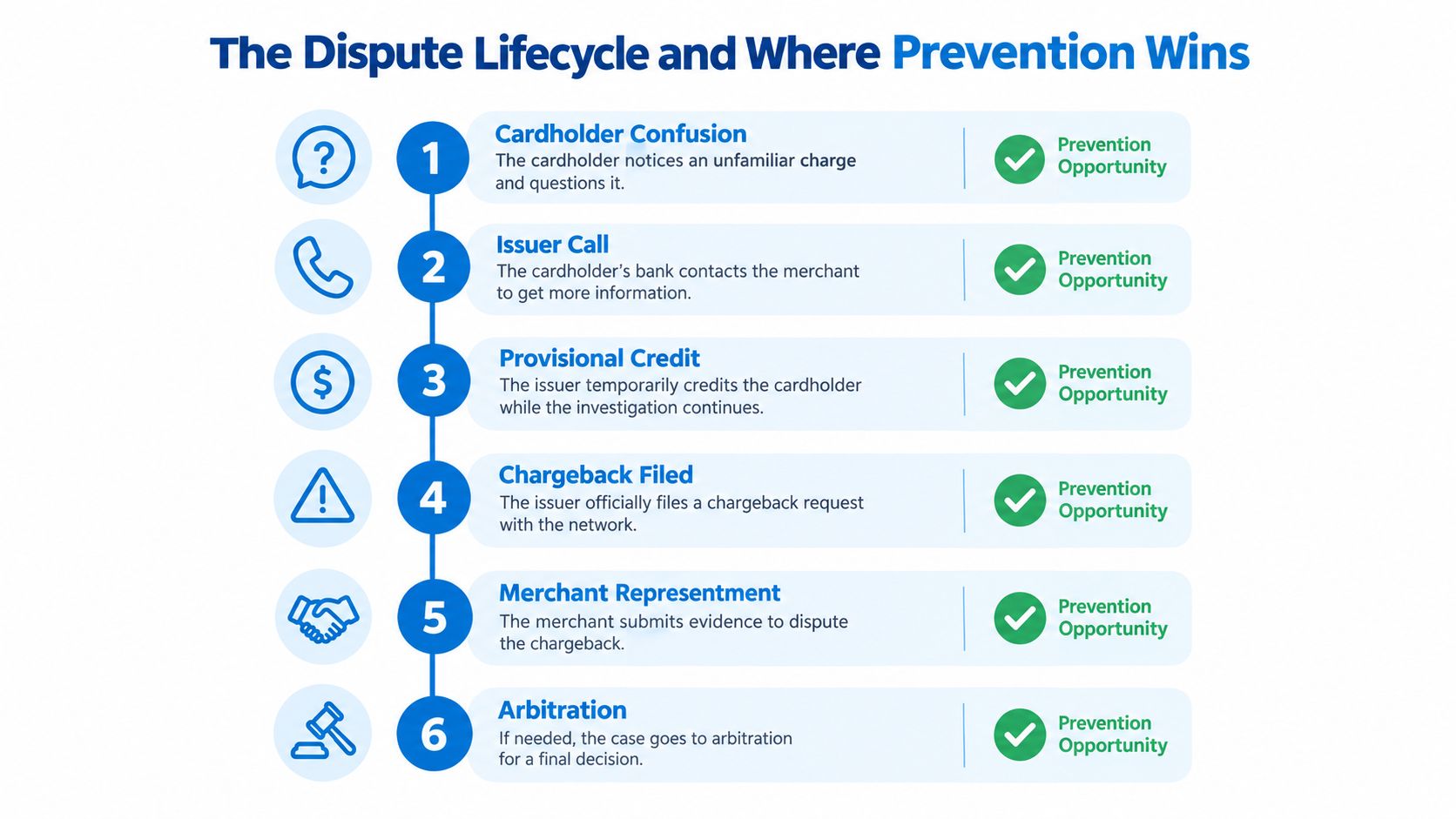
A dispute usually begins with confusion or dissatisfaction, not with a card-network form. The customer sees an unfamiliar descriptor, can't find a cancellation path, doesn't receive an expected product, or believes a subscription renewed without adequate notice. The customer then contacts the issuer, the issuer may provide provisional credit, and the dispute can progress into a formal chargeback.
Once the chargeback is filed, the merchant has moved from customer resolution to defensive documentation. Representment, the process of contesting the chargeback, can recover revenue, but it demands accurate records and disciplined response handling. Arbitration comes later, when earlier stages haven't resolved the case and the parties continue to contest the transaction.
The strongest intervention point
The pre-dispute stage is where merchants still have practical options. A real-time alert can give the merchant time to refund the customer, stop fulfillment, correct an explanation, or ask support to contact the buyer before the complaint reaches the card-network chargeback process.
One industry analysis reports that Ethoca and Verifi-style alerts resolve 82% of customer disputes before chargeback filing, because merchants can act while the complaint remains inside the issuer workflow, as described by VoxBooster's chargeback analysis. Mastercard also states that catching disputes earlier in the process is the easiest way to reduce chargeback costs.
The timing changes the economics. A refund before fulfillment may prevent product loss as well as a chargeback. A clear support response may preserve the customer relationship. An automated alert-to-refund rule may resolve a case without requiring an analyst to open a dashboard.
Match the control to the stage
- Cardholder confusion: Use a recognizable descriptor, accessible order details, and clear support contact information.
- Issuer contact: Receive alert-network signals and trigger an appropriate customer or refund workflow.
- Provisional credit: Freeze fulfillment where appropriate and assemble transaction context.
- Formal chargeback: Submit evidence that answers the specific reason code.
- Representment: Track deadlines, response status, and missing documentation.
- Arbitration: Escalate only cases where the evidence and commercial value justify further action.
The mistake is treating every stage as a fraud investigation. Many cases are recoverable customer-service events if the merchant acts before the issuer files the chargeback.
High-Leverage Prevention Controls You Can Ship This Quarter
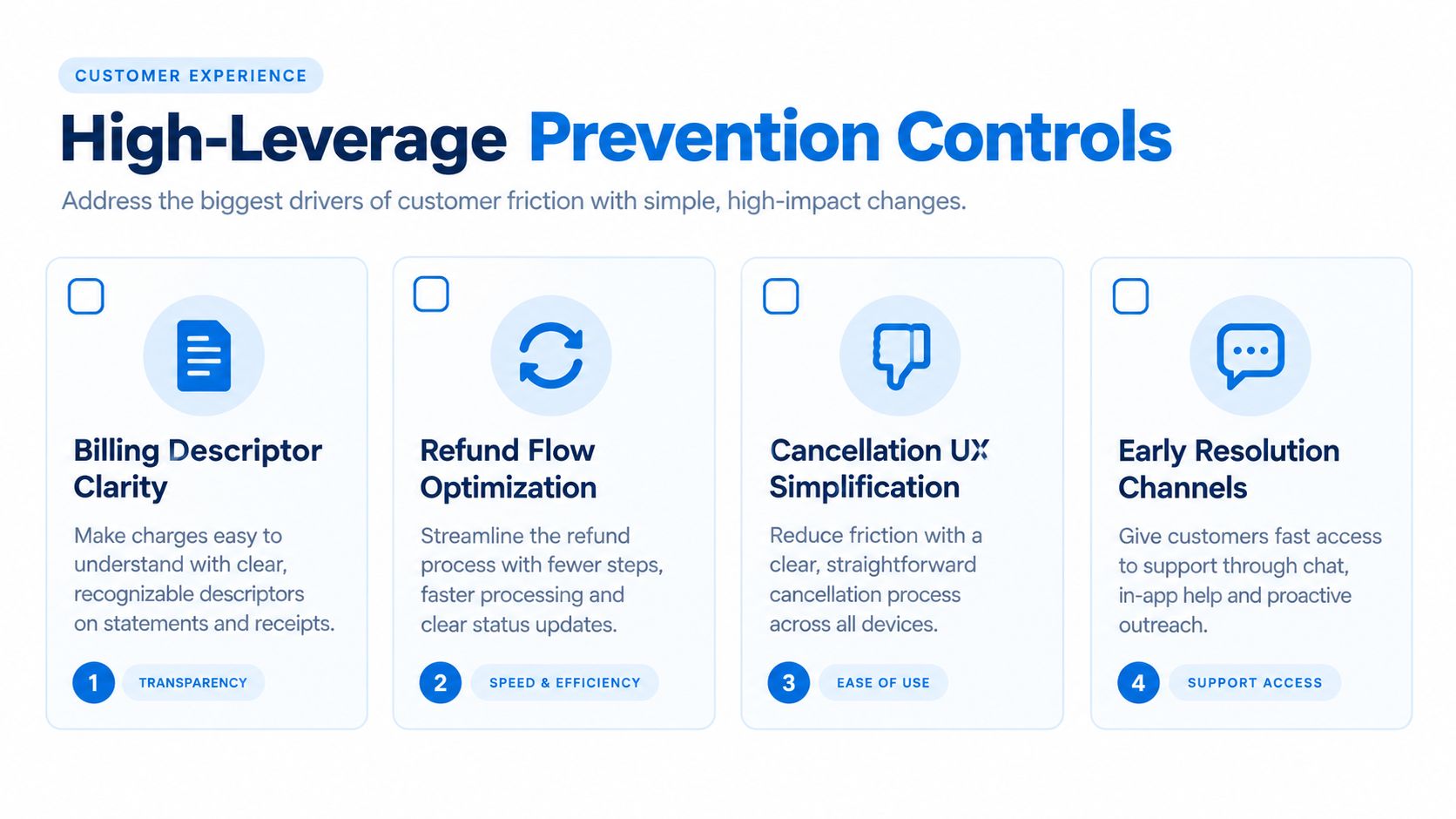
Start with controls that change what the customer sees and what the merchant can prove. You don't need a new vendor for every improvement. Descriptor cleanup, cancellation clarity, and a faster refund process are often operational decisions before they're technology projects.
Make the charge recognizable
The billing descriptor should match the name customers know, not an obscure legal entity or truncated processor label. Include a recognizable phone number or support path where the payment setup allows it, and test how the descriptor appears across banks and statement formats.
A customer who recognizes the charge can resolve confusion without calling the issuer. A customer who sees an unfamiliar name has a reason to treat the transaction as suspicious, even when the payment was valid.
Resolve refunds and cancellations directly
Give customers a cancellation route that doesn't require a support exchange for a straightforward request. Confirm the cancellation immediately, explain the effective date in plain language, and acknowledge refunds with a traceable status.
The operational target should be simple: act quickly enough that the customer doesn't need to use the bank as a second support channel. Configure early-alert rules to refund, stop fulfillment, or route the case to support based on the transaction state.
Use authentication selectively
3DS, or 3-D Secure, is bank authentication that can involve an app approval, SMS challenge, or biometric confirmation. It can strengthen evidence and help the issuer verify the buyer, but applying a challenge to every transaction can create unnecessary checkout friction.
Use risk-based authentication where the transaction, device, customer history, payment method, or issuer response justifies it. Record the authentication result and associate it with the transaction so the evidence remains usable later.
Capture subscription consent at the moment of sale
For recurring billing, store the first-charge agreement, recurring-payment disclosure, cancellation terms, timestamp, customer account identifier, and the acknowledgment or consent token. Don't rely on a generic terms page that the merchant can't connect to the specific transaction.
Evidence should be created at sale time, not invented during representment.
No orchestration layer is required to rewrite a descriptor or simplify a cancellation page. Authentication routing, alert handling, saved payment methods, and evidence assembly are different. Those controls benefit from a payment layer that can connect providers, transaction events, customer records, and downstream actions.
Alert Networks, Evidence Capture, and the Orchestration Layer
Ethoca, Verifi, Visa RDR, and CDRN-style services can warn a merchant before a dispute becomes a chargeback. The alert is useful only if the merchant can match it to the original transaction and take action quickly.
That matching is harder than it sounds in a multi-provider environment. An alert may arrive through one processor while the original payment was routed through another. A single-gateway dashboard sees only its own rail, so the merchant can miss the relationship between the warning, the order, the customer account, and the eventual dispute.
Build one transaction timeline
A useful orchestration view should correlate:
- Payment identity: Network reference, processor reference, order ID, and customer account.
- Checkout context: Device or session identifier, IP address, purchase time, and location signals.
- Authentication data: 3DS result, AVS address check, and CVV outcome where available.
- Fulfillment proof: Shipping records, delivery confirmation, product access logs, or usage history.
- Customer interaction: Emails, phone records, refund requests, cancellation activity, and support outcomes.
This is an evidence graph, not just a folder of screenshots. It lets an automated workflow assemble a reason-specific response without asking an analyst to search five systems.
Merchants should also document which action follows each alert. A low-risk customer complaint may trigger an immediate refund. A fulfillment-stage alert may stop shipment. A subscription complaint may route to support with the customer's billing history already attached.
The pre-dispute alert documentation is a useful reference for teams designing those event flows.
Alert networks at a glance
| Network | Issuer Coverage | Typical Alert Window | Best Use Case |
|---|---|---|---|
| Ethoca | Mastercard-linked alert ecosystem | Before formal chargeback filing | Refunds, fulfillment holds, and support intervention |
| Verifi CDRN | Visa-linked dispute-resolution ecosystem | Before formal chargeback filing | Early resolution and transaction matching |
| Visa RDR | Visa rapid-resolution workflow | Before formal chargeback escalation | Automated resolution for eligible disputes |
Evidence still has to answer the reason code. Mastercard examples include delivery confirmation, proof of purchase or usage history, accepted refund policy, AVS and CVV matches, IP address, exact purchase time and date, device location, and customer correspondence, as set out in its merchant chargeback guidance.
Visa likewise advises merchants to retain receipts, shipping records, and customer communications in its chargeback acceptance guidance. The orchestration layer turns those scattered records into a repeatable operating process.
Prevention as a Customer Experience Problem
Fraud tools are necessary, but they can't resolve a customer who doesn't recognize a recurring charge. The transaction may be authorized, the card may be valid, and the merchant may still receive a dispute because the customer experience failed after checkout.
Mastercard says about 60% of payment disputes escalate into chargebacks, while its research projects global chargeback volume to reach 324 million by 2028, as reported in Mastercard's dispute-resolution update. That escalation makes upstream resolution more valuable than a strategy focused only on representment.
First-party misuse changes the playbook
The Chargeback Field Report says 62% of merchants saw first-party misuse disputes increase and 57% saw refund or policy abuse rise over the past year. First-party misuse means the customer, rather than an unknown criminal, is involved in the transaction but disputes it improperly or uses the dispute process to pursue a refund.
That category demands different controls. A stronger fraud score won't explain a confusing descriptor, repair a broken cancellation journey, or reassure a customer after a renewal.
Remove the reasons customers reach for their bank
Use plain-language billing names. Send renewal communication that states what will be charged and when. Make cancellation self-service where the product allows it, and show the customer what happens after cancellation.
A customer who sees a recognizable merchant name and can quickly find an order or subscription record has a direct path to resolution. A customer who sees a vague descriptor, waits days for support, and can't verify cancellation has a strong incentive to contact the issuer.
This is commercially important beyond dispute ratios. Clearer billing and faster resolution protect customer trust, reduce avoidable refunds and operational contacts, and give payment teams cleaner signals when a dispute really is suspicious.
Agent-Assisted Commerce and the New Prevention Surface
Dispute prevention doesn't end when a human clicks the checkout button. In agent-assisted commerce, a person may ask an AI or support agent to find a product, compare options, and complete a purchase. The key question changes from “Was this card used by the customer?” to “Was this purchase authorized under a clear delegation?”
That distinction matters because a later dispute may concern the agent's authority, the price it saw, the product it selected, or the spending policy under which it acted. A merchant that records only a payment token and approval response will struggle to explain the purchase.
Record delegated intent
An auditable agent payment flow should preserve:
- Explicit authorization: A token or event showing that the customer permitted the agent to act.
- Spending boundaries: Maximum amount, approved category, currency, or time window.
- Merchant permissions: Whitelisted merchants or restricted product types where relevant.
- Purchase context: Prompt or instruction, merchant, price displayed, selected item, and timestamp.
- Policy decision: The rule that allowed the agent to proceed.
Agent-readable receipts should use stable merchant information and clear purchase descriptions. The customer, support team, issuer, and merchant should be able to reconstruct what the agent was told and what it did.
Authentication needs an agent path
Traditional 3DS challenges assume a human is present to receive an app prompt, SMS, or biometric request. That can break an automated purchase flow if the merchant hasn't designed a supported delegated-authentication pattern.
Merchants should separate authentication from intent records. Strong authentication can help establish that a payment was verified, while the consent trail explains whether the agent was allowed to make that specific purchase. Both will matter as machine-to-machine and agent-led payment flows become more common.
Juniper Research expects friendly fraud to account for 28% of chargebacks globally by 2031, according to the research cited in Mastercard's dispute-resolution coverage. The commercial lesson is clear. Build auditable delegated payment flows now, before an agent-driven purchase becomes an evidence problem.
A Subscription Merchant Story From Chaos to Recoverable Signal
Consider a hypothetical subscription retailer with recurring billing across several payment providers. Its customers see an unfamiliar statement descriptor, the cancellation path is difficult to find, and some renewals lose useful authentication context during routing. Support receives complaints after the issuer has already been contacted, so the business has little time to resolve the problem directly.
The fix isn't “retry harder.” The merchant first rewrites the descriptor and makes cancellation visible from the account area. It then connects pre-dispute alerts to the order system, places fulfillment holds where appropriate, and creates a standard evidence packet containing consent, billing history, access records, and customer communications.
The operating model changes
The merchant also separates payment continuity from any single gateway. A processor-neutral card-on-file layer keeps saved payment methods available for supported routing decisions, while the orchestration system records which provider attempted the payment and which provider returned the result.
That gives the team a usable signal. A failed rebill can be distinguished from a customer cancellation, a bank decline, a disputed renewal, or an alert that requires an immediate refund. Product and revenue teams can then improve the billing experience instead of treating every dispute as an isolated fraud event.
| Metric | Before Layered Prevention | After Layered Prevention |
|---|---|---|
| Billing descriptor | Unfamiliar or inconsistent | Recognizable customer-facing name |
| Cancellation path | Support-dependent | Clear self-service route |
| Alert handling | Manual and fragmented | Matched to order and customer records |
| Evidence | Reconstructed after filing | Captured throughout the payment lifecycle |
| Processor visibility | Provider-specific | Consolidated across connected providers |
| Subscription recovery | Repeated retries without context | Rules based on payment and customer signals |
The subscription recovery resource covers the broader payment-recovery problem. The important point is operational: dispute prevention works when the merchant turns scattered events into decisions that support, payments, and engineering can act on.
Practical Takeaways and Next Steps
Dispute prevention should have an owner, a response policy, and a measurable operating queue. It shouldn't sit between fraud, support, payments, and finance with no team accountable for the outcome.
Start with the controls that remove customer confusion, then add the infrastructure that makes early action reliable.
- Audit billing descriptors: Confirm that customers see a name they recognize and can connect to the purchase.
- Tighten cancellation UX: Let customers cancel or request help without forcing them to contact the issuer.
- Enable 3DS selectively: Use bank authentication where the risk and evidence value justify additional checkout friction.
- Join alert networks: Evaluate Ethoca, Verifi CDRN, and Visa RDR-style workflows for pre-chargeback intervention.
- Capture evidence continuously: Store consent, authentication, fulfillment, access, refund, and customer-service records with the transaction.
- Aggregate provider signals: Make alerts and disputes visible across every connected processor, not just the gateway that received the event.
- Train support teams: Give agents clear rules for refunds, fulfillment holds, renewal complaints, and escalation.
- Review agent permissions: Record delegated intent, spending limits, merchant permissions, and the context behind automated purchases.
Avoid the familiar traps
A single-gateway dispute dashboard can't provide a complete view when payments route across multiple providers. A fraud-only program misses first-party misuse and customer-experience failures. A retry-only subscription strategy can create more customer frustration without addressing why the payment or renewal is being challenged.
Mastercard's chargeback guide requires supporting documentation within 10 calendar days of the representment settlement date, and its rules specify detailed fields for ATM or PIN-based evidence, including transaction amount, type, date and time, account accessed, PAN read from Track 2 or chip, and terminal number, as stated in the Mastercard chargeback guide. Your systems should make that evidence retrievable without a last-minute manual search.
The practical next step is an evidence and routing audit. Identify where saved payment methods live, which provider receives each alert, how quickly refunds happen, and whether your team can assemble a reason-specific response from one transaction timeline.
A processor-neutral payment orchestration layer can connect checkout, saved payment methods, routing, pre-dispute alerts, and evidence workflows without making one processor your entire continuity strategy. Visit FloPay to review its payment orchestration, secure vaulting, and agent-assisted payment capabilities, then use a Vault Risk Review to identify the gaps most likely to affect recurring revenue.