Do Not Honor Meaning for Merchants: Causes and Fixes
Learn the do not honor meaning in payments, common causes, and merchant troubleshooting steps, plus retry and routing strategies that turn declines into recovered revenue.

Most advice on Do Not Honor starts with “try the card again.” That's incomplete, and for a multi-provider merchant it can be expensive. A code 05 decline doesn't prove the card is unusable, and it doesn't prove your checkout caused the failure. It tells you that one authorization path failed while hiding why. Treating that event as a routing signal, not an automatic terminal block, gives payments, engineering, and revenue teams a better chance to protect the sale.
The commercial issue is simple. A vague decline can stop a first purchase, interrupt a subscription rebill, or create involuntary churn. Merchants need to separate a genuine issuer or product restriction from a temporary condition, a gateway-path problem, or a retry that was sent at the wrong time.
Table of Contents
- What Do Not Honor Really Tells a Merchant
- Why the Bank Won't Say Why
- First Things to Check After a Do Not Honor Decline
- Real Scenarios Behind the Same Decline Code
- Why Retrying Harder Is Usually the Wrong Answer
- Cascade Routing and Other Remedies That Actually Recover Revenue
- How Payment Orchestration Makes Do Not Honor Survivable
- A Short Checklist and What to Do Next
What Do Not Honor Really Tells a Merchant
The popular assumption is that Do Not Honor means the issuer has permanently blocked the card. That's too blunt to be useful. “Do Not Honor” is a generic card decline, commonly mapped to ISO 8583 response code 05, where the issuer refuses the transaction without returning a specific explanation. Adyen's explanation of Do Not Honor makes the operational point clearly: the merchant receives a refusal, but not the underlying reason.
The same label can sit over very different conditions. The issuer may have detected suspicious activity, applied a temporary restriction, rejected the merchant category, enforced a spending limit, or refused to share its risk decision. Insufficient funds can also be part of the ambiguity, even though a distinct “Insufficient Funds” category exists. The response code doesn't tell you which explanation applies.
That's why the right question isn't “Why did the bank block this card?” Ask instead:
What does this code tell me about the payment path that just failed, and what signal is missing?
It tells you the issuer declined the authorization request received through that route. It doesn't tell you whether another eligible gateway would receive a different outcome, whether a later attempt would occur after account conditions changed, or whether the card is restricted across all merchants.
The scale makes the ambiguity commercially important
Independent payments analysis ranks code 05 among the most common decline reasons in the U.S., second only to “Insufficient Funds.” The same analysis finds that “Do Not Honor” and “Insufficient Funds” together account for most of the declined transaction volume worldwide. Payment teams should monitor this category on its own rather than bury it in a generic failed-payment dashboard.
The range is also market-specific. Broader reporting finds that Do Not Honor accounts for a share of refused payments that varies widely by geography and card network. This regional explanation of Do Not Honor supports a practical conclusion: there's no meaningful universal DNH rate for every merchant.
Your checkout architecture matters because it determines what you can do after the first path fails. A merchant operating one processor may have no practical route except a later retry or customer outreach. A merchant with multiple eligible gateways can test whether the failure belongs to the card, the issuer decision, or the route that carried the request. For a broader view of how checkout design affects payment performance, see FloPay's ecommerce payment process guide.
Why the Bank Won't Say Why
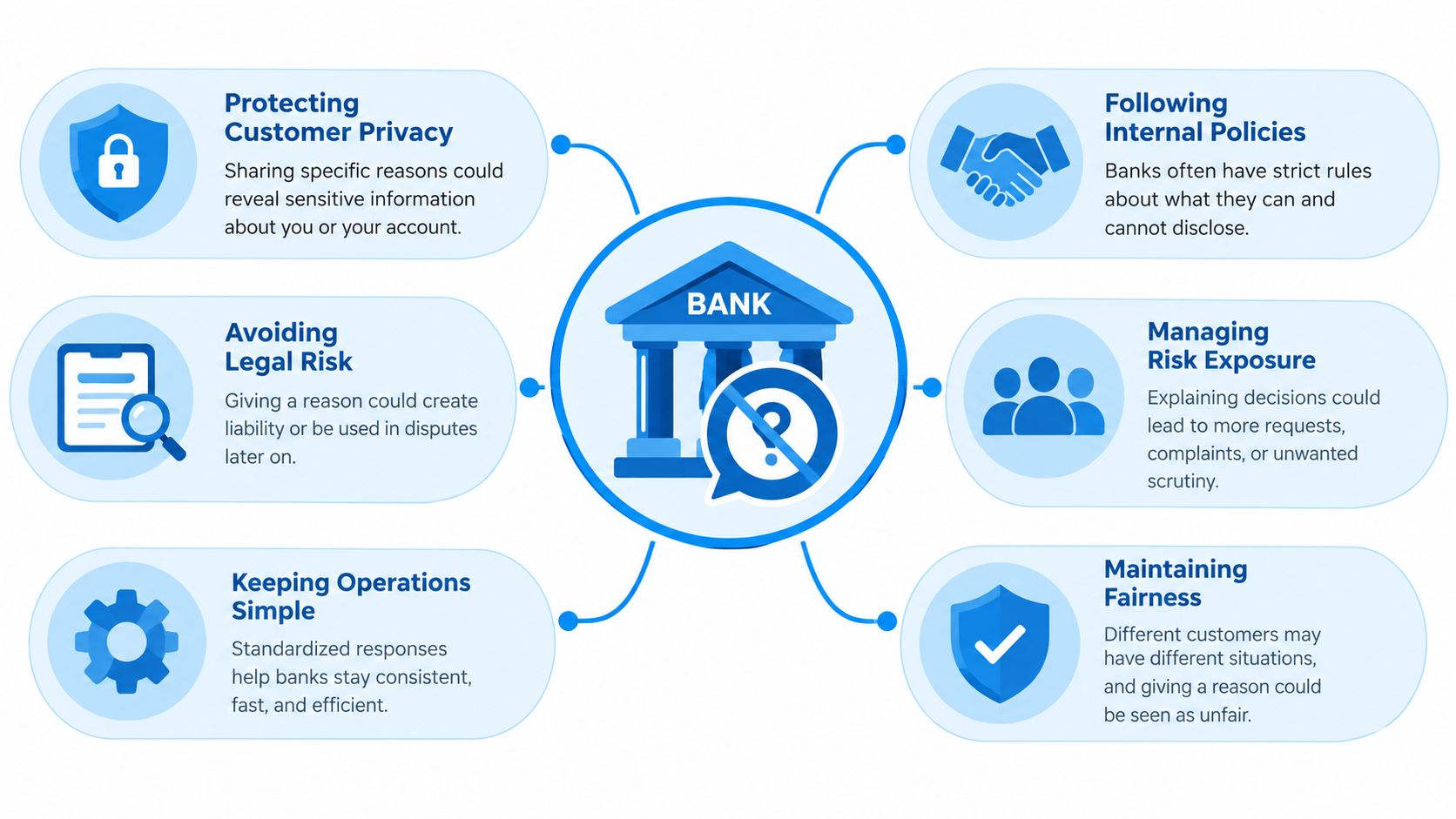
Issuers often return generic declines because the decision comes from internal risk logic that they don't expose to merchants. A fraud model may detect unusual location, transaction velocity, merchant category, card usage, or cross-border behavior, but the authorization response still arrives as a broad refusal. Giving the merchant the exact rule could expose how the issuer protects the account.
Regional and issuer policies add another layer. A cardholder may be able to pay successfully in one market while a cross-border transaction receives code 05. Network, issuer, and acquirer risk systems evaluate the same payment context differently, so a transaction can be declined without the customer having a generally unusable card.
The gateway can also reduce the information you receive. A processor or payment service provider may reformat a downstream response, map several issuer outcomes into ISO 8583 code 05, or expose only the normalized reason in its dashboard. An aggregator may flatten distinct signals into the same merchant-facing label.
Four layers can produce one vague message
The ambiguity usually sits across several parts of the stack:
- Issuer decision: The bank's risk engine, account restriction, spending limit, or card policy rejects the request.
- Network interpretation: The card network carries the response and applies its own response framework.
- Acquirer or gateway path: The merchant's acquiring bank or gateway may add risk controls or route-level restrictions.
- Merchant integration: The platform may store only the normalized code and discard useful fields from the raw authorization message.
That's why a merchant identifier matters. A MID, or Merchant ID, identifies the merchant account used on the payment path. Reviewing DNH by MID can reveal whether one account, region, or gateway is producing the spike instead of the whole business. FloPay's explanation of a Merchant ID is useful for teams that need to connect decline records to the specific processing account involved.
You shouldn't promise customers that the bank declined them for fraud, and you shouldn't tell engineering that code 05 proves a bad card. The honest customer message is that the bank didn't approve the payment and another payment method may be needed. Internally, retain the full response context so your team can investigate the path rather than guess at the issuer's private rule.
First Things to Check After a Do Not Honor Decline
Start with the transaction record, not the customer's bank. Your first objective is to establish whether the event is isolated, reproducible, route-specific, or part of a wider operational pattern.
Run the checks in this order
-
Confirm the exact code. Verify that the raw response is 05, not 51, “Insufficient Funds,” or another decline category. A wrong classification sends recovery logic down the wrong path.
-
Compare attempts carefully. Check whether the same payment was declined again within minutes, then compare it with later attempts. A repeated immediate refusal tells you less than a later change in outcome, and repeated rapid submissions can create additional issuer or network scrutiny.
-
Pull the attached signals. Review Address Verification Service, or AVS, results, Card Verification Value checks, and 3DS authentication status. AVS compares billing address details, CVV checks the security value, and 3DS adds bank authentication through an app, message, or biometric flow. Code 05 is vague, but these fields may expose a data-quality or authentication problem.
-
Inspect the journey. Segment the event by card type, billing country, device fingerprint, merchant category, and customer status. A first purchase and a recurring merchant-initiated transaction, or MIT, deserve different treatment because the customer isn't present during a subscription rebill.
-
Check recent success. Look for the same PAN, meaning the full card number, succeeding through another route or elsewhere in your provider stack. Don't expose raw card data in merchant systems. Use tokenized references and controlled access to compare payment history safely.
What to skip
Don't immediately tell the customer to call the issuer before checking your own logs. The bank may not provide useful detail to the merchant, while your gateway data can show a broken route, missing billing fields, or a failed authentication step.
Also skip hard-coded retry timers. Industry guidance treats some code 05 outcomes as soft declines, but recommends respecting the scheme-mandated minimum interval, typically 24 hours for most codes, before resubmitting an unchanged payment. PXP's decline-code guidance supports a controlled retry approach, not repeated attempts in the same minute.
Visa's framework is more nuanced than a universal retry rule. Its issuer-decline categories distinguish never-reattempt outcomes, later-retry possibilities, detail corrections, and generic cases. The Visa decline framework described by Flint shows why your retry engine should use the accompanying category and context where available, rather than treating every 05 as permission to keep sending the same authorization.
Real Scenarios Behind the Same Decline Code
A payments dashboard can show four identical 05 responses while the underlying events have nothing in common. The code is a label, not a diagnosis.
A prepaid card reaches a limit
A customer uses a prepaid card for an initial digital product purchase. The first payment succeeds, but a later charge arrives after the card has reached a spending or balance restriction. The issuer returns Do Not Honor rather than a detailed explanation.
The useful clue is the card profile and timing. If similar prepaid cards fail on recurring charges while standard credit cards continue to approve, the problem may be product eligibility or account limits. Routing the payment through another gateway won't overcome a genuine issuer or product restriction. The recovery path is an alternative payment method or direct customer outreach.
A subscription arrives at the wrong moment
A subscriber's rebill runs when the account hasn't settled funds. The payment receives code 05, but a later attempt succeeds after the billing cycle changes. The customer hasn't canceled, the card hasn't necessarily expired, and the original failure doesn't prove a permanent block.
Structured dunning beats blind repetition. A subscription recovery campaign can wait for a more credible billing window, communicate clearly, and suppress retries when later evidence points to a hard stop.
An issuer risk rule fires
A customer normally pays from a familiar device and location. This time, the transaction comes from a new device, an unusual country, or a different purchase pattern. The issuer's risk engine refuses the authorization and returns the same generic code.
The merchant may have strong fraud controls and complete billing data. That doesn't guarantee approval because the issuer evaluates information and history that the merchant cannot see. The customer may need to authenticate with the bank or use another method, rather than receiving more immediate attempts.
A travel purchase triggers velocity controls
A traveler books several services in a short period. The card has enough available funds, but the issuer sees an unusual burst of activity. The booking attempt returns 05, and subsequent rapid retries produce the same result.
The log pattern matters more than the message. Review transaction velocity, device continuity, country, amount pattern, and route performance. If the issue is issuer-level velocity control, a second gateway may not help. If the failure is tied to a particular merchant account or gateway path, alternate routing may produce a different result.
Operational rule: Code 05 tells you what the issuer returned, not which scenario fired. Read the surrounding transaction pattern before choosing the remedy.
Why Retrying Harder Is Usually the Wrong Answer
The default response to a decline is often more attempts. That approach confuses activity with recovery.
Sending the same authorization repeatedly through the same gateway can reinforce the pattern that triggered the refusal. Issuer risk systems and network controls can react to velocity, while customers see a broken checkout or repeated payment prompts. A recovered authorization can still create downstream problems if the transaction context was suspicious or the customer didn't intend the charge.
A retry that approves also isn't automatically a retained customer. The customer may still face duplicate pending entries, confusion around subscription billing, or a later dispute. Revenue teams should measure successful settlement and customer continuity, not only the moment an authorization response turns positive.
The route is a variable
The single-processor setup hides an important test. If the same tokenized payment method is sent through another eligible acquirer or gateway, the result may change because the path, merchant account, risk profile, or connectivity condition changed. That doesn't mean every DNH is recoverable. It means the first decline doesn't always justify declaring the card dead.
Stripe is a strong processor, and keeping Stripe in your stack can be entirely sensible. The risk appears when Stripe, or any other provider, becomes the only payment continuity strategy. If all saved payment methods and routing logic depend on one gateway, you have processor concentration risk, limited fallback, and a card-on-file portability problem.
Choose controlled recovery
The better hierarchy is:
- Change the path when the decline may be gateway-specific.
- Change the time when subscription timing or a temporary account condition is plausible.
- Change the method when issuer or product restrictions make card retries futile.
- Stop when your rules identify a hard-stop outcome.
This is why cascade routing deserves more attention than repeated retries. It tests a different processing path without forcing the customer through checkout again. For merchants with only one gateway, the missing capability isn't another timer. It's payment resilience.
Cascade Routing and Other Remedies That Actually Recover Revenue
Three remedies deserve a place in your DNH recovery policy, but they solve different problems. Don't present them as interchangeable, and don't promise that any of them can overcome a genuine issuer block.
Cascade to an alternative gateway first when the first route fails. Treat DNH as a generic issuer decline that can move to the next eligible payment method, and use cascading processing to test an alternate path when you run more than one gateway. The key boundary is hard: a merchant with one gateway cannot benefit from cascade routing, regardless of vault or retry policy.
Retry later for recurring billing when timing is plausible. A subscription rebill may fail because the account condition changes during the billing cycle. A structured campaign can wait rather than resubmit immediately. A later point such as day 27 on a monthly cycle can work, but that timing must match your billing model, issuer guidance, and customer communication.
Recover the MID path when connectivity or account health is involved. A MID, or Merchant ID, can experience a connectivity problem or route-specific issue. Retry on the same MID after service health returns, or route to an alternate MID when your acquiring setup supports it. This is different from trying to bypass a card restriction.
| Remedy | Best-Fit Scenario | Expected Lift | Won't Help When |
|---|---|---|---|
| Cascade to an alternative gateway | The first gateway, acquirer, or MID path may be the problem | Can recover approvals that the first route rejected, but the actual result depends on the alternate path | The issuer or product blocks the card across routes |
| Timed subscription retry | A recurring payment may succeed after account conditions change | Can support recovery when the first attempt was a timing miss | The card is restricted, the product is ineligible for recurring billing, or the issuer maintains the block |
| MID recovery and rerouting | Connectivity, merchant-account health, or route-specific failure is suspected | Can restore processing after the affected path becomes healthy or a secondary MID is used | Repeated issuer refusal, confirmed fraud, or a merchant-category restriction |
The expected lift column should be treated as a decision principle, not a promised percentage. Public guidance describes DNH frequency as highly dependent on market and network, and independent analysis of one set of observations found that code 05's share of declines differed sharply across Visa, Mastercard, Discover, and American Express, with American Express by far the highest. The cross-network analysis illustrates why your own route-level data matters more than a universal benchmark.
Use alternative payment methods when the evidence points to a hard stop. PayPal, wallets, or another card can preserve the customer relationship when routing logic cannot change the issuer's decision.
How Payment Orchestration Makes Do Not Honor Survivable
Payment orchestration changes the meaning of a DNH event. In a single-provider setup, the decline often ends the transaction because the merchant has no approved way to present the payment through another route. In an orchestrated setup, the event becomes a decision point.
A processor-neutral, PCI-compliant card-on-file layer can hold tokenized payment methods and map them to supported providers without putting raw card numbers into merchant systems. If a payment token is usable across the configured routes, the orchestration layer can send the failed authorization toward another eligible acquirer without asking the customer to type the card again.
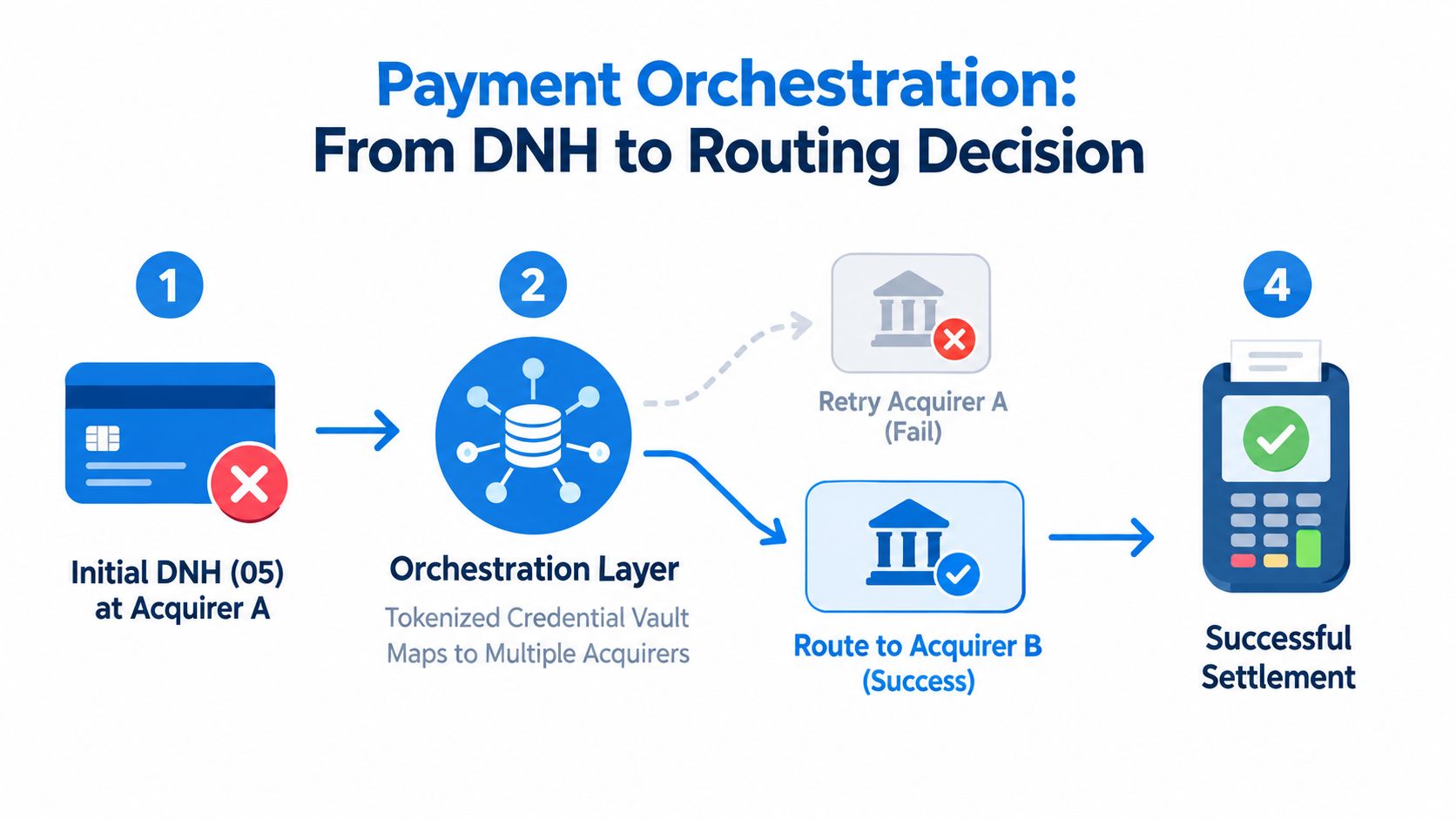
The practical difference is portability
A typical Stripe-only saved-card design stores a gateway-scoped credential. That can work well while Stripe is the only route, but it limits fallback when the payment path fails. A vault-backed architecture is designed differently. The saved payment method remains available through a secure, processor-neutral layer, subject to provider support, token rules, compliance controls, and network requirements.
A routing decision can then consider:
- Gateway health: Is the original provider or MID showing connectivity or processing problems?
- Regional fit: Is another acquirer better positioned for the cardholder's market?
- Decline context: Does the response look retryable, route-specific, or like a hard stop?
- Customer state: Is this a first payment, a renewal, or a merchant-initiated transaction?
- Provider eligibility: Can the same tokenized payment method be used safely through the alternate route?
FloPay provides payment orchestration, a unified checkout, and Flo Vault, a processor-neutral PCI-compliant card-on-file layer designed to make saved payment methods portable across supported providers. Its value here isn't a claim that every DNH becomes an approval. It's that the merchant can separate the customer's payment method from a single gateway path and make routing decisions with more control. Payment orchestration software explains the broader architecture behind that approach.
The data layer is just as important as the retry call. A single dashboard may show “Do Not Honor” as one failed category. Orchestration can expose the gateway, MID, region, attempt timing, and route outcome, allowing teams to distinguish issuer restrictions from a path that underperformed. That visibility supports recurring revenue today and creates a foundation for agent-assisted commerce tomorrow, where human or AI agents need secure, auditable payment flows.
A Short Checklist and What to Do Next
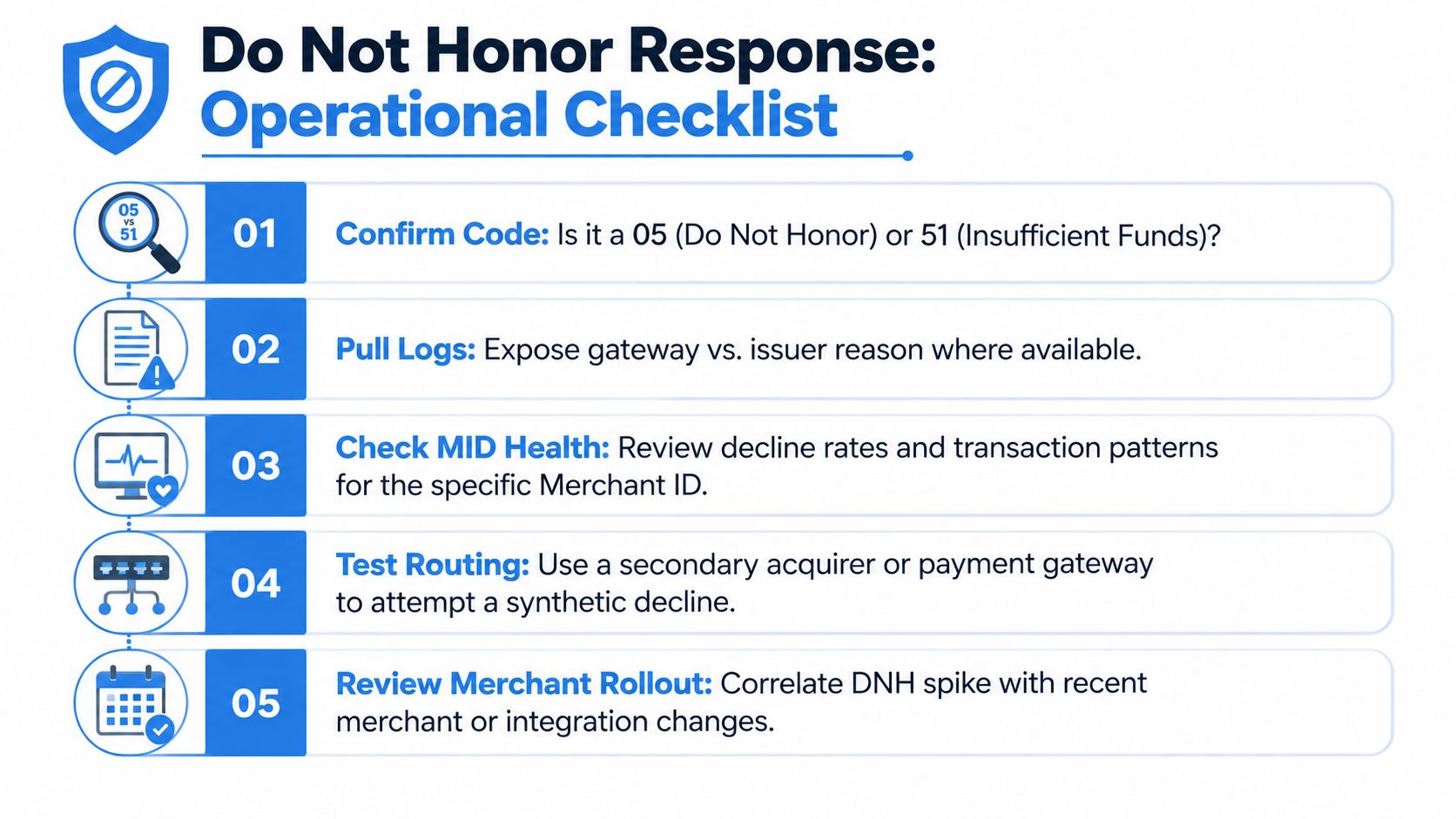
Run this checklist when code 05 starts rising. Each action should produce a decision, not another dashboard.
-
Confirm the code. Separate 05, Do Not Honor, from 51, Insufficient Funds, before applying retry rules.
-
Pull the raw logs. Capture the gateway response, issuer fields where exposed, AVS, CVV, 3DS, MID, country, card type, and attempt timing.
-
Check MID health. Compare the affected Merchant ID with other MIDs, gateways, regions, and transaction types. A localized spike deserves a different response from a portfolio-wide pattern.
-
Test the route safely. Use an approved secondary acquirer or gateway in a controlled test, never uncontrolled production retries. Confirm that your tokenized credential can support the alternate path.
-
Review timing. Match subscription retries to issuer and scheme guidance, and suppress retries when the evidence indicates an issuer- or product-level hard stop.
-
Audit concentration. Identify whether saved payment methods, recurring revenue, and checkout continuity depend on one processor. Stripe can remain your processor while you build multi-provider readiness around it.
The practical takeaway is clear: Do Not Honor is an ambiguous decline, not a complete diagnosis. First establish whether the issue belongs to the issuer, the card product, the timing, the MID, or the gateway path. Then route, retry later, recover the processing path, or stop based on evidence.
If you're responsible for recurring revenue or checkout resilience, book a Vault Risk Review with FloPay to map your DNH exposure, gateway dependency, and saved-payment portability gaps. FloPay can show how unified checkout, payment vaulting, and multi-provider orchestration fit into a recovery strategy without forcing you to abandon a processor that already works for your business.