Fraud Risk Management Guide for Modern Merchants
A practical fraud risk management guide covering detection, chargeback prevention, multi-processor controls, and agent-assisted payment workflows for 2026.
You've invested in fraud controls, tuned rules in your main gateway, and built a checkout that converts. Then you add a second processor for regional coverage or resilience. Suddenly, a different gateway is approving the same type of transaction your first provider would have challenged. Your fraud program didn't become weaker because the model stopped working. It became weaker because your controls, evidence, and decisions were never designed to travel.
A useful fraud risk management guide must start there. Fraud isn't only an approval-time problem. It spans checkout, authentication, routing, recurring billing, fulfillment, refunds, disputes, support, and agent-assisted payments. The commercial objective is straightforward: protect revenue without blocking good customers or creating a new operational dependency.
Table of Contents
- Why Most Fraud Programs Fail Before They Begin
- The Closed-Loop Fraud Risk Methodology
- Fraud Detection Across Multiple Processors Without Faking the Workflow
- Chargeback-Focused Practice for a New Merchant
- Handling Post-Purchase Fraud Without Hurting Loyal Customers
- Fraud Controls for AI and Human Agents Initiating Payments
- Practical Takeaways for Your Fraud Program This Quarter
Why Most Fraud Programs Fail Before They Begin
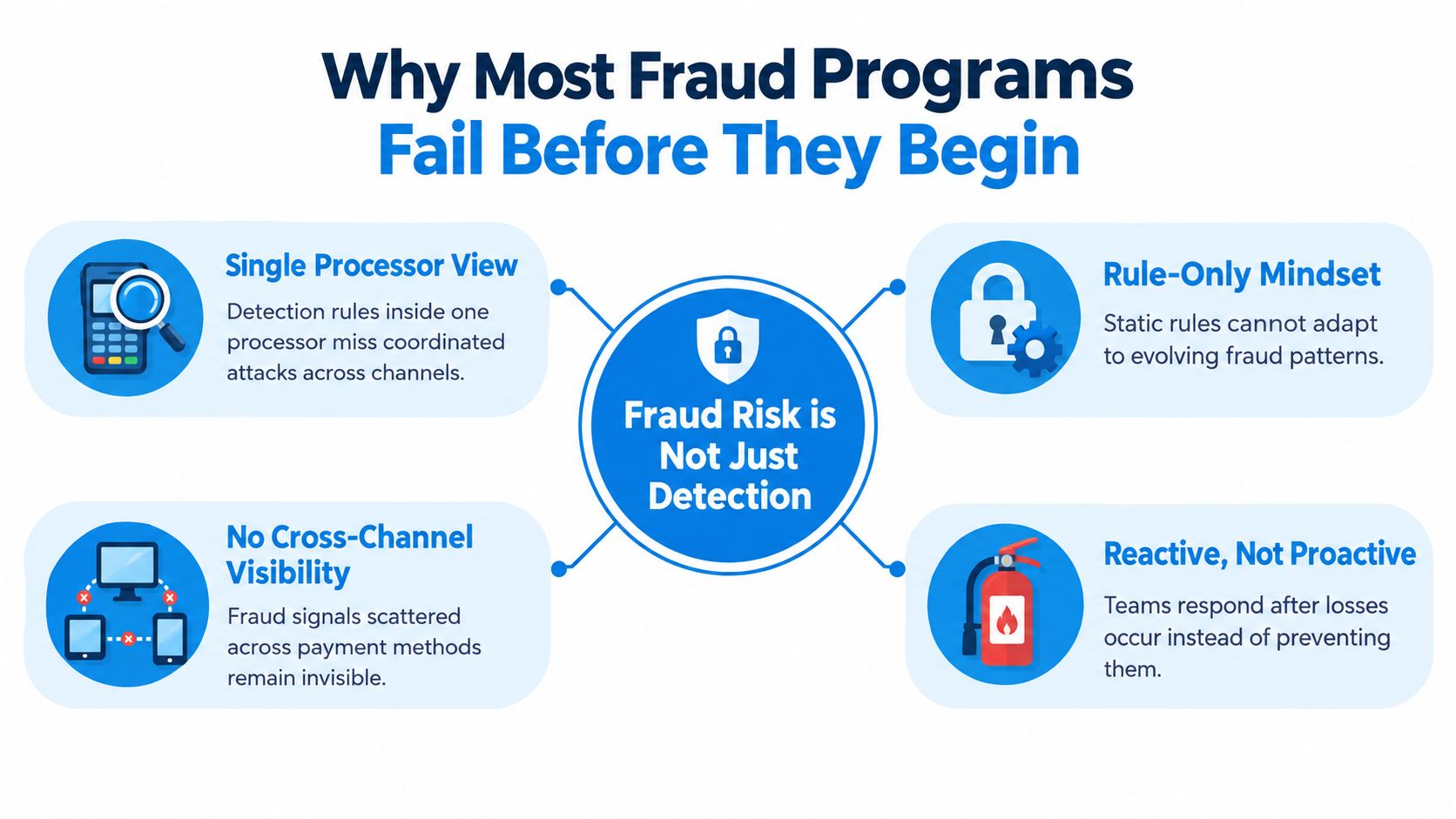
A merchant may configure Stripe Radar carefully, then add Adyen for European coverage. Stripe sees its own history, device signals, authentication outcomes, and dispute feedback. Adyen sees a different slice of the customer and transaction. If the second gateway approves a cohort with a history of chargebacks, the orchestration layer has created more payment capacity without creating shared fraud visibility.
That's the structural weakness most guides miss. Fraud controls aren't portable across processors by default. A rule built inside one provider rarely follows the payment when routing changes. Smart routing without shared evidence can therefore create a false sense of security.
The single-processor blind spot
A gateway can score a transaction well while your business still misses coordinated activity across channels. The same customer might use several payment methods, create multiple accounts, request refunds through support, and dispute a subscription renewal later. Each processor may see only one part of that pattern.
The Association of Certified Fraud Examiners' 2024 study analyzed 1,921 investigated cases across 138 countries and territories, with identified losses exceeding US$3.1 billion. It estimates that a typical organization loses approximately 5% of annual revenue to fraud, a benchmark that helps leadership set risk appetite and control investment. The ACFE report summary also shows why a single control model is inadequate: financial statement fraud had a median loss of approximately US$766,000, while asset misappropriation was more frequent but had a median loss of about US$120,000.
For a payments business, that means separating account takeover, payment manipulation, refund abuse, insider misuse, merchant fraud, and chargeback-related schemes. Your fraud risk and compliance guidance should support that operating model, not reduce every risk to an approve-or-decline score.
Fraud is a lifecycle problem
The right question isn't “Which rule blocks this payment?” It's “Which evidence should influence this decision, and what happens after the payment succeeds?”
That includes:
- Before payment: account creation, device or session signals, payment-instrument history, and authentication context.
- During payment: routing choice, retry history, address checks, bank response, and 3DS, meaning bank authentication through an app, SMS, or biometric confirmation.
- After payment: fulfillment, usage, cancellation, refunds, complaints, disputes, and recovery.
Operational rule: Keep Stripe as a processor, but don't make Stripe your entire payment continuity strategy.
The same principle applies to Adyen, PayPal, and every other provider. Payment resilience means your checkout can use multiple providers while your fraud program still has one accountable view of risk.
The Closed-Loop Fraud Risk Methodology
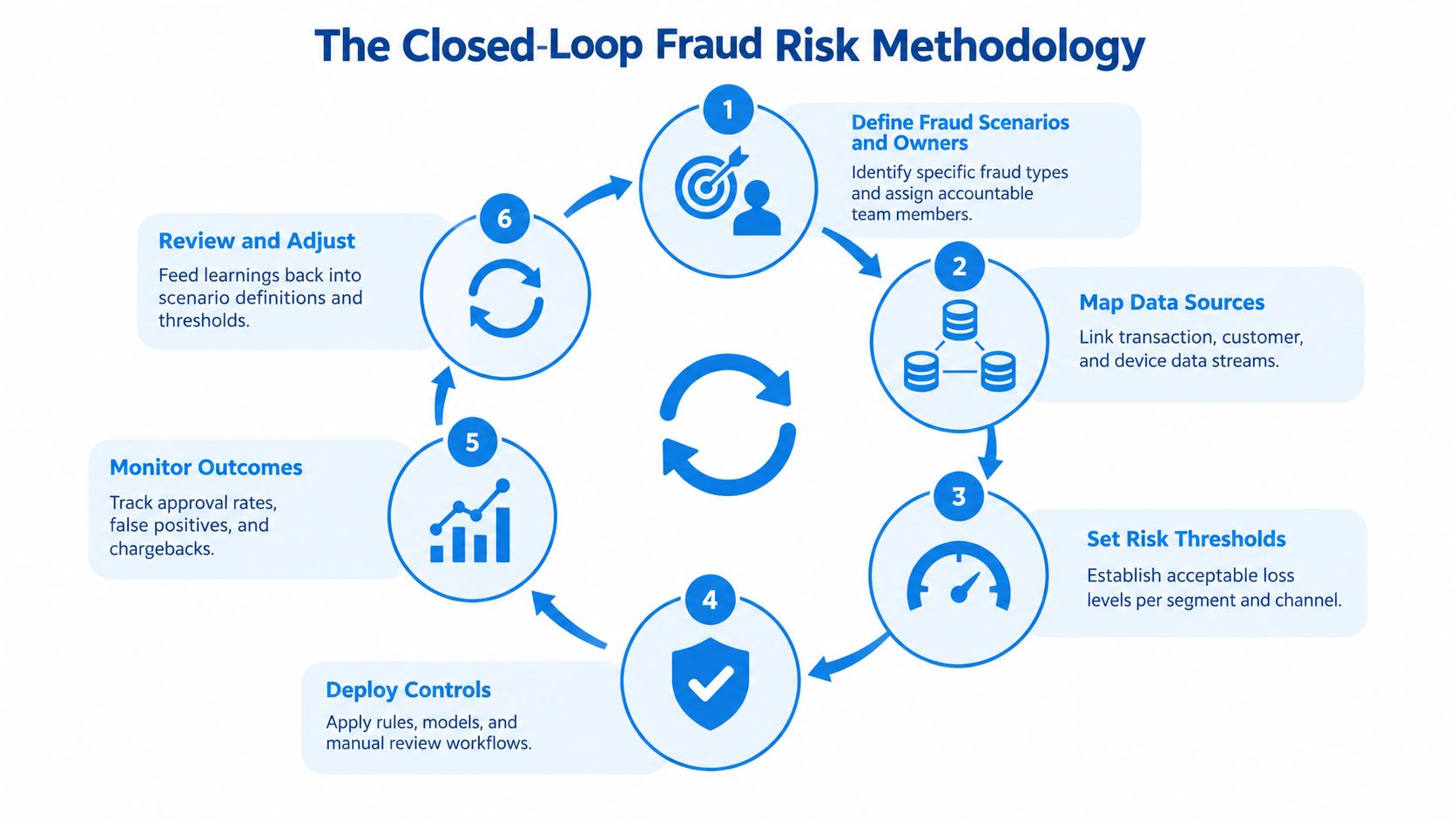
A fraud program should run as a closed loop, not as a folder of processor settings. Assign an owner to each scenario, connect controls to evidence, investigate decisions, and use confirmed outcomes to improve the next decision.
The ACFE found that the median fraud scheme lasted 12 months before detection. Cases discovered within six months had a median loss of US$30,000, compared with US$250,000 for schemes continuing for two to three years. The ACFE 2024 report makes the operating point clear: earlier detection protects more revenue than a larger alert queue discovered late.
Define, map, and collect
Start with named scenarios and accountable owners.
-
Define fraud scenarios and owners. Assign responsibility for account takeover, refund manipulation, friendly fraud, payment-instrument abuse, insider misuse, and agent-assisted transactions. A payments lead may own routing evidence, while revenue operations owns refund and dispute workflows.
-
Map preventive, detective, and corrective controls. Preventive controls include authentication and permission limits. Detective controls include monitoring, complaints, reports, and reconciliations. Corrective controls include refund decisions, account review, representment, and recovery.
-
Collect structured signals. Preserve transaction attributes, access events, complaints, customer reports, employee reports, reconciliation outcomes, and dispute results. For a processor-neutral design, retain tokenized payment references, routing choice, retry history, authentication result, device or session signals, and dispute outcome. This gives teams evidence without retaining raw card data in merchant systems.
NIST's identity guidance says organizations should assess the impact of compromise before deciding whether identity proofing or validated attributes are necessary. That's important because collecting every identity and behavioral signal creates privacy exposure without automatically improving decisions. Document why each data field exists and what decision it supports.
Monitor, investigate, and measure
Apply thresholds by scenario. A recurring subscription rebill shouldn't use the same response as a new account buying a high-value physical product. Set separate paths for step-up verification, manual review, decline, delayed refund, and post-transaction recovery.
A fraud score isn't the control. It needs reason codes, analyst feedback, model-drift monitoring, and validation against confirmed outcomes. Without that governance, teams end up optimizing for alert volume instead of loss avoided.
Investigation records should preserve the evidence, decision, reviewer, escalation path, and final outcome. Then measure:
- Detection time: How quickly did the team identify the issue?
- Loss avoided: What exposure was stopped before settlement or recovery?
- False positives: How often did a control create unnecessary customer friction?
- Control coverage: Which scenarios, providers, payment methods, and lifecycle stages are covered?
- Recovery rate: How much confirmed loss did the business recover?
Retune controls only after reviewing those outcomes. A rule that blocks more payments but creates support queues and loses loyal customers may be commercially worse than a narrower control with stronger evidence.
Fraud Detection Across Multiple Processors Without Faking the Workflow
The most common oversight when merchants combine smart routing with fraud controls is simple: they configure fraud protection in one gateway, add a second gateway, and assume the second provider behaves the same way. It doesn't.
Stripe, Adyen, and PayPal each use their own data, risk services, authentication flows, dispute processes, and merchant configuration. Their signals can be useful, but they aren't interchangeable. FloPay doesn't currently include a configurable fraud rules engine with managed velocity checks or billing-address mismatch rules, so merchants must understand which controls belong to each provider and which evidence must be maintained at the orchestration layer.
| Signal | Stripe Radar behavior | Adyen behavior | PayPal behavior | Implication for orchestration |
|---|---|---|---|---|
| Velocity | Can evaluate activity using Stripe's available payment and account context. | Can assess risk through Adyen's own payment and shopper context. | Uses PayPal account and transaction context within its ecosystem. | Preserve cross-provider payment history so repeated attempts don't disappear when routing changes. |
| Billing address mismatch | Can use address-related checks as part of Radar decisions where the relevant data and issuer response exist. | Applies its own risk configuration and payment-data context. | Uses PayPal account and funding-source information rather than mirroring card-processor logic. | Record the submitted address, result, provider, and reason without treating a mismatch as automatic proof of fraud. |
| Device signals | Uses signals available to Stripe's risk systems. | Uses its own shopper-risk and device context. | Benefits from PayPal account and network context. | Don't assume a device signal collected by one provider is visible to another. |
| 3DS | Supports risk-based authentication and challenge flows. | Supports authentication and exemption handling through its own configuration. | Uses PayPal's wallet authentication model, which differs from card 3DS. | Preserve authentication status, exemption context, and provider response for later review and dispute evidence. |
| Dispute feedback | Returns provider-specific outcomes and reason information. | Returns its own dispute and risk outcomes. | Handles disputes within PayPal's rules and evidence model. | Normalize outcomes into a shared internal taxonomy so routing decisions learn from all providers. |
A BIN, the first digits of a card number that identify the issuing bank and card type, can help contextualize geography and funding source. AVS, or address verification service, checks whether billing details match issuer records. Neither signal should be treated as a universal verdict. A missing postal code may be less concerning than a wrong postal code, and a prepaid card that approves the first subscription payment may still fail during later rebills.
The orchestration layer should preserve the evidence required for each payment path, including authentication result, exemption status, routing decision, retry sequence, and later dispute outcome. That matters under European rules, where SCA, or Strong Customer Authentication, exemptions depend on transaction risk, amount, recurrence, payment channel, and monitored fraud performance. For remote payments, the low-value exemption can apply below €30, while cumulative conditions can reach €100 since the last SCA, subject to the applicable requirements. The European Commission's delegated regulation sets the relevant framework.
If monitored fraud exceeds the applicable reference rate for two consecutive quarters, a payment service provider must stop using the relevant transaction-risk exemption. The EBA explains that the assessment sits at the account-servicing provider level, which makes outcome data and provider association essential. The EBA clarification is why a checkout rule that approves frictionless treatment without post-transaction monitoring is incomplete.
A payment orchestration layer should therefore make provider differences visible, not hide them behind a generic “risk passed” label.
Chargeback-Focused Practice for a New Merchant
New merchants don't need a sprawling fraud department on day one. They need a clean customer-facing record, early dispute visibility, and a fulfillment process that produces credible evidence.
FloPay's practical starting point is chargeback-focused. FloPay doesn't currently include a configurable fraud rules engine. The controls below address a common source of avoidable loss: customers disputing payments because the merchant's descriptor, cancellation terms, or fulfillment evidence is unclear.
Get the customer-facing basics right
Your billing descriptor should be recognizable on the customer's statement. Publish return and cancellation terms where customers can find them, and make contact details visible in confirmation emails, account areas, and support flows.
Create these artifacts:
- Descriptor record: Document the exact business name customers see after payment.
- Policy record: Keep the current cancellation, renewal, return, and refund terms tied to the checkout version.
- Contact path: Give customers a clear route to resolve billing questions before they contact their bank.
This won't stop deliberate fraud, but it can reduce confusion that becomes friendly fraud, where a customer recognizes the purchase only after checking their records or asks a bank to reverse a payment instead of contacting the merchant.
Turn on chargeback prevention
Enable FloPay chargeback prevention with early dispute alerts and auto-refund rules that match dispute signals against the original payment and customer or order data. The point isn't to refund every suspicious payment. It's to give operations a timely choice before a dispute becomes a formal loss.
Route each alert to an owner, record the decision, and keep the payment match auditable. One case may justify an automatic refund, while another needs manual review because the customer has an active subscription or an unresolved service issue.
Match capture to fulfillment
For physical goods, pre-authorize the card at checkout and capture the payment on shipment. This connects the payment to fulfillment timing and gives the dispute team stronger evidence about what was ordered, when it was shipped, and where it was delivered.
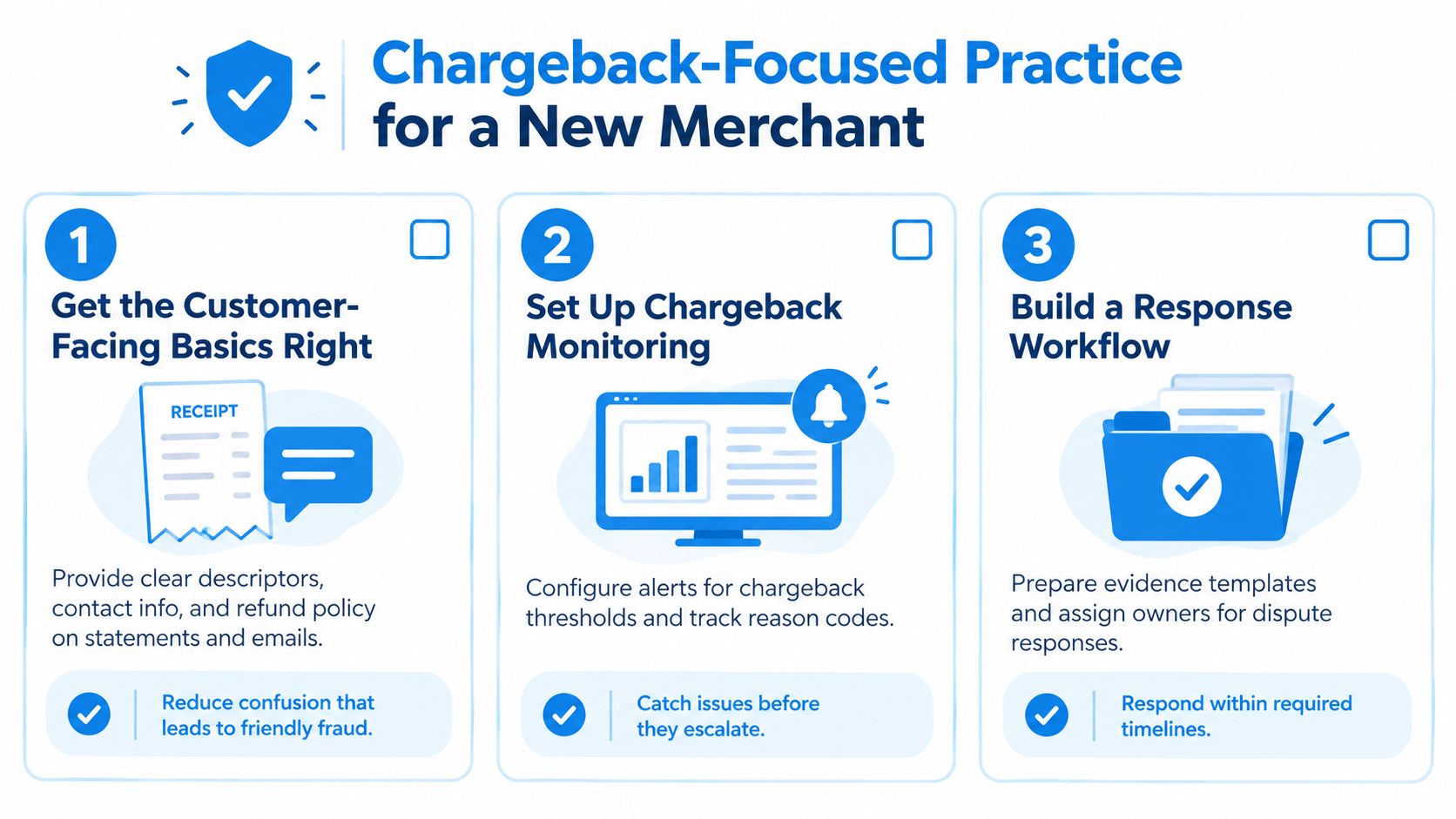
Build an evidence folder containing the order record, authorization and capture events, delivery status, customer communications, refund history, and policy version. This chargeback prevention guidance should be treated as an operating workflow, not a promise that every dispute can be prevented.
Handling Post-Purchase Fraud Without Hurting Loyal Customers
A subscription customer disputes a renewal after years of uninterrupted payments. The merchant sees a chargeback and labels the account fraudulent. Support blocks the customer, cancels access, and refuses to investigate. The merchant may protect one renewal while losing a customer who didn't recognize the descriptor or believed cancellation had completed.
That response confuses fraud, first-party misuse, and service failure. A stolen card, a customer who knowingly abuses refund policy, a customer who forgot a renewal, and an account takeover can produce similar dispute symptoms but require different evidence and treatment.

Separate the scenario before choosing the response
For a cancellation dispute, preserve consent records, renewal notices, cancellation timestamps, and the terms shown at checkout. For non-receipt, use fulfillment, delivery, access, and support records. For account takeover, examine login changes, device or session shifts, password resets, authentication events, and post-payment activity. For intentional policy abuse, look for repeated refund patterns, inconsistent explanations, and account relationships, while avoiding a conclusion based on one signal alone.
The response should match the evidence:
- Step-up verification: Ask for additional confirmation when account or payment behavior changes without enough evidence for a decline.
- Delayed refund: Hold a refund briefly while checking fulfillment, usage, and account history.
- Partial credit: Resolve a legitimate service complaint without treating the entire payment as fraudulent.
- Account review: Restrict risky actions while keeping access available where possible.
- Representment: Challenge the dispute when records clearly support the merchant and the customer's claim conflicts with the evidence.
A recurring-revenue business needs this segmentation because binary approve-or-decline decisions happen too early. After payment, the right choice may be approve the refund, retain the customer, challenge the dispute, or review the account. The best control is the one that protects net revenue and customer trust together.
Put loyalty into the risk calculation
A 2025 global survey of 1,466 fraud and payments professionals found that 77% reported increased fraud volume in the prior year and 54% reported more refund abuse. 66% of merchants ranked loyalty and brand reputation above stopping refund abuse, according to the survey data.
That doesn't mean accepting every refund. It means measuring customer friction as a cost. If a long-tenured customer with a clean usage history disputes one renewal, a support-led resolution may outperform an aggressive account block. If a new account repeatedly requests refunds across payment methods, a controlled review may be justified.
Commercial test: Don't ask only whether a payment looks suspicious. Ask whether the proposed response costs more than the exposure it addresses.
Fraud Controls for AI and Human Agents Initiating Payments
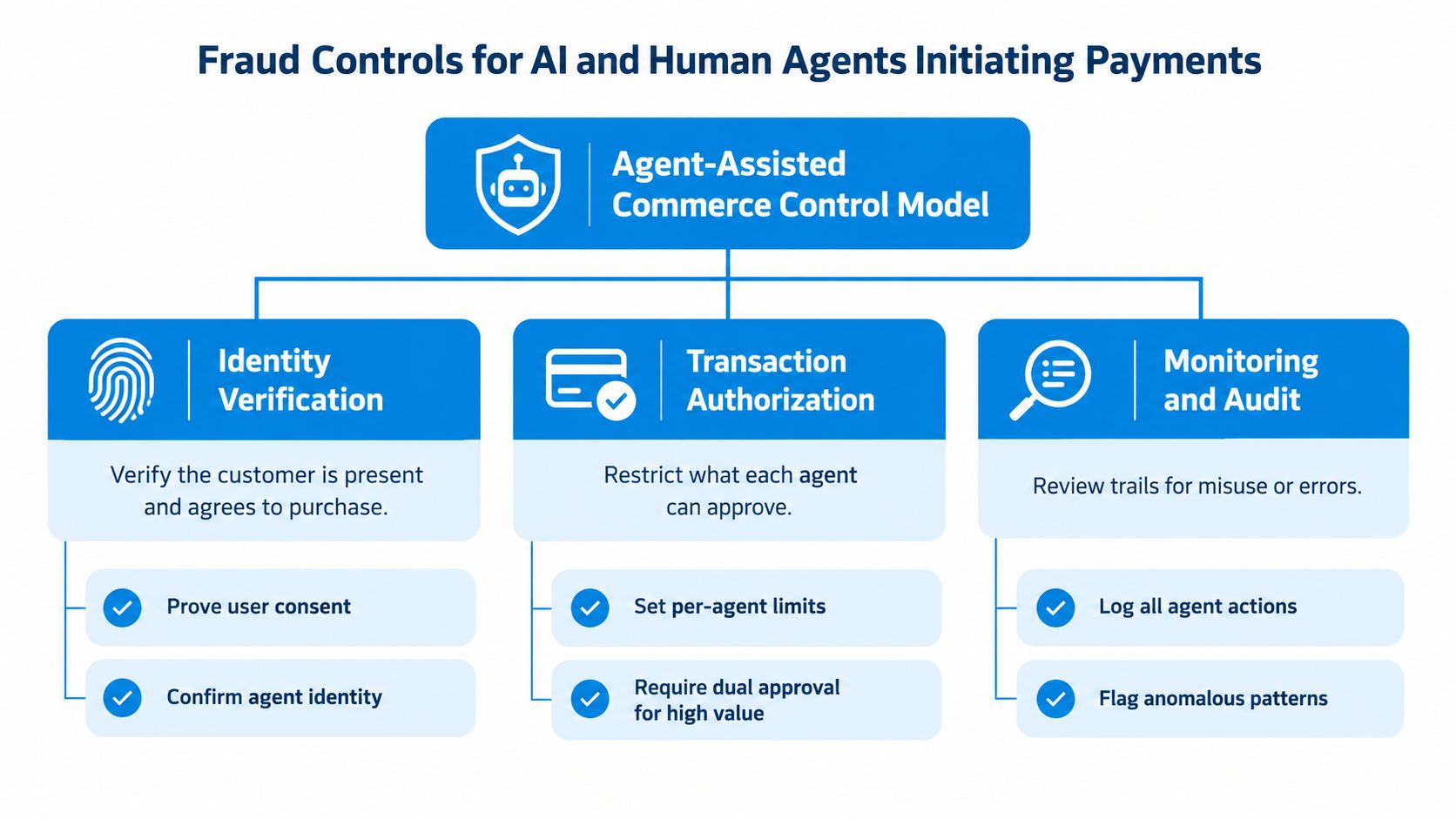
Agent-assisted commerce changes the first question in fraud prevention. Instead of asking only whether a transaction looks risky, ask whether the person or system initiating it has the authority to make that purchase.
Industry data shows 43% of merchants accept real-time payments, 45% identify real-time-payment fraud as a leading emerging attack, and 63% are exploring or planning agentic-AI payment implementations. The industry overview highlights why card-centric controls aren't enough for payment flows that may settle rapidly or become difficult to reverse.
Prove authority before payment
An agent needs an identity, a defined principal, and a permission boundary. A human support agent may be allowed to issue a replacement order but not change the beneficiary of a payout. An AI sales agent may recommend a product and prepare a basket but require customer confirmation before initiating payment.
Use cryptographic identity verification before an agent initiates payments or accesses sensitive payment services. Then bind the payment to the user's intent, destination, amount, and purpose. This creates an auditable chain from request to payment instead of treating the final transaction as the only event that matters.
Constrain the action
Set limits at the agent level, not just at the merchant level.
- Per-agent limits: Define permitted amounts, currencies, payment methods, merchants, and destinations.
- Step-up triggers: Require customer authentication for unusual amounts, new destinations, changed beneficiaries, or actions outside normal behavior.
- Replay protection: Ensure a captured instruction can't be submitted again to create duplicate payments.
- Tokenized credentials: Give agents access to authorized payment references rather than raw card details.
- Human override: Let an accountable operator pause, approve, reject, or reverse an action.
- Post-transaction monitoring: Review what the agent did, whether the customer received value, and whether disputes or refunds follow.
More AI detection isn't automatically the answer. A model may identify an unusual payment, but it can't repair an agent with excessive permissions. Governance over what the agent is allowed to do often matters more than another score applied after the fact.
FloPay's Agent Vault provides a foundation for delegated agent flows by keeping payment handling tokenized and traceable. The operating requirement remains the same: record the principal, agent identity, permissions, customer confirmation, payment instruction, provider response, and later outcome.
Practical Takeaways for Your Fraud Program This Quarter
A fraud program is working when it improves decisions, not when it produces more alerts. Track five measures across processors, routes, payment methods, geographies, and recurring-billing cohorts.
Detection time shows how long suspicious activity remains invisible. Shorter detection gives the team more options, including account review, refund decisions, payment holds, and recovery.
Loss avoided measures exposure stopped before it becomes a settled loss or expensive dispute. Separate prevented transactions from successful payments that were later recovered, because both affect commercial performance differently.
Alert precision shows whether analysts are reviewing useful cases or wasting time on noise. A high-volume queue with poor precision creates fatigue and encourages reviewers to approve risk mechanically.
Control coverage identifies gaps between providers and lifecycle stages. Map which controls apply to Stripe, Adyen, PayPal, wallets, recurring rebills, refunds, support actions, and agent flows. A control that exists only in one gateway isn't a complete business control.
Recovery rate measures how much confirmed loss the team gets back through refunds, representment, fulfillment evidence, or account remediation.
Use this quarter's review to answer five practical questions:
- Saved payment methods: Where do your tokenized payment methods live, and can your card-on-file layer support more than one provider?
- Processor controls: Which fraud signals and authentication decisions stay inside each gateway?
- Chargebacks: Are early dispute alerts and auto-refund rules enabled and assigned to owners?
- Subscriptions: Do consent, renewal, and cancellation records support the requirements of the FTC's 2024 Negative Option Rule, including affirmative consent and a simple cancellation mechanism? The Government Accountability Office summary describes those requirements.
- Agents: If a human or AI agent initiates payments, are its permissions, limits, customer confirmation, replay protection, and audit trail defined?
Start with the gap most likely to create immediate exposure. In many businesses, that's not a new detection model. It's a second gateway, a non-portable saved payment method, or a refund workflow with no owner.
FloPay brings payment orchestration, embedded checkout, processor-neutral vaulting, routing, and chargeback prevention into one integration. If your fraud controls don't follow every payment path, visit FloPay to review your provider coverage.