Payment Was Declined: Immediate Steps to Fix It
Payment was declined? Learn the immediate diagnosis steps, common decline reasons, and practical recovery actions for merchants and customers.
A customer reaches the final step of checkout, clicks Pay, and gets the message: “Payment was declined.” Your support queue starts filling, your analytics show an abandoned order, and someone suggests trying the same card again. That response is often too simple.
A declined payment can come from the issuer, authentication, merchant risk rules, billing data, routing, or processor availability. The fastest recovery starts with the merchant's evidence, not a generic customer-facing checklist. Find the transaction, identify the failure class, and choose an action that matches the cause.
Table of Contents
- What Support Agents Ask First
- The Four Types of Payment Declines
- The Diagnostic Decision Tree
- When to Retry and When to Route Elsewhere
- Building Long-Term Payment Resilience
What Support Agents Ask First
“The transaction ID, please.”
That's the first question a FloPay support agent asks when a merchant reports that a payment was declined. The transaction ID, also called the payment reference number, is the precise lookup key for the payment record. It takes the investigation from “a customer couldn't pay” to a specific event with an issuer response code, gateway, card type, timestamp, and routing history.
Consider two support tickets. The first says, “A customer in France had a card decline this morning.” The second includes the transaction ID. The second ticket can be investigated immediately. The agent can see whether the issuer rejected the authorization, 3-D Secure failed, the selected gateway timed out, or a routing rule sent the payment down an unsuitable path.
Without the transaction ID, support falls back to the merchant's email address or account ID, plus the approximate transaction time. Those details can locate the right account, but they're less precise when a business has several payment attempts close together.
Practical rule: Don't ask a customer to retry before you've captured the transaction ID and the original response.
Where to find the useful reference
The ID is usually visible in the checkout dashboard's payment detail view. Engineering teams should also expose it in the checkout response and persist it with the order record. If your integration uses webhooks, include the payment reference in the event payload stored by your application, so support can search from the order, customer record, or fulfillment system.
Once the transaction is located, the dashboard record answers the first commercial question: is this card-side or gateway-side? A card-side decline may require the cardholder to authenticate, update billing details, use another method, or contact the issuer. A gateway or configuration failure is different. That's where your payments team may need to change routing, credentials, data formatting, or processor settings.
This discipline also protects your reporting. A retry isn't a new customer opportunity. It's another attempt on the same payment journey, and your system should preserve that relationship.
The Four Types of Payment Declines
Not every decline deserves another attempt. The right recovery action depends on whether the original failure is permanent, fixable by the customer, authentication-related, or caused by payment infrastructure.
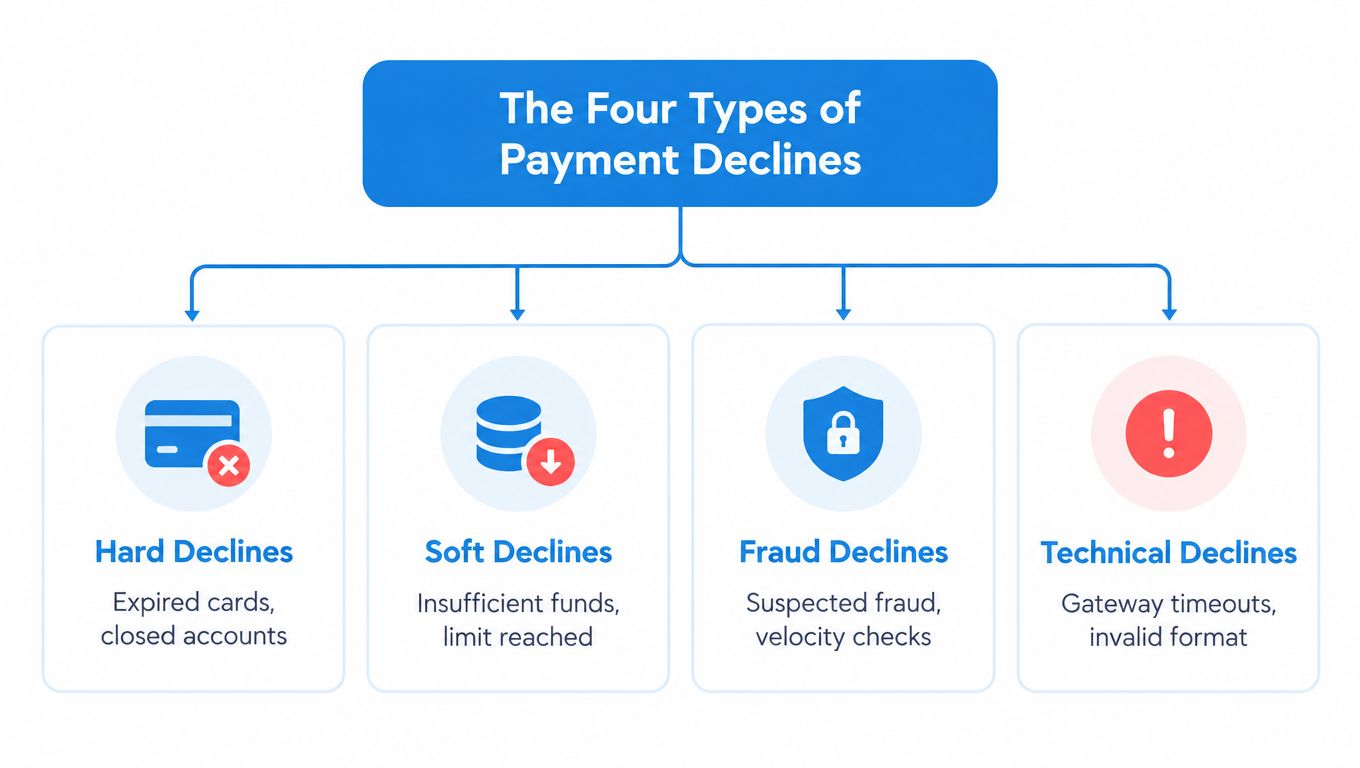
Hard declines
A hard decline indicates that repeating the same request is unlikely to help. Typical examples include an expired card, a closed account, or a permanent fraud block. The customer needs to provide a replacement payment method or resolve the account issue with the issuer.
Repeatedly submitting unchanged card data creates friction and can make the customer think your checkout is broken. For recurring billing, a hard decline should normally stop automated retries and trigger a clear card-update journey.
Customer-remediable declines
Some failures can be fixed without changing the processor. Insufficient funds, an incorrect card number, an incorrect expiry date, or a wrong billing postcode belong in this group. The merchant should explain the next action clearly, rather than presenting a vague “try again” message.
A billing-data error deserves a correction flow. A balance-related failure may justify a later retry, especially for a subscription renewal, but an immediate sequence of identical authorizations usually adds little value.
Soft declines and authentication failures
A soft decline may reflect a temporary issuer decision or a request for stronger authentication. 3-D Secure, often called 3DS, brings the issuing bank into the checkout through an app approval, SMS code, or biometric confirmation.
The payment may succeed after the customer completes that step. If the issuer asks for authentication, the correct response is to invoke the relevant 3DS flow and preserve the authentication result, not to send the same unauthenticated request repeatedly.
Technical and fraud-related failures
Technical declines include gateway timeouts, routing errors, processor availability problems, and invalid request formats. These are the failures where an alternate gateway, acquirer, or merchant ID may help.
Fraud declines need separate treatment. A risk engine may reject a legitimate customer because the transaction context looks unusual, while an issuer may reject it because of suspected fraud. The recovery path can involve better transaction data, risk review, or authentication. It shouldn't mean disabling fraud controls for everyone.
A useful adjacent scenario is the prepaid card. A prepaid card can work for an initial checkout and then fail during a subscription rebill because the issuer doesn't allow that transaction type. Prepaid payment instruments need their own billing policy, not endless retries.
The Diagnostic Decision Tree
Start with evidence, then classify the failure, then act. That order matters because an acceptance metric can hide retries and make a weak recovery process look healthier than it is.
Step one, retrieve the complete attempt
Use the transaction ID to pull the payment record. At minimum, log the processor, issuer or BIN, country, currency, payment method, 3-D Secure result, network response code, latency, and retry number.
The BIN, the first digits of the card number, helps identify the issuing bank and card type. The payment method distinguishes a manually entered card from a wallet or another APM, meaning alternative payment method. Those details often explain why two transactions from the same customer receive different results.
Report gross authorization rate separately from any metric that includes retries. Gross authorization rate means approved authorizations divided by all issuer authorization attempts. If three attempts are counted as three fresh opportunities, the dashboard can overstate the number of successful customer journeys.
Step two, identify who rejected the payment
Read the issuer response code and the gateway event together. Generic ISO 8583 code 05, commonly labeled “Do Not Honor,” is a particularly important example because it doesn't identify the underlying issuer reason.
Code 05 is frequent and deliberately unhelpful. It may represent a genuine issuer refusal, but it can also appear alongside a transient route or merchant-ID connectivity problem. Compare the same cohort across gateways before deciding that the card itself is unusable.
A payment gateway integration should expose provider responses rather than collapsing every failure into one customer-facing status.
Step three, choose the narrowest safe recovery
Use the classification to select the action:
- Hard decline: stop automatic retries and request a replacement method.
- Insufficient funds: wait for a plausible billing-cycle recovery point, then retry under controlled limits.
- Authentication failure: launch 3DS or another issuer-approved verification path.
- Technical failure: use an alternate route when the evidence points to timeout, availability, or routing.
- Fraud response: improve relevant data or authentication, then reassess the risk decision.
A support agent can do this manually for isolated events. Engineering teams should encode the same logic in orchestration rules, with explicit stop conditions and a full event trail.
The process is easier to understand when the dashboard shows the decision path, not just the final label.
A recovery dashboard should compare processor routes using identical cohorts and report recovery by decline class. Blended approval alone doesn't tell you whether failover rescued technical failures, whether retries recovered genuine soft declines, or whether fraud controls are being weakened.
When to Retry and When to Route Elsewhere
Retrying and rerouting solve different problems. A retry gives a plausible transient condition time to clear. Route fallback sends the payment through a different gateway, acquirer, or merchant ID. An alternative payment method changes the payment rail altogether.
The common mistake is treating all three as interchangeable.
Match the tactic to the failure
For a subscription rebill with insufficient funds, an immediate retry usually isn't useful. A later attempt may work after the customer receives income or frees available balance. For a Do Not Honor response, an alternate route can help when the underlying problem is a transient merchant-ID connectivity issue, but it won't override a definitive issuer refusal.
For a transaction_not_allowed response on a prepaid or fintech-issued card, switching gateways is the wrong fix. The issuer is restricting the transaction type. Suppress automatic retries, place the subscription into a grace or pause state, and send a secure link for the customer to replace the card with a standard debit or credit card.
| Decline Code | Meaning | Recovery Action |
|---|---|---|
05, Do Not Honor | A broad issuer response with no precise underlying reason | Compare the route, try a suitable alternate gateway or merchant ID when a route issue is plausible, and offer another payment method |
transaction_not_allowed | The issuer or card program blocks this transaction type, often on a prepaid rebill | Don't keep retrying. Move the subscription to grace or pause and request a replacement card |
| Insufficient funds | Available balance or credit is inadequate | Retry after a reasonable delay, not in an immediate loop |
| Authentication failure | The issuer requires verification or the verification attempt failed | Trigger 3DS or another supported authentication path |
| Timeout or routing error | The payment infrastructure didn't complete the request reliably | Fail over to an alternate processor when the route is eligible |
Don't confuse more friction with better risk control
Cross-border payments make this balance harder. The European Central Bank's payment-fraud data shows that card fraud was 0.031% of transaction value domestically, and ten times higher for cross-border transactions where strong customer authentication isn't legally required.
That difference supports regional rules, not universal challenges. A domestic low-risk payment may not need the same authentication path as an unusual cross-border transaction. At the same time, a cross-border payment shouldn't be rejected only because it looks unfamiliar when valid authentication and issuer data could resolve the uncertainty.
The recovery sequence should be controlled:
- Correct the data first: Fix an incorrect PAN, expiry date, billing postcode, or stored-credential indicator before another attempt.
- Authenticate when requested: Use 3DS when the issuer or risk policy calls for it.
- Retry plausible transient failures: Apply a delay and a retry limit. Don't resubmit a permanent issuer refusal.
- Route technical problems selectively: Fail over only when the response indicates a processor, availability, or routing issue.
- Offer another method: Wallets, PayPal, and other APMs can give the customer a secure path when card recovery has reached its limit.
A wallet also changes the authentication context. Mobile shoppers may approve a payment biometrically, and a stored wallet credential can avoid some manual-entry errors. That doesn't make wallets universally better, but it gives the merchant another route when card entry or issuer checks fail.
Smart routing should preserve fraud controls, country rules, currency requirements, and network signals. Indiscriminate cascading can increase duplicate authorizations, confuse reconciliation, and turn a temporary problem into a customer-support problem.
Building Long-Term Payment Resilience
Daily decline handling reveals structural weaknesses. If every saved card exists only inside one gateway, a processor outage or configuration problem can affect both today's checkout and tomorrow's subscription renewals. That's processor concentration risk, not an argument against using a strong provider.
The two frequent operational patterns point to different controls. Code 05 deserves route and timing analysis because it can be associated with a gateway, acquirer, or merchant-ID path. transaction_not_allowed on prepaid rebills is a hard stop that needs card-type screening, retry suppression, and a replacement-payment flow.
Build the operating model around evidence
A resilient payments team should review:
- Gateway dependency: Identify which checkout and recurring flows depend on one processor.
- Card-on-file portability: Check whether saved payment methods can support a move between providers through a secure, tokenized payment architecture.
- Decline segmentation: Break results down by issuer region, country, currency, payment method, gateway, billing event, and authentication outcome.
- Recovery reporting: Measure recovery by decline class, not blended approval alone.
- Dispute exposure: Track chargeback rate by product, cohort, processor, method, and billing event. Network monitoring uses ratios as well as absolute dispute counts, so volume changes can alter the risk picture. The FTC complaint describing chargeback monitoring explains the use of both monthly chargeback counts and chargeback-to-transaction ratios.
A merchant ID, or MID, is the account identifier used by an acquirer to associate transactions with a merchant. Understanding what a merchant ID is helps teams diagnose whether a failure belongs to the card, the route, or the acquiring setup.
The practical target isn't maximum retries. It's payment resilience, with enough routing flexibility to recover eligible demand and enough control to stop harmful attempts. A processor-neutral, PCI-compliant card-on-file layer can make saved payment methods portable across supported providers while keeping raw card data out of merchant systems.
That foundation also matters as agent-assisted commerce develops. Human or AI agents will need secure, auditable ways to use saved payment methods, apply the same decline rules, and escalate exceptions without exposing sensitive card data.
Before changing your retry policy, pull a sample of declined transactions, attach every attempt to its transaction ID, and label the failure class. That audit usually shows whether your biggest opportunity is better billing data, authentication, routing, card replacement, or just stopping retries that were never going to work.
FloPay provides payment orchestration, embedded checkout, multi-provider routing, and a processor-neutral card-on-file layer through Flo Vault, with support for controlled recovery across cards, wallets, PayPal, and Stripe. Review your declined-payment workflow and visit FloPay to explore a more portable, traceable approach to payment recovery.