What Is A2A Payment and How It Actually Works
What is A2A payment and why merchants care: direct bank transfers, faster settlement, lower fees, and how to add A2A without breaking your card stack.
A2A payments are bank-to-bank transfers that skip card networks. Industry reporting shows that they already represent a meaningful share of European e-commerce transaction value (European Business Magazine). For merchants, that can mean lower intermediary costs and richer payment data, but refunds, disputes, and recurring billing work differently from cards.
A customer abandons an order after a 3-D Secure step sends a one-time password to a phone they no longer use. Another shopper sees a decline from an unfamiliar card issuer and gives up. These are ordinary checkout failures, not edge cases. A bank payment can remove some card-specific friction, but it introduces a different set of operational questions.
The useful answer to what is an A2A payment isn't "pay by bank." The commercial question is where this rail improves acceptance, margin, settlement visibility, or payment resilience, and where cards remain the safer default. A2A is real infrastructure, not a card replacement. Merchants should add it selectively, measure it thoroughly, and avoid building a second brittle payment stack.
Table of Contents
- What A2A Payments Mean
- How an A2A Payment Moves Step by Step
- A2A Versus Card Payments at a Glance
- Where A2A Is Already Working in 2026
- Where A2A Still Hurts Merchants and Shoppers
- Adding A2A Without Replacing Your Card Stack
- A 30-Day Checklist to Evaluate A2A for Your Business
- Key Takeaways and What to Do Next
What A2A Payments Mean
Before adding A2A, decide which checkout problem you are trying to fix. The rail can improve payment cost, data, or confirmation speed, but it also changes refunds, disputes, recurring billing, and operational risk. Treat it as a merchant decision, not a cheaper card button.
A2A stands for account-to-account. It is the umbrella category for direct account transfers that may be payer-initiated pushes or payee-initiated pulls. Money moves between bank accounts without card networks such as Visa and Mastercard. A card payment instead involves the customer, issuing bank, card network, acquiring bank, and processor across authorization, clearing, and settlement.
A typical pay-by-bank checkout flow is:
- The shopper selects Pay by bank or another A2A option.
- They choose their bank and authenticate in its banking environment.
- Their bank approves the payment instruction.
- The relevant bank rail sends funds to the merchant or payment provider.
- The merchant reconciles the payment with the order.
Three commercial differences deserve attention.
The cost line
A2A removes the card interchange stack and can reduce dependence on card-scheme processing. Pricing varies by provider, country, rail, risk profile, and transaction type, so do not assume every bank transfer costs less. Compare total cost, including integration, refunds, reconciliation, fraud handling, and customer support.
The data line
A bank-connected payment may provide richer account and payer information than a card authorization. Where the rail supports structured ISO 20022 messages, that data can support more useful reconciliation. Fields and data quality still vary by method and market.
The mechanics line
Pay-by-bank payments are usually push payments. The customer tells their bank to send funds, rather than authorizing a merchant to pull money. Instant-payment systems can settle in real time, while ACH-style rails may be near-real-time or slower, as Mastercard's explanation of A2A payments makes clear.
That distinction affects confirmation timing, refund workflows, dispute rights, and cash-flow reporting. Review A2A within the wider e-commerce payment process, and connect it to the existing card stack rather than creating a separate failure point.
Pay-by-bank, open banking payments, instant bank payments, direct debits, and real-time payments describe related methods, not identical ones. Direct debit is an A2A pull method that lets a payee collect funds under a mandate. Pay-by-bank commonly pushes a one-off payment through an open banking connection. "Real-time" describes settlement speed, not A2A's definition.
How an A2A Payment Moves Step by Step
The merchant sees a successful order. Behind that result, several parties and systems coordinate the payment.
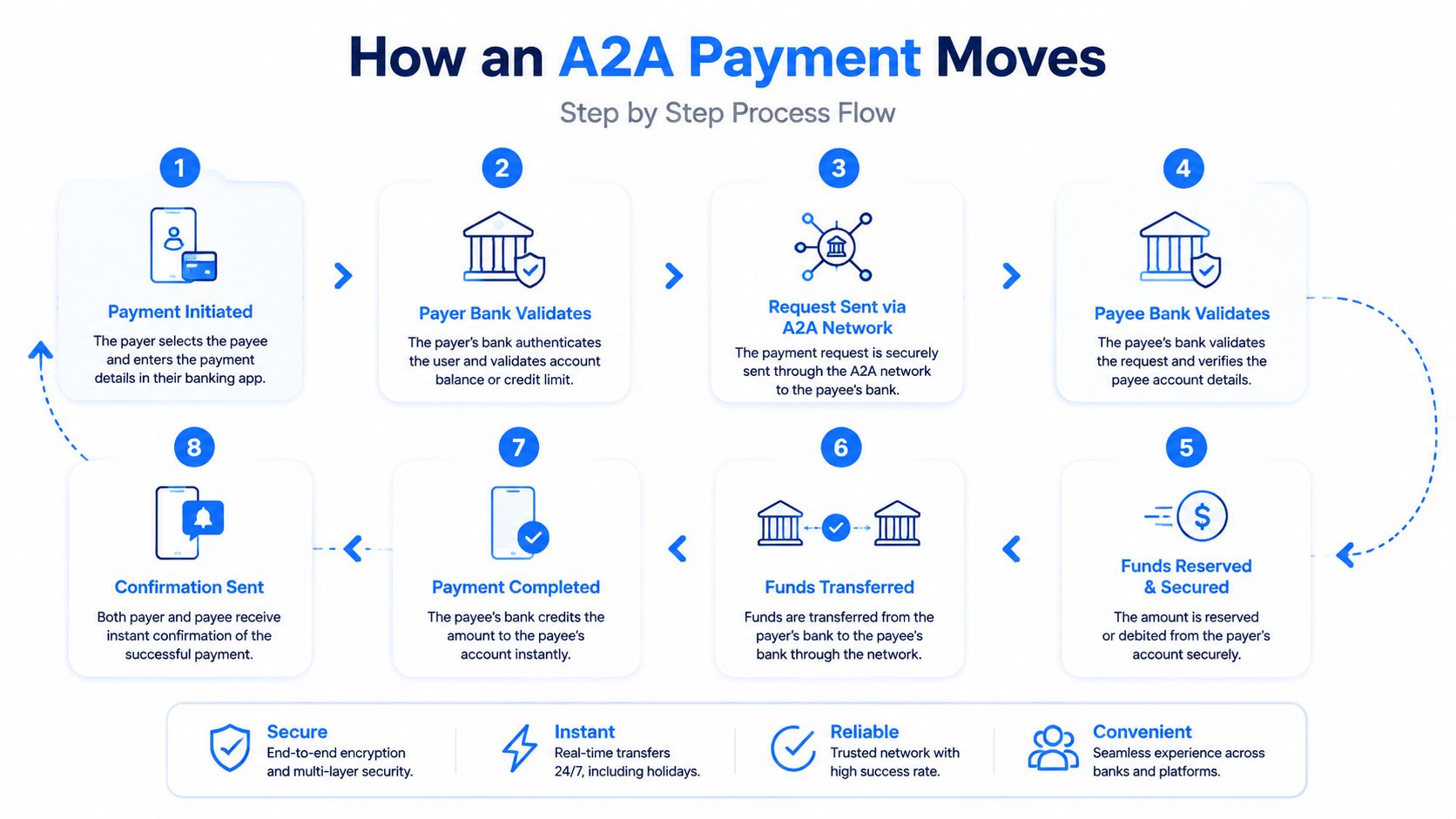
The customer journey
First, the shopper chooses a bank method. The checkout displays pay-by-bank, an open banking option, or a local instant payment method. The payment provider may show a bank-selection screen rather than asking the shopper to type account details into the merchant's website.
Next, the shopper is redirected to their bank. The bank holding the account is the ASPSP, or account-servicing payment service provider. In plain English, it is the bank or financial institution where the payer's account sits. The shopper authenticates with bank credentials, a biometric, or an approval inside the bank's app.
In Europe, that authentication can form part of strong customer authentication under PSD2. The important operational point is that the bank confirms the payer's instruction, not that a card network approves a card credential.
The shopper then approves either a one-time payment or, where supported, a mandate for future payments. Recurring permissions need clear limits, timing, and cancellation rules. A merchant that assumes a one-off approval automatically behaves like a card-on-file credential will create failed renewals and support problems.
The payment infrastructure
An open banking TPP, or third-party provider, may connect the merchant to multiple banks through an API aggregator. The TPP handles bank connectivity and consent flows. A processor or gateway then manages payment status, reporting, and reconciliation.
The instruction travels over the applicable rail. Depending on geography, that may include SEPA Instant, Faster Payments, RTP, FedNow, or another account-transfer network. SEPA Instant Credit Transfer was introduced in 2017, enabling participating European countries to move funds across borders within seconds (University of Venice research).
The merchant dashboard should translate that complexity into four usable states:
- Authorization: the bank or rail has accepted the payment instruction.
- Settlement: funds are available to the merchant or its payment provider.
- Refund: money is pushed back through the supported refund process.
- Statement entry: the provider supplies a reference that connects the bank movement to the order.
A payment showing "approved" before funds are final can create fulfillment risk. Engineering teams should store the full event history, not just a green checkout response.
A2A Versus Card Payments at a Glance
A2A and cards solve different merchant problems. Cards offer broad acceptance, familiar consumer protection, and mature recurring billing. A2A can offer direct bank movement, faster settlement on instant rails, and less reliance on card-scheme economics.
| Dimension | A2A, account-to-account | Card payments |
|---|---|---|
| Cost structure | Avoids card interchange and can have simpler provider pricing, but total cost depends on the rail and operational model | Includes issuing, network, acquiring, and processor economics |
| Settlement | Instant rails can make funds available quickly, while other bank rails may take longer | Often follows card clearing and merchant settlement schedules |
| Refunds | Usually a new push payment or provider-initiated refund, not a reversal of the original instruction | Mature refund APIs and established reversal workflows |
| Disputes | Protection varies by scheme and often lacks card-style chargebacks | Established chargeback rules and dispute processes |
| Data | May include bank, payer, and structured payment information, subject to rail and consent | Strong transaction data, but card credentials are tokenized or masked through the payment stack |
| Recurring billing | Depends on mandates, variable recurring-payment support, and customer consent | Mature card-on-file and merchant-initiated transaction patterns |
| Cross-border use | Fragmented across domestic schemes and currencies | Card credentials generally have wider international acceptance |
| Customer habit | Strong in markets with trusted bank rails, weaker where pay-by-bank is unfamiliar | Familiar to shoppers in most online markets |
The merchant trade-off is blunt. A2A can improve unit economics and cash visibility, but the shopper may lose card-like protections such as chargebacks, rewards, and familiar dispute handling. That protection gap can reduce conversion when customers don't recognize the bank-payment brand or worry that a mistaken transfer will be difficult to recover.
Industry research describes meaningful European A2A e-commerce transaction value and continued global growth (FIS). Separate research likewise describes A2A as an established share of European e-commerce transactions (SBS Software).
Cards remain the default for global, subscription-heavy, dispute-sensitive merchants. A2A is the sharper option where domestic instant rails exist, checkout friction is costly, and margins can't absorb unnecessary intermediary fees. Your card-on-file strategy still matters, especially when recurring revenue depends on silent renewals and recoverable failures.
Where A2A Is Already Working in 2026
A2A works when the payment rail matches an established customer habit. Assess three things before adding it: bank coverage in the target market, customer trust in that rail, and your ability to reconcile payments and handle refunds.
Europe is an established pay-by-bank market for checkout. SEPA Instant provides a shared euro-area foundation, while open banking sends shoppers through their own banks. Regulation reinforces that infrastructure. Regulation (EU) 2024/886 expands instant euro payment coverage and requires funds to be immediately available to recipients (Worldline).
The United Kingdom offers another practical model. Faster Payments and open banking support account top-ups, regulated payments, bill collection, and selected online checkout journeys. Open banking payment volumes and active connections continued to grow through 2025 (Open Banking Limited).
India's UPI and Brazil's Pix show the commercial value of domestic rails that consumers already use every day. The recommendation is straightforward: add A2A where it fits an existing payment habit, rather than presenting it as a fashionable alternative.
| Market | Primary rail | Consumer pay-by-bank maturity | Best fit today | Watch out for |
|---|---|---|---|---|
| Euro area | SEPA Instant and open banking | Established and expanding | Checkout, high-value orders, collections | Refund and dispute expectations |
| United Kingdom | Faster Payments and open banking | Strong | Top-ups, bills, selected checkout flows | Mandates and recurring consent |
| India | UPI | Mainstream consumer use | Everyday commerce and digital services | Scheme and product-specific rules |
| Brazil | Pix | Mainstream consumer use | Fast checkout and merchant settlement | Local operating requirements |
| United States | ACH, RTP, FedNow, open banking connections | Secondary for consumer checkout | B2B, payouts, account funding | Trust, pull-payment limitations, fragmented coverage |
The United States remains a targeted test market for consumer checkout. Awareness, perceived protection, and fragmented bank coverage limit adoption. Industry research still characterizes US pay-by-bank usage as a small share of consumer transactions (Intelevo Research). Test A2A on high-friction or high-value flows first. Keep cards as the default until conversion, settlement, and support data justify a broader rollout.
Where A2A Still Hurts Merchants and Shoppers
The most common A2A mistake is treating a successful first payment as proof that the payment method works for the whole customer lifecycle. It doesn't.
Subscriptions expose the difference quickly. A card can support a merchant-initiated transaction after the customer leaves checkout, subject to network, issuer, fraud, and mandate rules. Many A2A methods need fresh consent, a new redirect, or a customer-authorized mandate. If a renewal fails because the account has insufficient funds, the merchant may not be able to retry without customer involvement. Smart dunning becomes harder when every retry needs customer participation.
Refunds create a second operational gap. A card refund reverses money through a familiar scheme workflow. An A2A refund often requires the merchant or provider to push funds back, and the timing and eligibility depend on the rail. Customer service teams need a clear process for a shopper who says, "I paid, but I don't see the refund," because the original payment may not have a card-style reversal path.
Disputes are also less standardized. A customer complaint can move through a bank's own process rather than a Visa or Mastercard chargeback framework. That may reduce some friendly-fraud exposure, but it can also leave both parties with less predictable procedural protection.
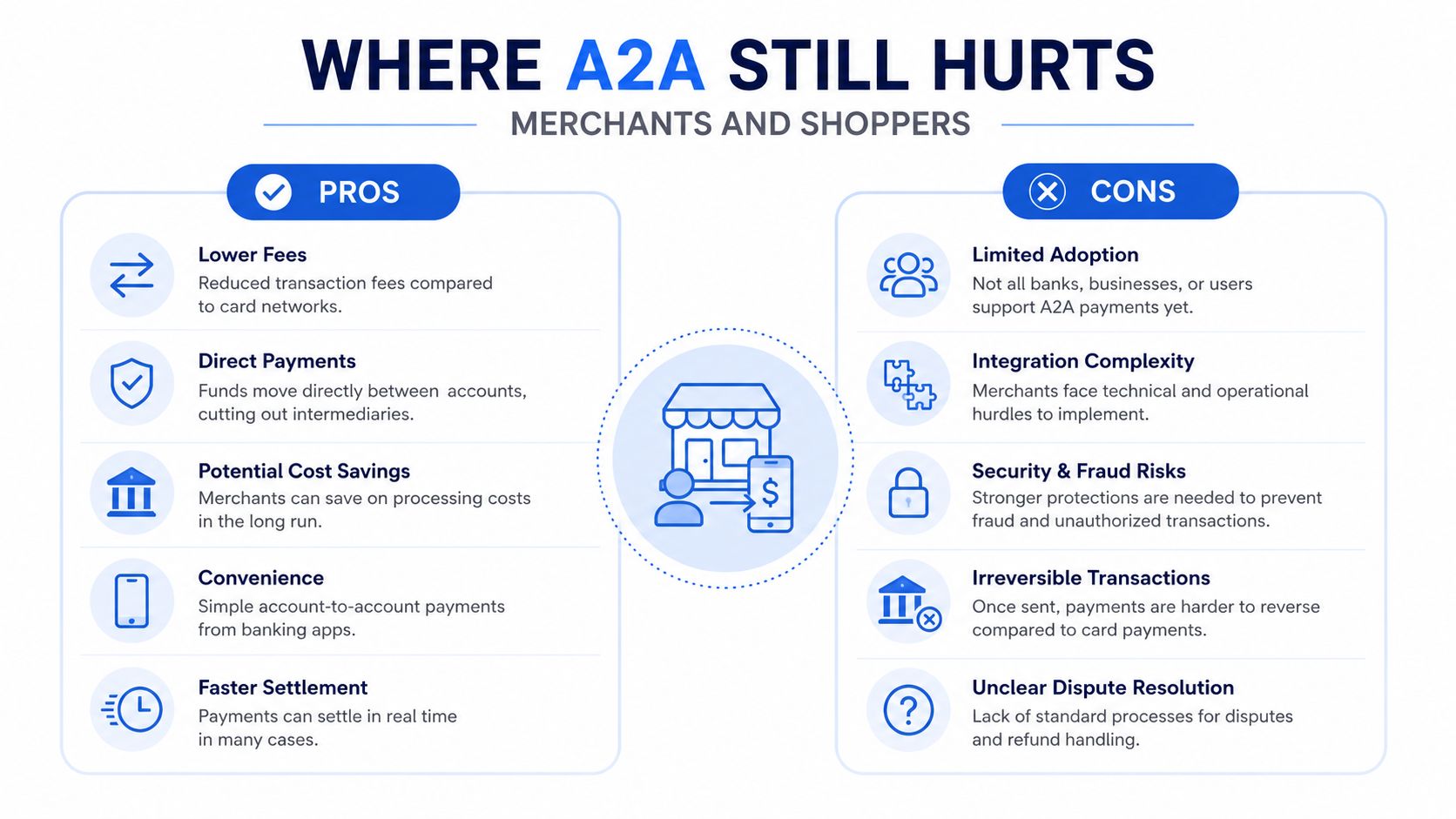
Cross-border checkout adds another fault line. A domestic bank rail doesn't automatically serve a buyer in another region, and the merchant may carry the currency-conversion and reconciliation burden. A Visa or Mastercard credential remains more portable across borders, even though cross-border card costs and issuer controls can hurt margins.
Merchant rule: Use A2A for the transaction types and markets where its local trust and rail coverage are strong. Don't force it onto recurring or cross-border journeys simply because the headline processing cost looks attractive.
Adding A2A Without Replacing Your Card Stack
A2A should sit inside checkout as another rail, not become a second product that engineering has to maintain independently. Cards can remain the default and fallback, while A2A becomes a routing option selected by country, device, basket size, customer preference, and risk signals.
That requires a shared control layer. The checkout should collect consent through the relevant bank flow, while the orchestration system tracks payment status and decides what happens when a redirect fails or a rail times out. The merchant shouldn't have separate order logic, separate reporting, and separate customer-service tooling for every payment method.
The architecture that avoids duplication
A practical design has four layers:
- Checkout layer: presents cards, wallets, and A2A without forcing the merchant to rebuild the purchase experience for each provider.
- Routing layer: chooses a payment path based on market coverage, transaction context, risk, and historical performance.
- Vault layer: stores tokenized payment methods or consent references through secure, provider-supported mechanisms. It should not store raw bank credentials in the merchant's systems.
- Ledger and event layer: unifies authorization, settlement, refund, failure, and reconciliation events across rails.
Bank consent IDs aren't the same as card tokens. They expire, have scope, and may limit the amount, merchant, or payment frequency. Engineering teams must model those permissions explicitly. A human should remain in the loop for sensitive agent-assisted payment flows, or the customer must delegate clear limits covering the amount, merchant, and purpose.
A processor concentration risk remains even after adding A2A if every route depends on one gateway. Keep Stripe as a processor if it serves your business well, but don't make Stripe your entire payment continuity strategy. A gateway-independent orchestration layer reduces the chance that one provider outage, policy change, or integration problem interrupts every payment path.
Payment orchestration software should therefore be judged on failure handling, reconciliation, portability, and observability, not only on how quickly it adds another payment button.
FloPay provides a unified checkout, payment orchestration, and secure vaulting layer for cards, Stripe, PayPal, wallets, and alternative payment methods, while its A2A work remains in exploration rather than client-ready deployment. That distinction matters. Merchants shouldn't buy a promise of instant A2A results from a product that hasn't launched the capability.
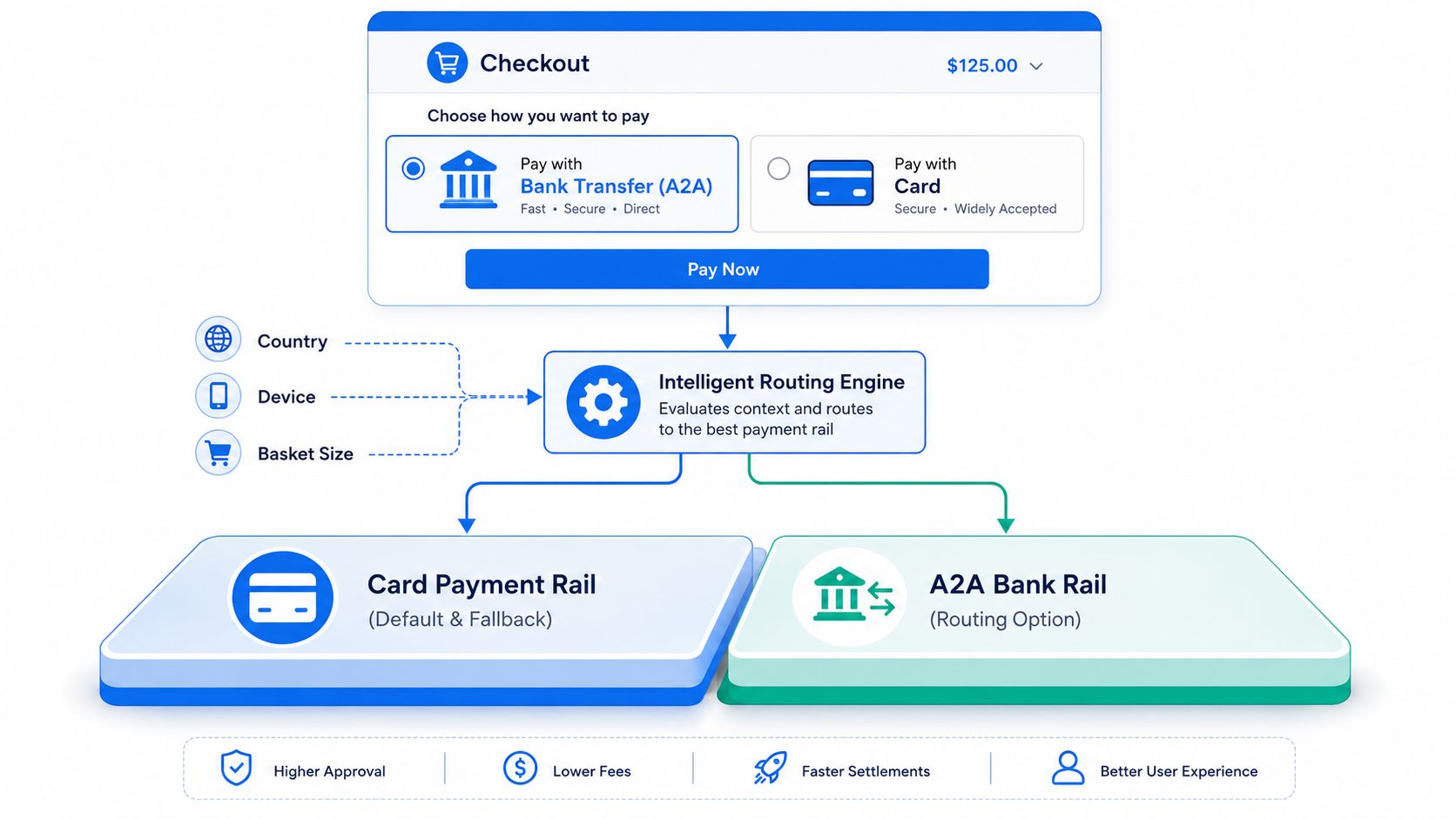
A useful payment stack also needs a clear fallback. If the bank selector doesn't load, the customer can't authenticate, or the instant rail doesn't confirm, the checkout can offer a card or wallet rather than producing an unexplained failure. That is how A2A improves resilience instead of creating a new single point of failure.
Watch how FloPay brings payment routes into one orchestration layer.
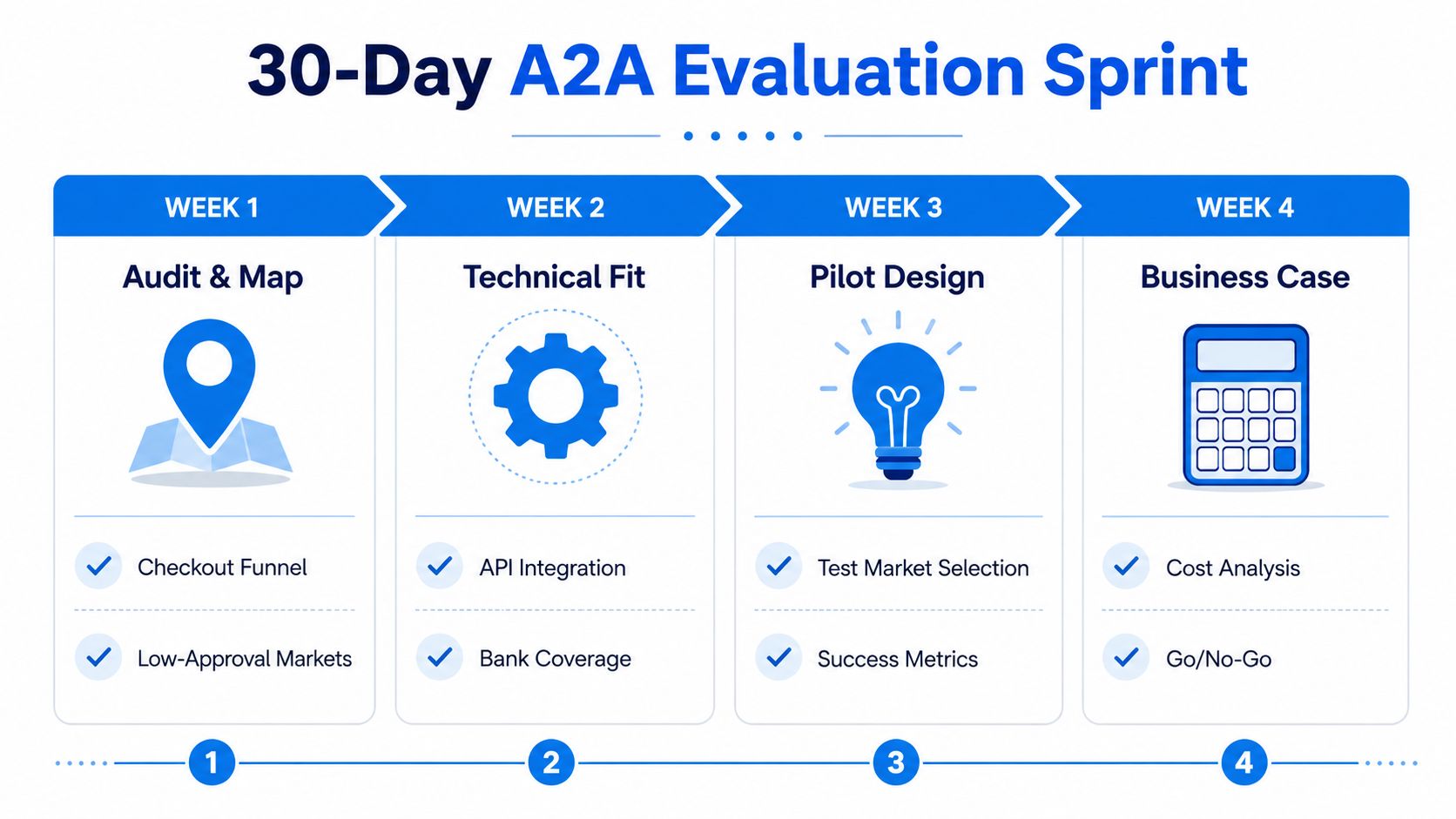
A 30-Day Checklist to Evaluate A2A for Your Business
Treat the evaluation as an operating sprint, not a strategy presentation. The first question is where your current card flow is expensive, unreliable, or unnecessarily difficult for customers.
Week one, find the commercial problem
Map checkout performance by market, payment method, device, and basket size. Identify where card authorization falls short, where cross-border fees reduce contribution margin, and where customers abandon after authentication. Review subscription renewals separately. A2A may solve a checkout problem while creating a rebilling problem.
Write down the target outcome before speaking to providers. That might be more successful payments, lower cost-to-serve, faster funds availability, or reduced dependence on one processor. Don't define success as "we launched A2A."
Week two, match rails to markets
Shortlist the domestic or regional rails that serve your customers. In Europe, examine SEPA Instant and open banking coverage. In the UK, assess Faster Payments connectivity. For other markets, investigate the applicable local rail, bank coverage, refund process, and merchant onboarding requirements.
Ask providers for written answers on:
- Bank coverage: Which customer banks and account types are supported?
- Settlement: When can the merchant fulfill the order?
- Refunds: Who initiates the refund, and what status events are exposed?
- Recurring consent: Can the merchant collect future payments, and under what limits?
- Reconciliation: Does each payment include an order-safe reference?
- Fallback: What happens when the bank redirect or rail fails?
Week three, test the existing integration
Use a sandbox through your current PSP or orchestration layer where possible. Don't fork a new checkout integration before proving the business case. Test successful payments, abandoned bank authentication, duplicate instructions, delayed confirmation, refund requests, and webhook gaps.
Week four, run a controlled pilot
Send a limited share of suitable traffic through the rail, preferably in a market with strong customer familiarity and a low operational risk profile. Measure approval, settlement timing, refunds, disputes, support contacts, reconciliation effort, and total cost.
Do not use invented targets to justify expansion. Set your own thresholds from your baseline, document them, and finish with a written go or no-go decision. The point of the month is a decision backed by payment and operations data, not a slide claiming that A2A is inevitable.
Key Takeaways and What to Do Next
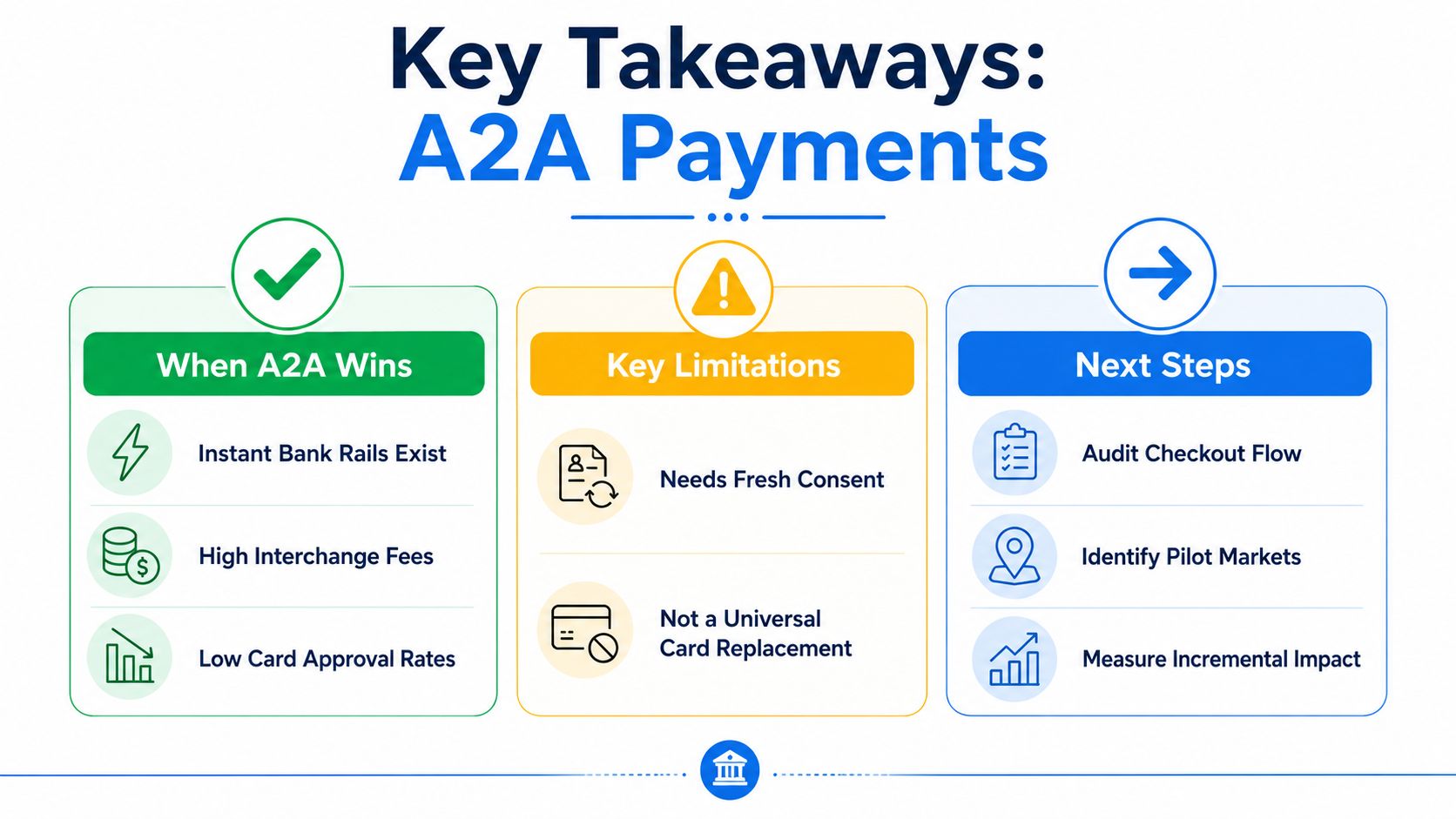
A2A is a real payment rail with commercial value, not a universal card replacement. It wins where instant bank rails are trusted, card costs are painful, or checkout authentication is losing completed orders. It underperforms when shoppers expect familiar dispute protection, subscriptions rely on silent rebills, or cross-border rail coverage is limited.
The market is already meaningful, but direct A2A adoption differs sharply by region and by measurement method. Industry analysis found direct A2A adoption in Europe and the UK became broader when account-funded wallets and buy-now-pay-later were included (Datos Insights). The practical point is clear: A2A can already sit inside broader payment behavior even when direct pay-by-bank volume appears modest.
Global forecasts also point to expansion (FIS). Treat that as a market signal, not a checkout business case. Your decision rests on customer trust, rail coverage, refund handling, reconciliation, and unit economics.
The decision framework
Use A2A as a routing option inside a payment stack that can keep operating when one provider or rail fails:
- Europe-facing merchant: Prioritize SEPA Instant and open banking where card authentication creates measurable checkout friction.
- UK merchant: Evaluate Faster Payments and open banking for top-ups, bills, and selected checkout journeys.
- US consumer merchant: Pilot a specific use case. Do not rebuild checkout around a payment habit customers may not yet seek out.
- Subscription business: Keep cards and card-on-file capabilities central until recurring consent, retries, refunds, and support meet your operating standard.
- Multi-provider merchant: Use one orchestration and ledger layer so cards, wallets, and bank rails share reporting, fallback rules, and operational controls.
FloPay's orchestration and Flo Vault model combines checkout, provider routing, and a processor-neutral, PCI-compliant card-on-file layer. That structure can reduce gateway dependency while leaving room to add new payment routes, without claiming that FloPay's A2A capability is already available for client onboarding.
Start with one market and one payment problem. Measure incremental conversion, cost, settlement effort, refunds, support contacts, and reconciliation. Document the operating process, then make a written go or no-go decision before expanding the rail.
If you are assessing A2A, audit checkout performance by market, identify where cards create measurable cost or friction, and test the relevant bank rail without building a second payment stack. FloPay provides unified checkout, payment orchestration, and secure vaulting across supported providers, so you can evaluate new payment routes while protecting resilience and recurring revenue. Talk to FloPay about reviewing the payment flow before committing engineering time to a full A2A rollout.