What Is a Credit Card Vault and Why It Matters
What is a credit card vault? Learn how token vaults protect PAN data, reduce PCI scope and keep saved payments portable.
A credit card vault, also called a token vault, is a PCI-controlled environment that stores the primary account number, or PAN, and replaces it with tokens so business systems don't handle raw card data. Detokenization, the controlled process of mapping a token back to the PAN, happens only inside the vault.
A subscription business can discover the practical meaning of that architecture on an ordinary billing day. A customer paid successfully at checkout, so the merchant saved the payment method inside its processor and scheduled future rebills. Later, a retry returns transaction_not_allowed. The customer hasn't necessarily canceled, but the rebill fails, support gets involved, and recurring revenue is put at risk.
That problem becomes harder when saved cards exist only inside one gateway. A processor outage, account restriction, pricing change, geographic expansion, or routing decision can turn a payment issue into a continuity issue. The question behind “what is a credit card vault” is often really this: how do we keep saved payment methods usable when our processor strategy changes?
Table of Contents
- Introduction Why Saved Cards Create Hidden Risk
- What a Credit Card Vault Actually Is
- How Tokenization and Vaulting Reduce PCI Scope
- Types of Vaults and Tokens You Will Encounter
- Why Vault Architecture Affects Revenue and Resilience
- How to Evaluate Portability and Recovery Before You Commit
- Next Steps for a Processor Neutral Card on File Strategy
Introduction Why Saved Cards Create Hidden Risk
A gateway-native vault is convenient. Your checkout collects the card, the processor tokenizes it, and your billing system stores a reference that can be used for later charges. For a young business using one processor, that may be a sensible starting point.
The risk appears when the stored reference works only inside that processor's ecosystem. If a merchant keeps all recurring payment methods with Stripe, Stripe remains a strong processor, but the merchant also carries processor concentration risk. A fallback gateway may be available, yet the saved cards can't necessarily follow the customer to it. The technical dependency becomes a revenue dependency.
Practical rule: Keep Stripe as a processor. Don't make Stripe your entire payment continuity strategy.
This matters most for subscription companies, SaaS businesses, digital product merchants, marketplaces, and any operation where a customer has already consented to future billing. Requiring customers to re-enter details during a processor change can create avoidable friction. It also weakens the value of payment orchestration, because routing is only flexible when the payment method can be presented to the selected provider.
A processor-neutral card-on-file layer changes that design. The vault stores the sensitive mapping, while checkout, reporting, billing, and routing systems work with tokens. That can keep raw card data out of merchant systems, reduce exposure, and support payment resilience across supported providers. It doesn't guarantee approval or remove every payment failure, because issuers, fraud controls, card status, and customer behavior still determine outcomes.
By the end, you'll be able to explain the vault to engineering and finance, distinguish PCI scope reduction from PCI elimination, compare gateway tokens with network tokens, and audit whether your saved payment methods are portable enough for fallback, recovery, and future agent-assisted commerce.
What a Credit Card Vault Actually Is
Start with the card number. PAN means primary account number, the full number printed on a payment card. It is sensitive cardholder data, so placing it in application databases, logs, analytics tools, or internal services creates security and compliance exposure.
Tokenization changes what other systems see. The vault receives the PAN through a controlled capture flow, stores the PAN in its protected environment, and returns a token. The token is a reference used by merchant systems, not a replacement card number that those systems can decode themselves. A vault stores the mapping between the PAN and token, and only the vault can detokenize it, as described in this plain-English explanation of token vaults.
A simplified payment flow looks like this:
- Capture: The customer enters card details through a hosted form, embedded checkout, or other controlled collection method.
- Tokenize: The vault creates a token and retains the PAN inside the protected cardholder data environment.
- Operate: Checkout, billing, reporting, and customer records store and pass the token.
- Charge: A payment service uses the token through the vault's authorized detokenization process.
- Protect: Merchant applications never need to receive the raw PAN for ordinary recurring operations.
The hotel safe analogy is useful, with one important qualification. Your business can keep the safe's booking reference, but it can't open the safe just because it has that reference. The vault controls the mapping, access policy, keys, and detokenization path.
What the vault includes
A vault isn't merely a database with encrypted fields. Its design includes PAN storage, token generation, access controls, key management, API boundaries, and detokenization controls. Those components determine who can use a token, for which merchant, through which provider, and under what operational conditions.
That distinction is why a vault can support recurring billing without turning your application into a card-data store. Your subscription service can say, “charge payment method token X,” while the vault handles the sensitive translation. A finance report can reference a saved payment method without exposing the card number.
A concise explanation for your team is: a credit card vault stores the PAN-to-token mapping in a controlled environment, so business systems can use tokens and the vault alone can recover the PAN when an authorized payment requires it. A processor-neutral implementation, such as Flo Vault, adds a further design question, whether the saved payment method can support more than one provider over time.
How Tokenization and Vaulting Reduce PCI Scope
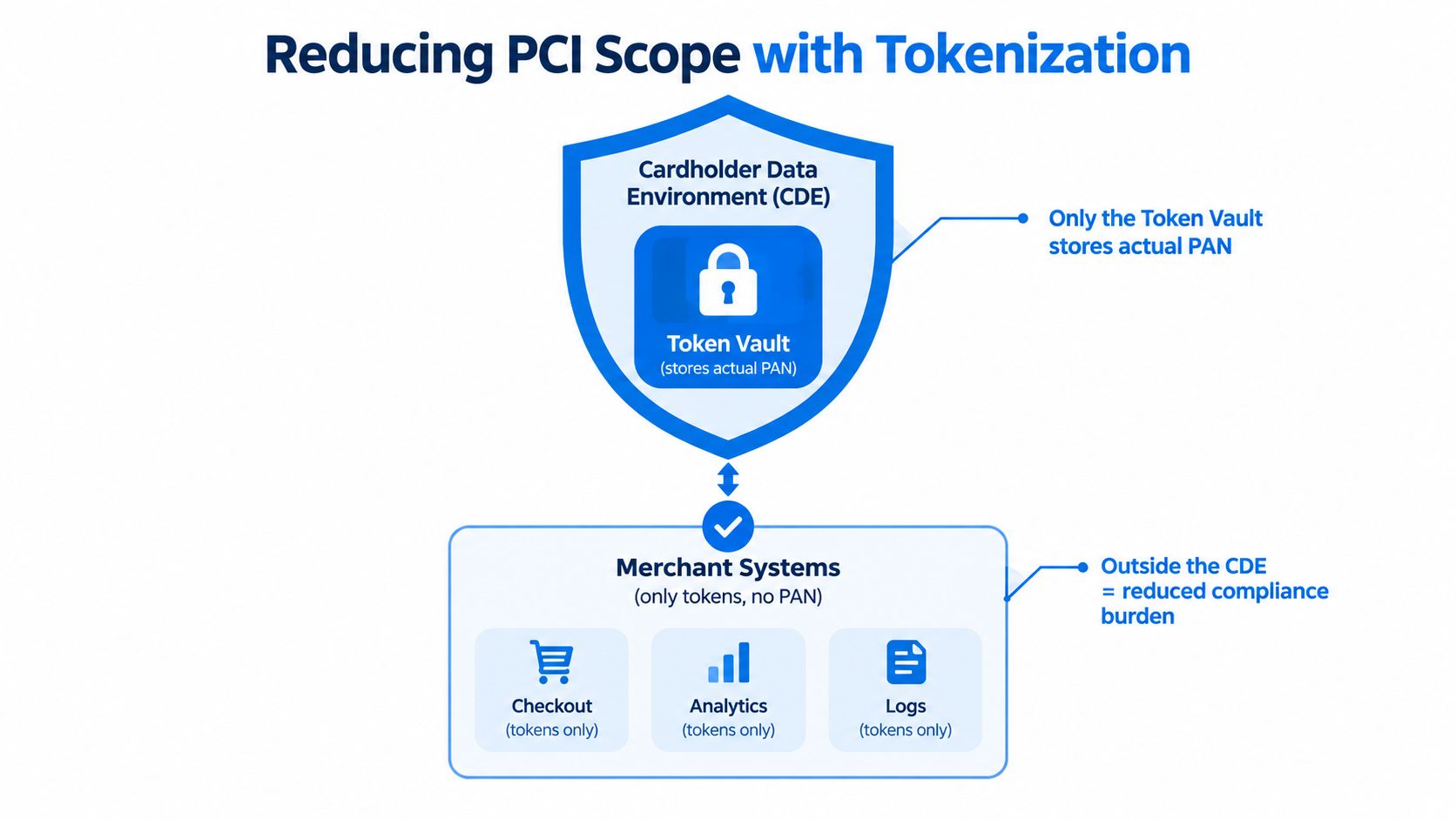
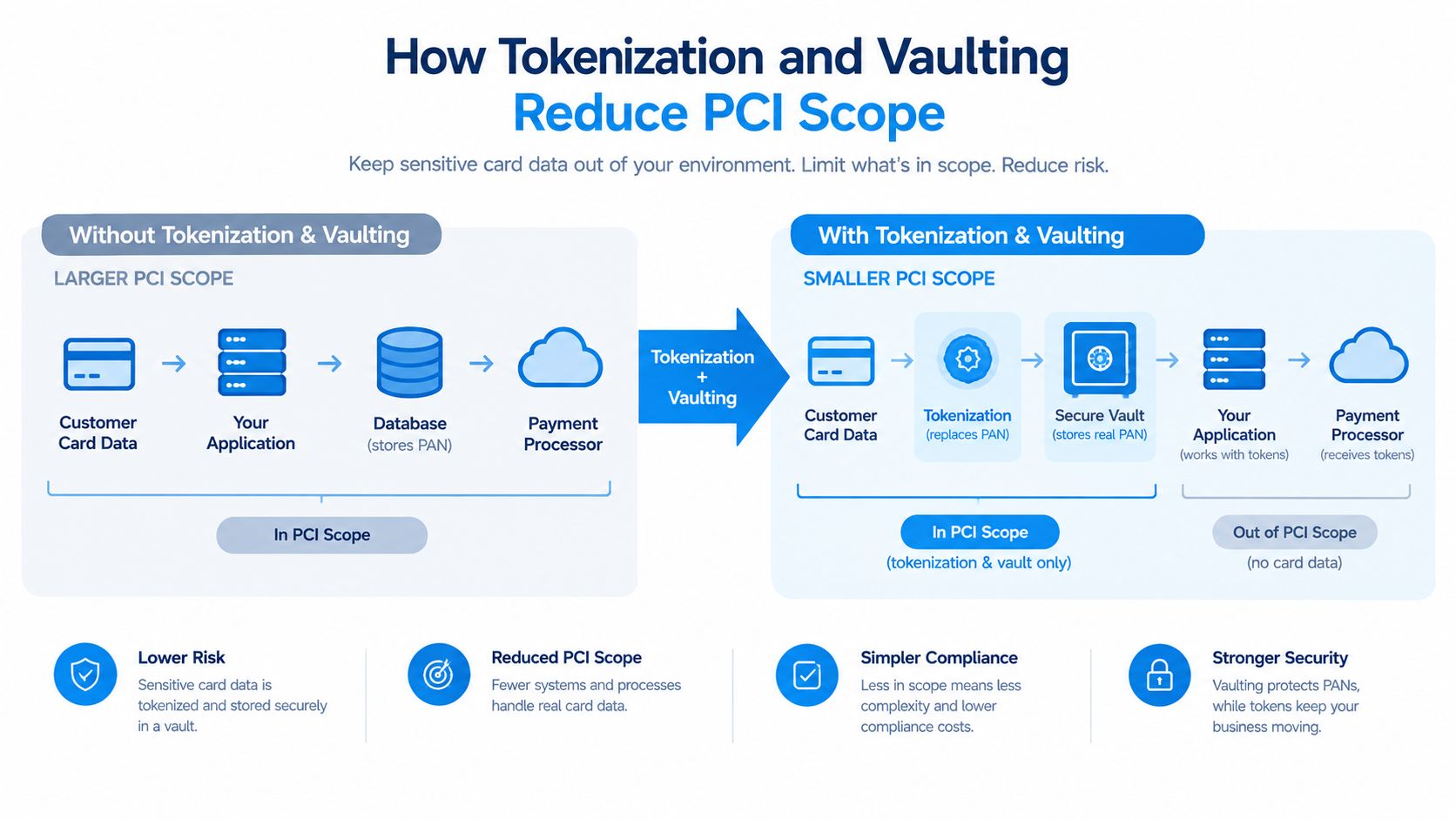
Tokenization reduces the number of systems that handle the PAN. Checkout, application services, logs, analytics, and billing workflows can operate on tokens instead of raw card credentials. That isolation can reduce PCI DSS scope, because fewer merchant systems sit directly in the path of sensitive card data.
The wording matters. A vault doesn't eliminate PCI DSS obligations. PCI Security Standards Council guidance treats the card data vault, PAN storage, tokenization components, and detokenization functions as part of the cardholder data environment. Those components still require appropriate security controls, monitoring, access governance, and documentation, as set out in the PCI tokenization guidance.
A third-party vault can move much of that concentrated burden away from the merchant's own infrastructure, but it doesn't make compliance irrelevant. The merchant still needs to understand its integration, accountabilities, provider responsibilities, and the systems that can access or influence payment flows.
Encryption isn't the same as tokenization
Encryption protects data by transforming it with a cryptographic method. If your systems store encrypted PANs and retain the ability to decrypt them, those systems can remain in PCI scope. Encryption alone doesn't turn card data into a non-sensitive reference.
Scope reduction requires a broader control design. PCI guidance distinguishes tokenization, truncation, and strong cryptography with proper key management, so a merchant should evaluate the complete architecture rather than label an encrypted database a vault. This comparison of encryption and tokenization under PCI DSS explains why the distinction affects compliance decisions.
A useful division of responsibility looks like this:
- The vault: Stores the PAN, manages token creation, controls detokenization, and protects the sensitive environment.
- Merchant applications: Store tokens and payment metadata needed for billing, customer service, and reporting.
- Payment teams: Define provider access, routing rules, recovery processes, and operational ownership.
- Compliance teams: Document the boundaries, controls, provider obligations, and residual scope.
The accurate commercial takeaway
The value isn't “PCI-free payments.” The defensible claim is narrower and more useful: vaulting concentrates card-data obligations in a controlled environment and keeps raw card data out of more merchant systems. That can lower operational exposure and simplify the systems that engineers and auditors need to assess.
For recurring commerce, this is closely related to the wider card-on-file payment model. The card-on-file experience needs a secure place for saved payment methods, but the business also needs to know whether those methods remain usable when routing, recovery, or processor relationships change.
Types of Vaults and Tokens You Will Encounter
A saved card can produce several token types, and each one controls a different part of the payment flow. A PCI or vault token may protect the PAN while remaining tied to one provider. A network token may support recurring approval through card-network connections. A gateway-scoped token may be quick to deploy but difficult to use elsewhere. Treating these options as interchangeable creates portability risk.
PCI or vault tokens are references generated by a tokenization system so merchant applications do not store PANs. Their commercial value depends on the vault's APIs, processor connections, export model, and detokenization controls. The token can be safe for application storage yet unusable outside the provider that created it, which can limit processor fallback or make a migration harder.
Network tokens are issued by card networks and can carry merchant and device context. That context may help issuers distinguish legitimate recurring payments from unfamiliar transactions. PCI tokenization remains the most common scope-reduction method used by 74% of organizations, according to industry observations discussed in the 2025 PCI Security Standards Council meeting insights. Network tokens therefore complement ordinary PCI tokenization rather than replace it.
| Token Type | Where It Works | Portability | Best For |
|---|---|---|---|
| PCI vault token | Inside the vault and its supported payment integrations | Depends on the vault's processor support and export model | Keeping PANs out of merchant systems |
| Network token | Through enabled network-token payment connections | Usually tied to defined merchant, network, and provider relationships | Recurring payments and credential lifecycle support |
| Gateway-scoped token | Inside the issuing gateway or processor ecosystem | Usually limited to that gateway's environment | Fast implementation with one processor |
| Processor-neutral vault token | Across supported providers through the vault's APIs | Designed for broader routing flexibility, subject to integration support | Multi-provider readiness and fallback |
Portability is a design property
A token represents a card, but that does not make it universally reusable. The receiving processor must accept the token type, the vault must support the required connection, and detokenization must be authorized under defined conditions. A migration may also require secure export, token mapping, validation, and documentation.
For a head of payments, the practical question is: can this saved payment method follow the customer if we change processor, add a regional gateway, or route a retry elsewhere? Engineering teams need the corresponding details, including API contracts, token lifecycle events, network-token enablement, and the boundary between business logic and payment data.
Network tokens and vault tokens can coexist. A well-designed vault remains the control point for payment-method lifecycle while enabling network-token capabilities where they fit. The token choice then supports more than PCI scope reduction. It also determines how readily the business can change providers, recover recurring payments, and preserve billing continuity.
Why Vault Architecture Affects Revenue and Resilience
A customer's first payment may succeed, yet the next recurring charge can fail because the stored credential, token type, provider route, or issuer context changed. The vault therefore affects more than PCI scope. It determines which payment method a retry can use, which processor can receive it, and how much useful context accompanies the credential. Token design becomes a commercial decision once a business depends on recurring billing.
Consider a prepaid card. It may approve the initial checkout while the balance covers that purchase, then fail during a later rebill because funds are unavailable. Repeating the same request through the same gateway does not change that condition. Recovery needs a clear failure signal, a suitable retry policy, customer communication, and, where appropriate, another saved method or a payment-method update.
The same principle applies to transaction_not_allowed. The response can mean that the issuer or payment context does not permit the transaction. A vault-backed architecture gives the merchant more control over which credential, token type, or provider enters the recovery path, while the issuer still makes the approval decision.
Network context and recurring approval
Network tokens issued by card networks can carry merchant and device context that helps distinguish legitimate recurring activity from an unfamiliar or higher-risk transaction. That context may help issuers approve valid rebills more often than merchant-generated vault tokens, as discussed in industry coverage of evolving payment security. Token lifecycle and network-token enablement therefore belong in the revenue plan, not only the security backlog.
For high-scale recurring billing, the vault can serve as the control point for token lifecycle, detokenization, and network-token enablement. Building those capabilities internally typically involves bringing the tokenization system into PCI DSS scope, establishing direct Visa and Mastercard network-token connections, maintaining vault APIs, and handling ongoing key-management engineering, as described in this technical guide to credit card vaults. The merchant's payment brands or acquirer determine the required PCI DSS validation and reporting method, as explained in PCI SSC guidance on validation and reporting.
The wider market direction also shows why this infrastructure matters. One forecast estimates that the global payment data tokenization market will grow from USD 3.1 billion in 2025 to USD 4.1 billion in 2026 and USD 15.2 billion by 2034, with a projected 17.6% compound annual growth rate. It also lists network tokenization among the most common implementations. These figures are estimates, not guarantees for an individual merchant, but they indicate why token vaults increasingly support recurring billing and card-on-file commerce. The forecast is presented in payment data tokenization market projections.
The resilience layer
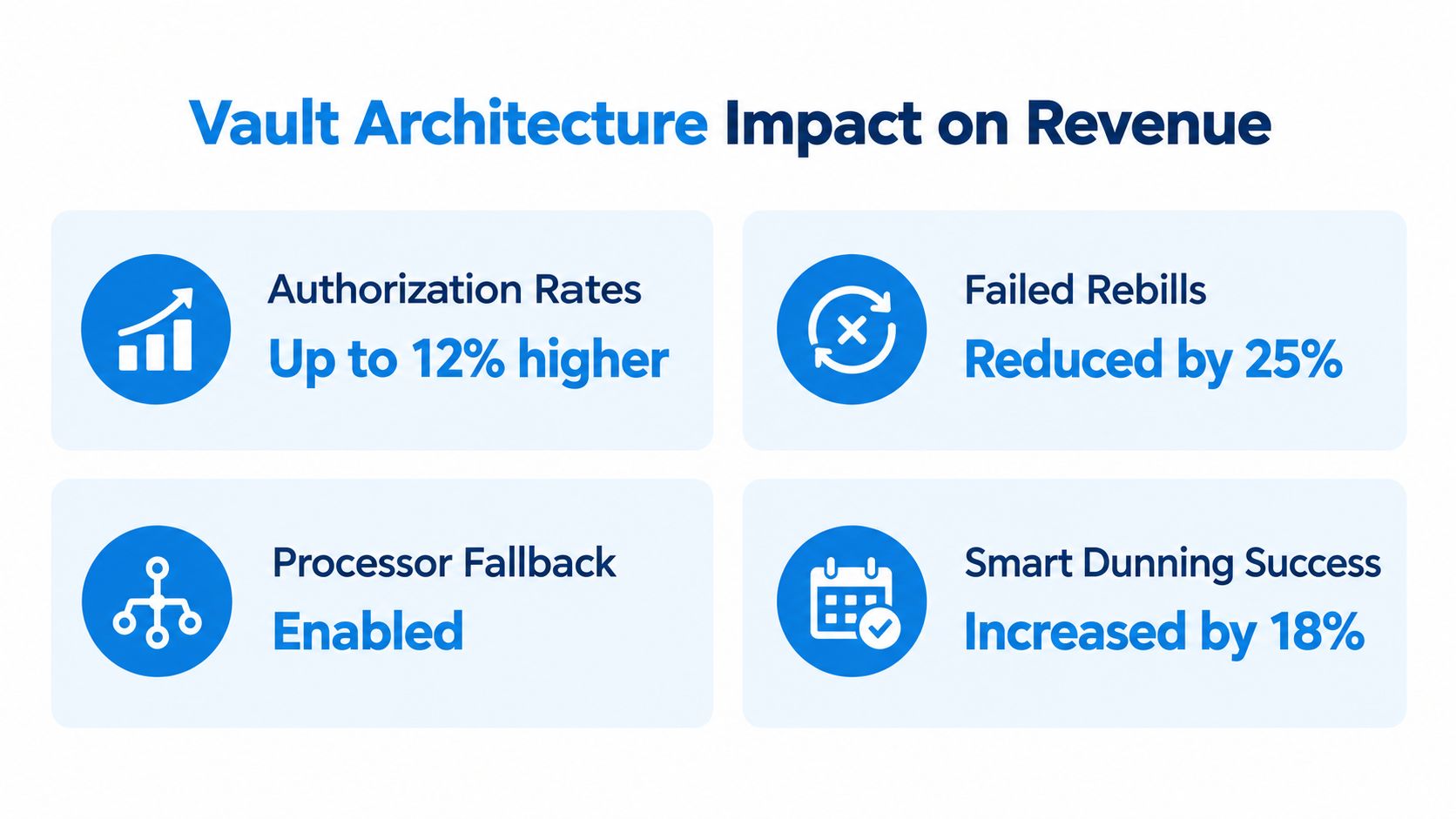
A saved payment method creates more resilience when it is not trapped inside one gateway. A merchant can keep Stripe in its stack while building fallback, recovery, and routing around a processor-neutral card-on-file layer. This is the practical connection between payment orchestration software and vault architecture.
Smart dunning also requires more than sending retries. Teams must distinguish temporary failures from cases requiring customer action, determine whether another provider is appropriate, and confirm that the stored credential remains usable. A portable vault does not make those decisions automatically. It gives the payment team the control surface to configure recovery, support processor fallback, and protect recurring revenue when one route fails.
How to Evaluate Portability and Recovery Before You Commit
A processor change can expose vault decisions at the worst possible moment. If saved payment methods are tied to one provider, a fallback plan may require customer re-entry, delay regional expansion, and interrupt subscription billing. Evaluate portability before an outage or commercial change turns it into a revenue problem.
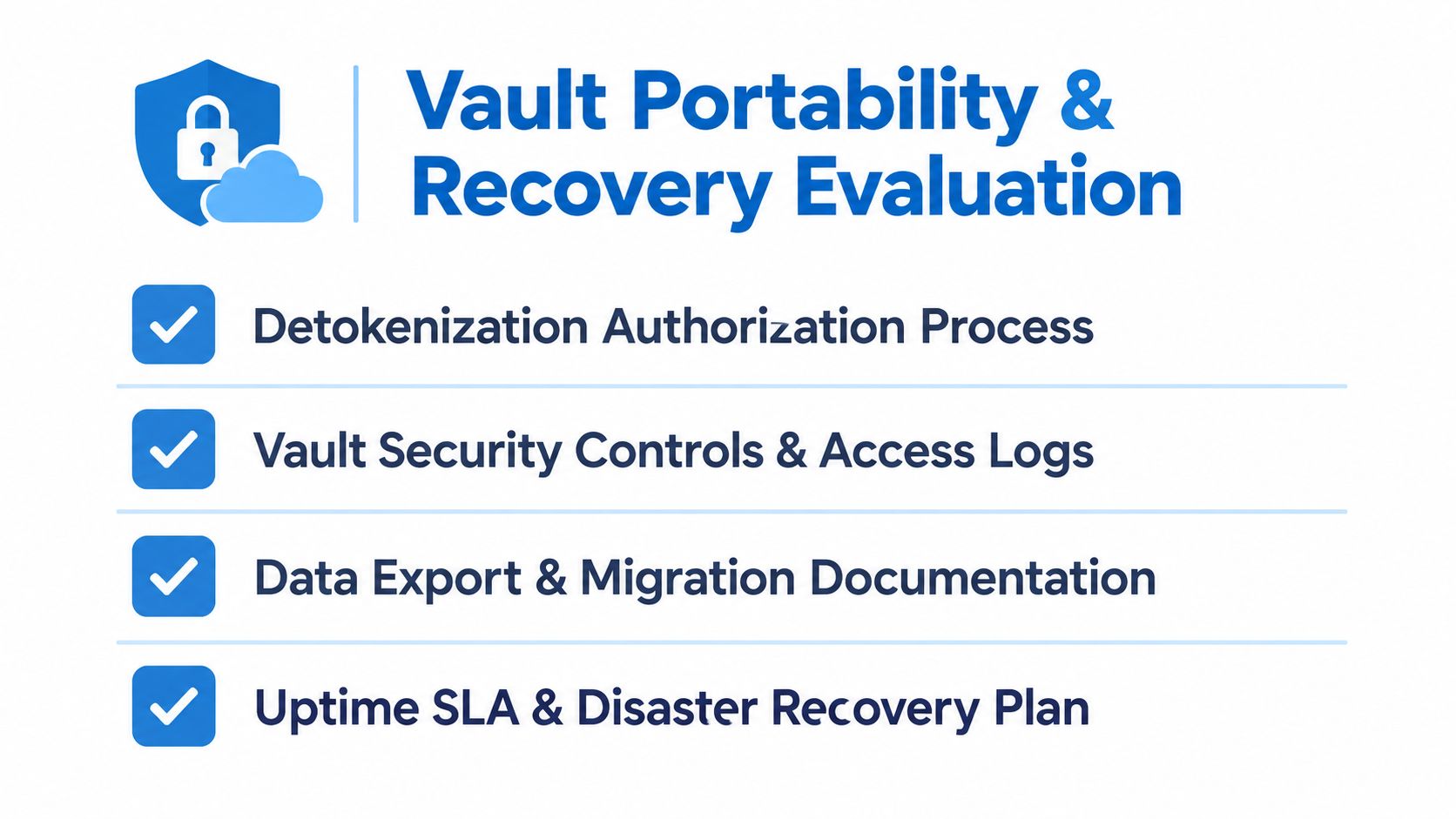
Start with detokenization. Ask who may request it, which systems are approved, how requests are authenticated, where access is logged, and how use is restricted by merchant, transaction type, and provider. PCI DSS applies to the cardholder data environment, including the tokenization system. PCI SSC's separate tokenization guidance covers token generation, vault security, and authenticated detokenization operations. A provider should explain these controls in operational terms. Guidance on payment token standards and migration risk also shows why recovery and migration require deliberate design.
A practical evaluation checklist
- Confirm portability: Verify that tokens work with every intended processor, not only the current gateway. Token portability determines whether fallback can preserve recurring revenue.
- Document migration: Record export formats, secure transfer procedures, token mapping, validation steps, and ownership of the migration runbook.
- Test recovery: Define how billing proceeds during a vault outage, processor outage, failed webhook, or provider change.
- Inspect access controls: Review permissions, audit logs, key management, environment separation, and approval paths for detokenization.
- Separate payment data from business logic: Check whether APIs let engineering work with tokens and payment events without placing sensitive data inside application services.
- Review bulk operations: Server-side vault APIs may support bulk tokenization of card data and custom values. That can simplify large migrations and separate payment data from business workflows, as described in the vault API guidance.
- Assess in-house cost: Account for operating the vault within the PCI DSS-scoped cardholder data environment, the validation and reporting method required by your payment brands or acquirer, network-token connections with Visa and Mastercard, API maintenance, and key-management operations.
Ask for proof, not assurances
Request a test environment and trace the full payment-method lifecycle. Tokenize a payment method, use it for an initial transaction, schedule a recurring charge, trigger a failed-payment path, and verify what the team can export or recover. Confirm that business systems can distinguish token status, expiry metadata, provider response, and customer-action requirements without receiving the PAN.
Recovery also includes the customer experience and internal response. If the processor changes, can billing continue without re-entry? If the vault is unavailable, what does checkout display? If detokenization is denied, which team receives the event, and how does smart dunning respond?
The strongest evidence is a controlled exercise with documented results, not a feature sheet.
Before signing, ask one uncomfortable question: “What exactly happens to our saved payment methods if we leave?”
Next Steps for a Processor Neutral Card on File Strategy
A credit card vault is not valuable merely because it hides card numbers. Its strategic value comes from the relationship between token type, portability, detokenization control, and payment recovery. Those choices affect whether a merchant can route intelligently, protect recurring revenue, and respond to processor disruption without rebuilding its customer relationship.
FloPay provides Flo Vault, an independent PCI-compliant card-on-file layer designed to keep saved payment methods portable across supported providers. That lets a merchant keep Stripe as a processor while preparing for fallback, multi-provider routing, and more resilient recurring billing. The same foundation can support secure delegated payment flows as agent-assisted commerce and machine-to-machine payments develop.
Start with an audit, not a migration project. Find out where saved cards live, which token type your systems use, whether detokenization is controlled, and whether a payment method can follow the customer to another supported provider. If the answer is unclear, you have a payment resilience gap worth addressing before the next outage, decline pattern, or processor change exposes it.
FloPay helps merchants connect checkout, payment orchestration, and secure vault-backed saved payment methods through a unified integration. Visit FloPay to explore a processor-neutral approach to recurring revenue resilience and payment control.