What Is Credit Hold
What is credit hold. Learn what a credit hold is, why PSPs impose one, and the practical steps merchants can take to resolve it and protect recurring revenue.

A credit hold is a temporary restriction a creditor or payment processor places on new transactions, orders, or charges when a customer or account carries high risk. For merchants, it usually means subscriptions stop renewing until the issue is resolved.
A founder discovers this the hard way on a Monday morning. Her dashboard shows a banner saying the Stripe account is restricted. Subscription renewals are queueing without clearing, customers are opening support tickets, and the team can't tell whether the problem is a failed card, a processor decision, or both.
Within the first hour, operations checks the billing queue, engineering reviews webhook events, and finance searches for an email from the risk team. The account manager's phone goes to voicemail. Then comes the more serious discovery: the saved card data sits inside the processor's vault, so moving future renewals to another provider isn't a simple routing change.
That is what makes a credit hold dangerous. The restriction may be temporary, but the commercial consequences start immediately. Customers lose access, recurring revenue becomes uncertain, and a payments team that has never rehearsed failover has to improvise while the primary provider investigates.
Table of Contents
- The Moment a Credit Hold Hits
- What a Credit Hold Actually Means
- Why PSPs and Creditors Trigger a Hold
- The Hidden Multiplier Inside Every Hold
- Credit Holds in Real Merchant Workflows
- How to Resolve a Credit Hold Quickly
- Preventing the Next Credit Hold
- Takeaways and Next Steps
The Moment a Credit Hold Hits
The first ninety minutes usually produce more confusion than action. The merchant sees failed rebills, but the customer may see only a generic decline. Support assumes the issue is isolated. Finance sees unpaid invoices. Engineering sees retries and webhook events. Nobody has the full picture yet.
A PSP, or payment service provider, can restrict further processing after identifying higher risk in the account. That risk might relate to disputes, refunds, account activity, or underwriting information. A trade creditor can apply a similar control when a buyer pays late, exceeds an approved limit, or becomes a poor credit risk.
For a subscription company, the practical effect is immediate:
- Renewals may stop: scheduled charges don't complete while the account is restricted.
- Retries may stall: dunning logic can't recover a payment if the provider won't accept new attempts.
- Fulfillment becomes uncertain: a business may not know whether to ship, suspend access, or wait for payment confirmation.
- Support volume rises: customers experience the service problem before the merchant has a clear explanation.
Operator's rule: Treat the first hold notification as an incident, not an administrative message.
The founder's next decision matters. She can spend the morning trying the same processor repeatedly, or she can separate the urgent continuity problem from the underlying risk investigation. The first task is to preserve legitimate payment flows where possible. The second is to identify and fix the condition that caused the restriction.
A credit hold doesn't automatically mean the account is permanently closed. It means the provider or creditor has placed a gate in front of additional exposure. The exact gate depends on the system and the commercial relationship.
What a Credit Hold Actually Means
A credit hold places a gate in front of new commercial exposure. It can block transactions, sales orders, shipments, services, invoices, payouts, or charges for a customer or merchant account. Oracle's receivables workflows show the distinction clearly: a hold can prevent new sales orders while existing receivables transactions continue to post. It controls additional exposure, rather than freezing the entire account. Oracle's receivables documentation
The term covers two connected situations:
- Trade credit and accounts receivable: a supplier stops accepting orders or shipments from a buyer with overdue balances, breached terms, or weakening creditworthiness.
- Payment processing: a PSP restricts new charges, payouts, or other payment activity after its risk systems identify concerns at the account level. The restriction may follow the mechanics described in our overview of ecommerce payment processing, but the exact controls depend on the provider.
A hold usually signals a temporary control, not a closed account. The provider or creditor may be investigating activity, reducing exposure, collecting overdue amounts, or completing a new risk review. Account closure ends the commercial relationship or processing access. A hold limits what the account can do while that review continues.
Do not confuse it with a card authorization hold. A hotel or fuel station places an authorization hold against a customer's available funds or credit for one transaction. A merchant credit hold affects the account's ability to create or process more business.
The trigger can sit on either side of the transaction
For a buyer, overdue invoices, credit-limit use, repeated late payment, or a changed credit assessment can trigger the restriction. For a merchant using a PSP, disputes, refunds, fraud signals, compliance reviews, or a reserve decision can produce the same operational result.
The label matters less than the control points. Confirm whether the hold blocks new shipments, recurring invoices, subscription retries, partial releases, or charges routed through another provider. A subscription retry may fail even when the customer's card remains valid. Vault portability also matters. If payment credentials cannot move to an approved PSP, changing the routing rule will not restore billing.
Sage Intacct, for example, can pause recurring invoices when a customer is placed on hold. It may later catch up missed postings in open periods, while transactions tied to closed periods can fail instead of posting automatically. Sage Intacct's customer credit documentation shows how a hold can disrupt billing operations, not only collections.
Treat the hold as a workflow restriction whose scope must be confirmed before you retry, ship, or suspend service.
Why PSPs and Creditors Trigger a Hold
Risk teams don't place holds because a payment failed once. They act when the account's pattern suggests that continuing to approve new exposure could create losses, regulatory problems, or operational disputes.
On the PSP side, common signals include:
- Chargeback activity: customers dispute transactions, and the provider sees growing exposure.
- Refund behavior: refunds rise sharply or don't match the merchant's stated business model.
- Business-model mismatch: actual transactions differ from the activity described during onboarding.
- Fraud and compliance indicators: account activity creates concerns that require review.
- Reserve or underwriting review: the provider reassesses whether it needs additional protection against future disputes and refunds.
A creditor evaluates the buyer from a different angle. It may focus on invoices past agreed terms, credit-limit breaches, repeated partial payments, changes in billing information, or adverse information from credit sources. The common logic is simple: new orders increase exposure while existing obligations remain unresolved.
Don't use invented thresholds as an early-warning system
Teams often search for a universal chargeback percentage that guarantees a hold. That number doesn't exist for every PSP, product category, geography, or risk profile. Thresholds can be set by the provider or banking partner, and internal risk rules aren't necessarily public.
A better monitoring table looks like this:
| Trigger | Typical threshold or signal | Who imposes it |
|---|---|---|
| Chargebacks | Rising dispute activity or a provider risk-limit breach | PSP, card-network partner, or acquiring bank |
| Refunds | A sudden increase, unusual concentration, or behavior inconsistent with the approved model | PSP or banking partner |
| Overdue invoices | Balances remaining unpaid beyond agreed terms | Trade creditor or supplier |
| Credit limit | Customer exposure exceeds the approved limit | Trade creditor or AR team |
| Account review | New risk, compliance, reserve, or underwriting concern | PSP or banking partner |
The 86% of employer firms that used trade credit in the prior twelve months in the U.S. Federal Reserve's 2024 Small Business Credit Survey illustrates why creditor-side holds matter. Supplier-financed purchasing is common, so a shipment block can interrupt a buyer's operations even when the buyer still considers the relationship healthy.
Don't benchmark your business against a number you can't verify. Benchmark against movement, concentration, and the written terms of your provider relationship.
Review dispute and refund trends, overdue balances, reserve changes, and processor messages as one operating picture. A hold is often the final visible event in a risk pattern that the merchant could have investigated earlier.
The Hidden Multiplier Inside Every Hold
The trigger gets attention, but single-processor dependency determines how much damage the hold can do.
A merchant that routes every subscription through one PSP inherits that provider's risk appetite, review process, and availability. When the provider restricts new charges, the merchant doesn't just lose one route. It loses the route, the stored payment methods connected to that route, and the operational confidence to keep billing customers.
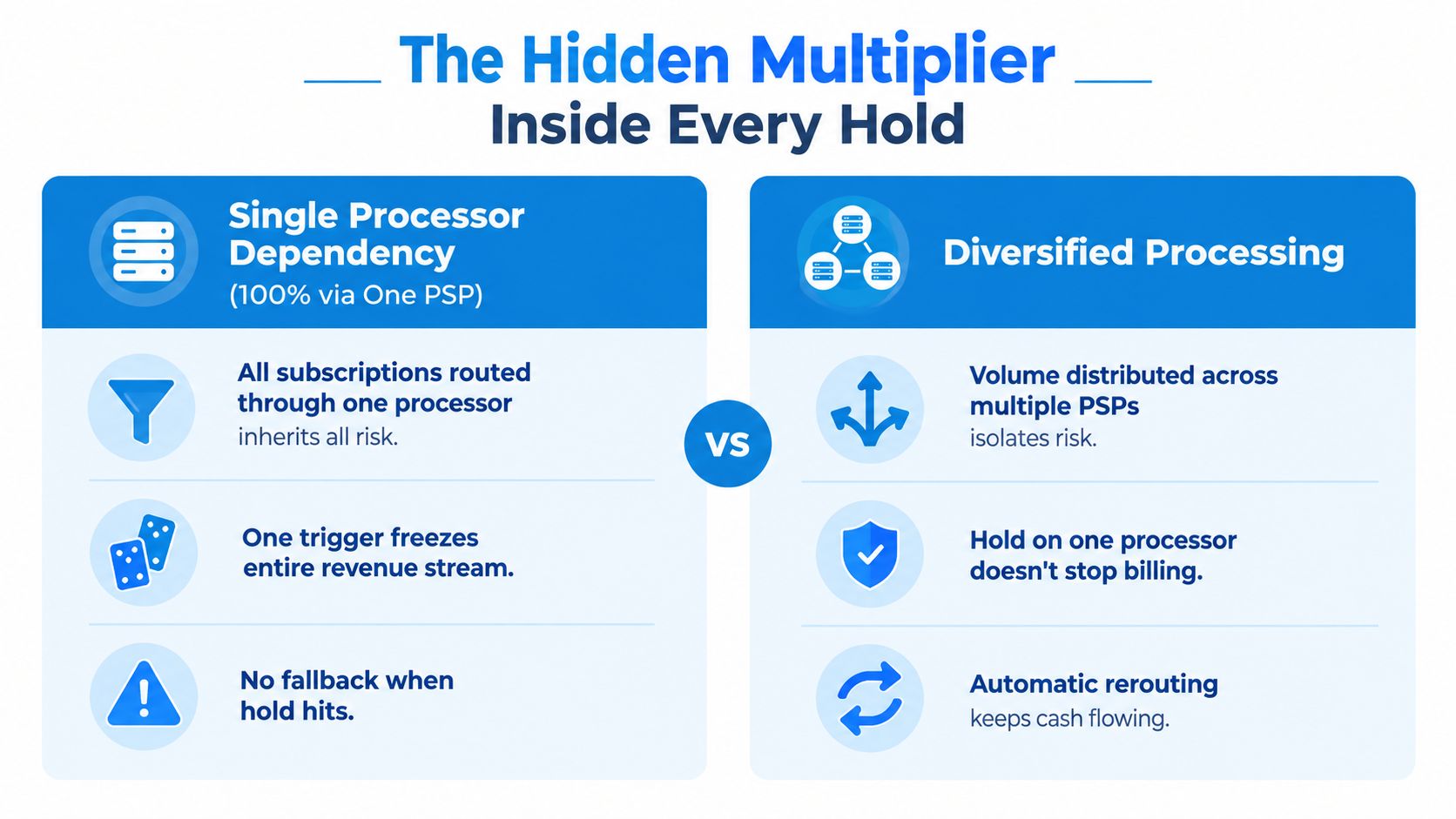
A processor-neutral card-on-file layer changes the failure mode. Instead of keeping saved payment methods usable only inside one gateway, the merchant uses a compliant vault architecture designed to support tokens and payment methods across supported providers. That doesn't remove the need to meet PCI obligations or obtain provider approval, but it can reduce the technical cost of switching routes.
Portability is a continuity control
With a portable vault and an approved secondary provider, the merchant can:
- Reroute new attempts: send eligible renewals or checkout payments through another processor.
- Preserve dunning: continue recovery workflows instead of abandoning every failed rebill.
- Isolate incidents: keep one provider's restriction from stopping every payment rail.
- Improve negotiating position: investigate the primary hold without treating every hour of delay as a revenue emergency.
The alternative is usually a migration under pressure. Engineering has to map gateway-specific tokens, finance has to reconcile multiple queues, support has to explain interrupted service, and customers may need to enter payment details again. That is a poor time to discover that card-on-file portability was never part of the architecture.
Stripe is a strong processor. Keep it as a processor if it performs well for your business. Don't make Stripe your entire payment continuity strategy. Multi-provider readiness is not an argument for unnecessary complexity. It's a practical response to concentration risk.
The provider strategy also determines what happens to retry logic, subscription state, fulfillment decisions, and reporting. Those workflows need explicit rules before a hold lands.
Credit Holds in Real Merchant Workflows
A subscription software company sees a cluster of disputes connected to one issuing-bank range. The PSP pauses new subscription charges while its risk team investigates. Customers with active access reach renewal dates, but the billing queue can't complete the rebills. Support receives “my card is fine” messages because the customer sees an account problem, not the merchant's processor restriction.
The right response isn't to keep retrying the same request. The team should identify whether the issue concerns a customer segment, a product flow, or the merchant account itself. It should also preserve subscription state so a temporary payment interruption doesn't turn into unnecessary cancellations.
A B2B supplier faces a different version. A long-standing buyer has an overdue balance that has passed its agreed terms and pushed total exposure beyond the supplier's approved limit. The supplier applies a credit hold, so the buyer's new orders and shipments stop while accounts receivable negotiates payment or revised terms.
That hold may be commercially justified, but it still creates a decision for both companies. The buyer needs to protect its supply chain. The supplier needs to reduce nonpayment exposure without damaging a valuable relationship. A clear release condition, documented owner, and defined escalation path matter more than a vague “account under review” status.
Recurring fulfillment makes the problem sharper
A direct-to-consumer brand selling monthly subscription boxes can be hit from both directions. A processor-level hold stops the recurring billing queue, while the warehouse still has an upcoming shipment cycle. If the business ships without payment confirmation, it increases exposure. If it stops every shipment immediately, it risks customer dissatisfaction and avoidable churn.
These workflows share one operational fact: a hold crosses team boundaries. Finance sees receivables, engineering sees payment events, growth sees conversion and retention, operations sees fulfillment, and customer support handles the fallout.
A payment hold is never only a payments problem once the first renewal fails.
The business should define whether access continues, whether fulfillment pauses, how many recovery attempts are allowed, and which provider handles new attempts. Without those rules, each team makes a local decision that can create a larger revenue problem.
How to Resolve a Credit Hold Quickly
Speed comes from preparation, but the first response still needs a disciplined order.
1. Investigate the root cause
Pull the original PSP notification and identify the exact restriction. Determine whether the issue concerns disputes, refunds, fraud, compliance, reserves, underwriting, or a customer balance. Measure the operational exposure in terms your teams can act on, including affected renewals, pending orders, blocked invoices, and customers approaching a billing date.
Don't assume every failed payment belongs to the hold. Separate ordinary card declines from provider-level restrictions so engineering doesn't waste time changing retry logic for a problem that requires risk-team action.
2. Gather evidence while continuity work starts
Collect transaction records, dispute responses, refund history, customer communications, product descriptions, fulfillment evidence, and relevant compliance documents. Finance should reconcile the payment queue, while engineering preserves event logs and identifies which payment methods can be used through another approved route.
A clear record also helps when a payment is reversed or canceled. The explanation of payment reversals can help teams distinguish a completed payment from a transaction that has been undone or released.
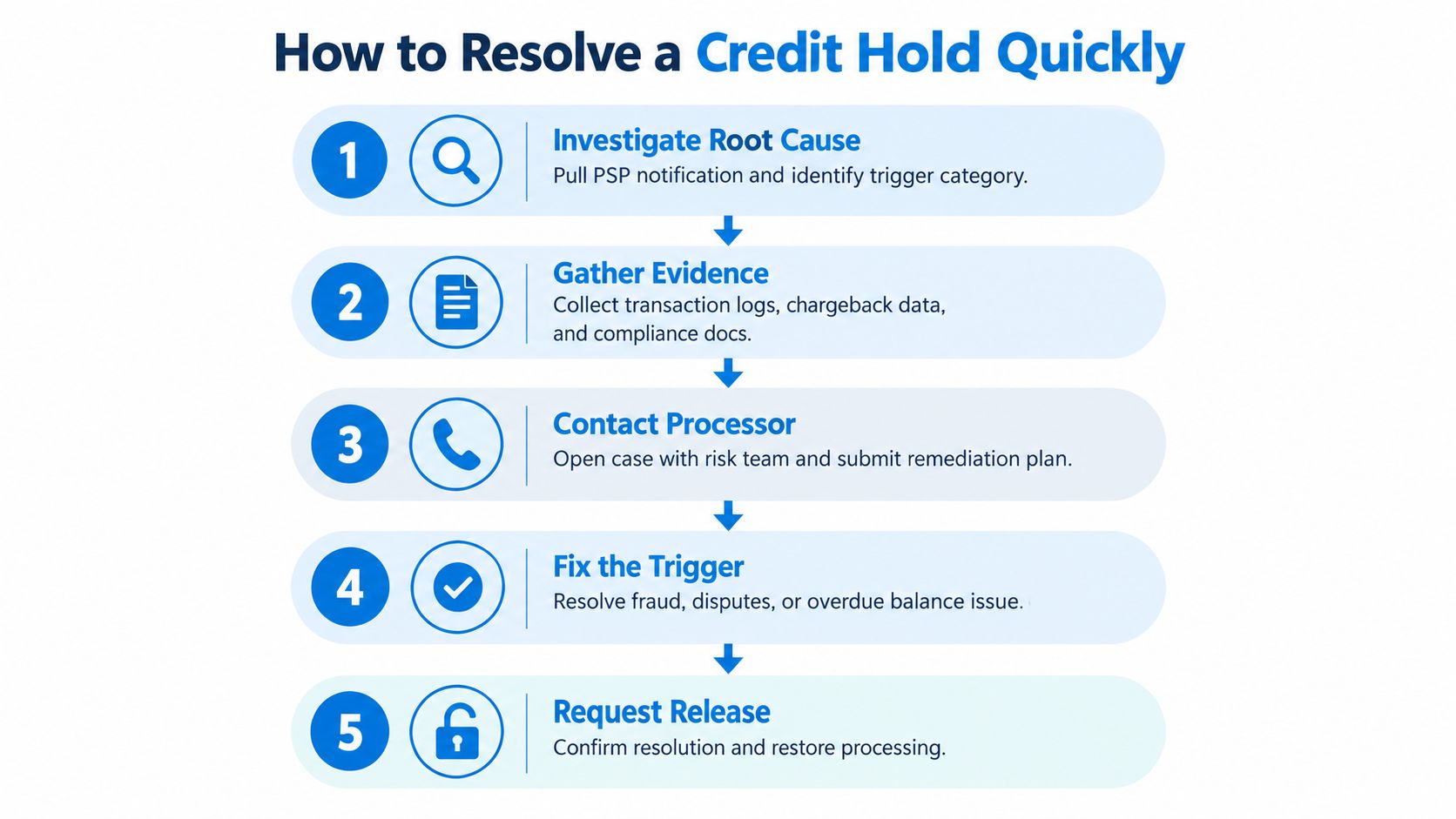
3. Open the processor case
Contact the PSP's risk or underwriting team, not just general support. Submit a concise remediation plan that names the trigger, explains the suspected cause, lists the controls already changed, and states what evidence supports the business model.
If the issue involves subscription billing, explain the retry, cancellation, refund, and customer-consent flows. If disputes are involved, show how the merchant is improving product communication, fulfillment records, and dispute prevention.
4. Fix the trigger and protect active revenue
Correct the underlying problem. That may mean improving fraud controls, changing a subscription retry path, reconciling an overdue balance, or supplying missing business information. In parallel, route eligible new attempts through an approved secondary provider if the merchant has the required setup and a secure, portable payment-method path.
Don't promise customers that the original processor will restore service by a specific time. Tell them what access, delivery, or billing continuity you can support, and give support a consistent escalation script.
5. Request release and verify the workflow
Ask the PSP to confirm the release conditions in writing. After re-enablement, test new payments, recurring rebills, refunds, webhooks, reporting, and fulfillment signals. A green dashboard doesn't prove that every downstream workflow has recovered.
The fastest recovery usually follows this sequence:
- Diagnose: identify the restriction and its scope.
- Document: assemble evidence and quantify affected workflows.
- Contact: open a case with the processor's risk team.
- Remediate: fix the risk or operational trigger.
- Restore: confirm release and test the complete payment lifecycle.
Watch a video walkthrough on handling a credit hold
Preventing the Next Credit Hold
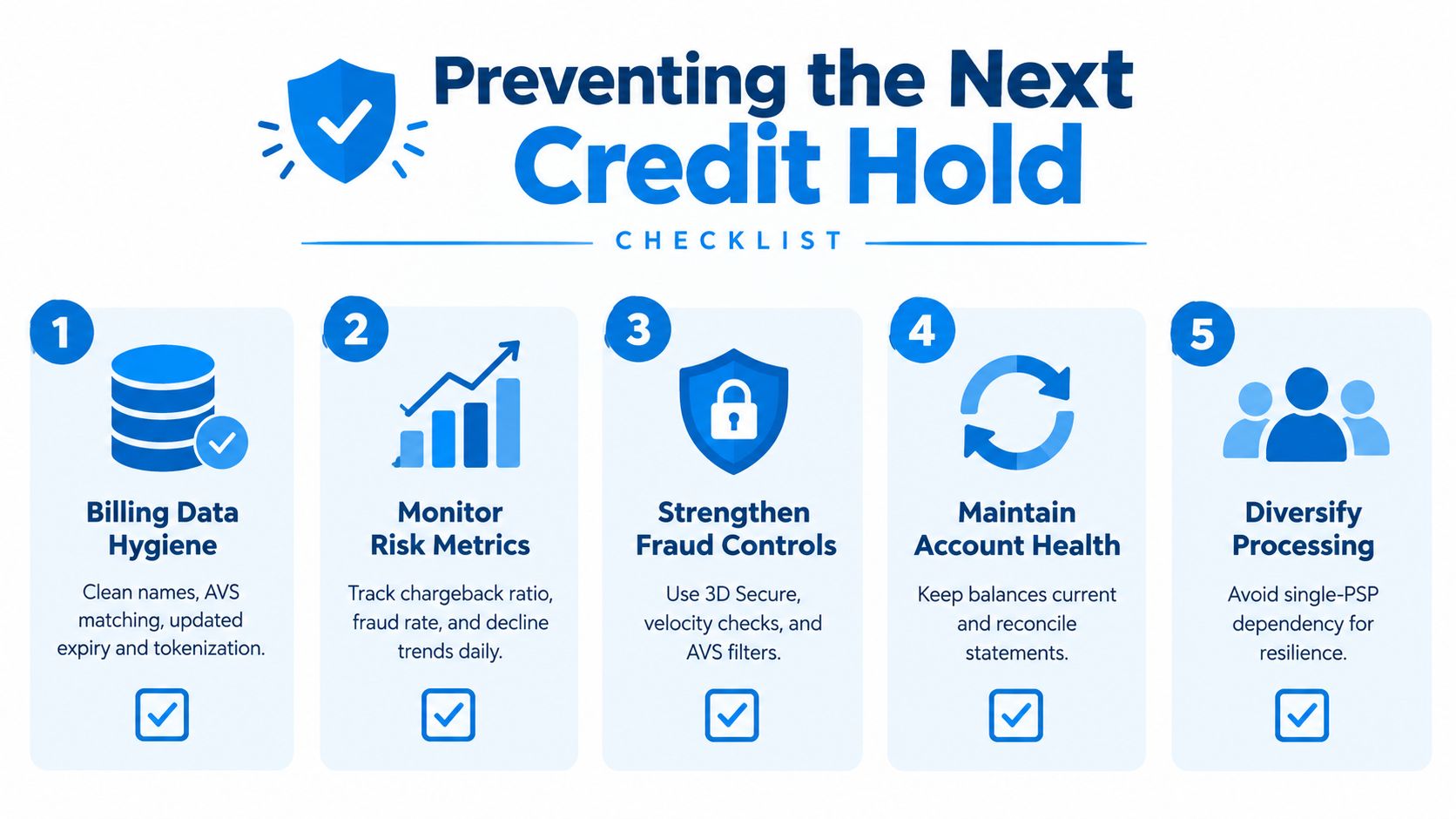
Prevention isn't a pile of disconnected controls. Billing data, fraud checks, dunning, provider routing, and risk review need to operate as one payment discipline.
Start with data quality. Customer names should be consistent, address checks should use accurate information, expiry details should be refreshed, and tokenized payment methods should rotate when providers issue updated credentials. A wrong postal code can create an avoidable address-verification mismatch. A missing postal code may be safer than sending an incorrect one.
Make recovery intelligent
Smart dunning should respond to the decline reason instead of hammering every failed payment. A soft decline may justify a later retry, while a hard decline or a transaction-not-allowed response may require customer action, a different payment method, or another provider.
Build graceful pause paths for subscriptions. Preserve the customer's plan and entitlements while the payment issue is worked, rather than converting every temporary failure into a cancellation. Keep fulfillment rules explicit so the warehouse doesn't ship blindly or stop loyal customers without a review.
Rehearse provider failover
A secondary processor should be approved, integrated, monitored, and tested before the primary route fails. Warm standby is more useful than a provider listed in a procurement document but untouched by production traffic.
A payment orchestration layer can connect routing, retries, fallback, and reporting in one operational model. Payment orchestration software is relevant when the merchant needs provider choice without creating a separate integration for every payment path.
Review disputes, refunds, declines, reserves, and account messages regularly. A hold should be a trigger for investigation, not the first time the team looks at payment risk.
Takeaways and Next Steps
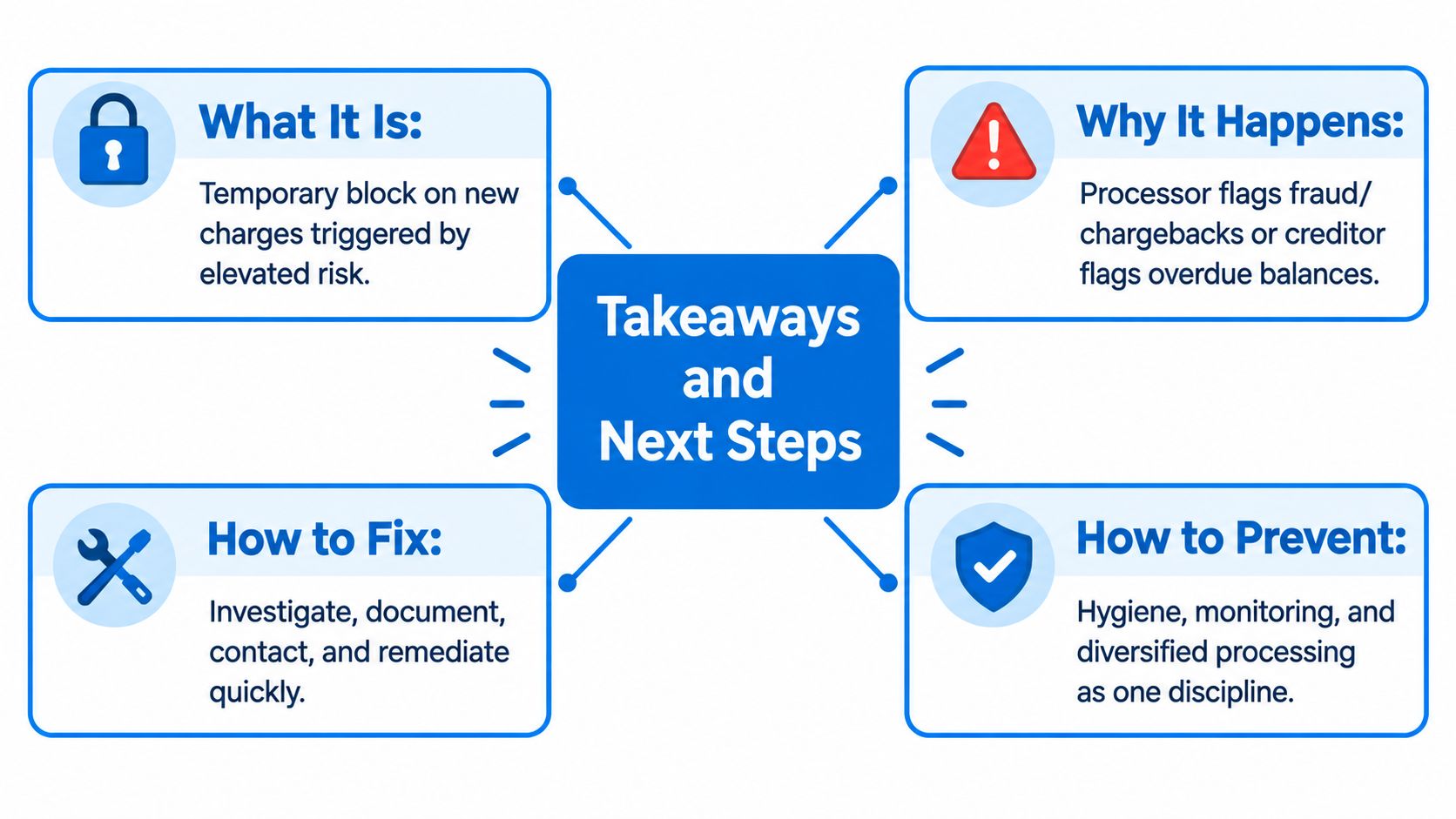
A credit hold is a temporary block on new charges or commercial exposure. A PSP may apply it after identifying increased merchant risk, while a creditor may use it when a customer has overdue balances or has exceeded its credit terms. For a subscription business, the result can be paused rebills, stalled retries, and a sudden shift from predictable recurring revenue to manual collections.
Resolve the incident by identifying the trigger, documenting the evidence, contacting the provider's risk team, correcting the underlying issue, and protecting eligible payment attempts through an approved fallback route. Prevent the next disruption with clean billing data, decline-aware dunning, preserved subscription states, monitored risk signals, and multi-provider readiness.
Use this one-day checklist:
- Review recent risk activity: Pull chargeback and refund trends from the latest operating period.
- Check payment-method health: Confirm saved methods can refresh and aren't trapped in a single gateway.
- Verify fallback readiness: Make sure a secondary processor is approved and technically usable.
- Document the runbook: Assign owners for diagnosis, customer communication, provider contact, and reconciliation.
- Test recovery: Confirm that a failover won't break webhooks, fulfillment, refunds, or reporting.
FloPay provides payment orchestration, embedded checkout, routing, and a processor-neutral card-on-file layer through one integration, so merchants can prepare for provider disruption without rebuilding every billing flow. If a credit hold exposes gaps in your recurring payments setup, visit FloPay to explore the platform and request a Vault Risk Review.