What Is Payment Reconciliation and Why It Matters
Learn what is payment reconciliation, how it protects revenue, common pitfalls across multiple gateways, and how orchestration simplifies it.
The sales dashboard looks healthy. Stripe shows successful checkouts, PayPal has its own payout schedule, a wallet provider is settling in another currency, and the bank balance doesn't quite match the ledger. Meanwhile, a subscription renewal may have been retried after a gateway timeout, a refund may be waiting for settlement, and a processor fee may have reduced the deposit.
That is the operating reality behind payment reconciliation. It isn't a monthly spreadsheet ritual reserved for accounting. It is the control that tells you whether money moved, where it moved, what it paid for, and whether your books describe reality. For a founder, head of finance, or payments lead, that means better cash forecasting, fewer duplicate charges, cleaner revenue reporting, and more reliable subscription renewals.
Table of Contents
- The End-of-Day Reality Behind the Numbers
- What Payment Reconciliation Actually Means
- The Transaction Lifecycle Behind Every Reconciled Line
- The Three Records Every Reconciliation Must Compare
- Why Multi-Gateway Setups Quietly Break Reconciliation
- The Two Pitfalls That Hit Hardest With Multiple PSPs
- A Practical Reconciliation Workflow That Closes the Books
- Reconciliation as the Foundation for Payment Resilience
The End-of-Day Reality Behind the Numbers
At the end of a busy trading day, a digital product merchant may have completed card checkouts, PayPal payments, wallet transactions, refunds, and subscription rebills. The internal order system states what customers bought and what they were charged. Each provider reports what it processed. The bank confirms what arrived. Those records rarely line up neatly by time or amount.
A successful payment can be captured today, included in a processor batch later, reduced by fees or a refund, and deposited on another banking day. A chargeback can also appear after the original sale was recorded. If the finance team compares only sales with deposits, it may mistake ordinary settlement timing for a missing payment, or overlook a real shortfall hidden inside a net payout.
The question founders should ask
The useful question isn't “Did checkout work?” It is “Can we trace every payment event from the customer order to the final accounting entry?”
That distinction matters commercially. An unlinked refund can leave a customer balance wrong. An unexplained fee can distort contribution margin. An unknown gateway outcome can trigger a duplicate retry. A failed subscription rebill can become lost recurring revenue if nobody sees the failure early enough to recover it.
Practical rule: Treat reconciliation as a revenue-protection control. If a payment can't be traced from checkout through settlement and the ledger, it isn't fully understood.
The rest of the payment stack can be fast and highly available, but finance still needs one coherent explanation of what happened. Reconciliation provides that explanation.
What Payment Reconciliation Actually Means
Payment reconciliation is the process of comparing a merchant's internal transaction records with external records from a bank, acquirer, or payment provider. The internal side may include invoices, orders, subscription events, payment attempts, and ledger postings. The external side may include processor reports, settlement batches, payout files, bank statements, refunds, chargebacks, and fee records.
The simplest analogy is balancing a checkbook. You compare what your own records say should have arrived with what the bank says arrived, then investigate every difference. In payments, the comparison is more involved because one customer action can create several records across separate systems.
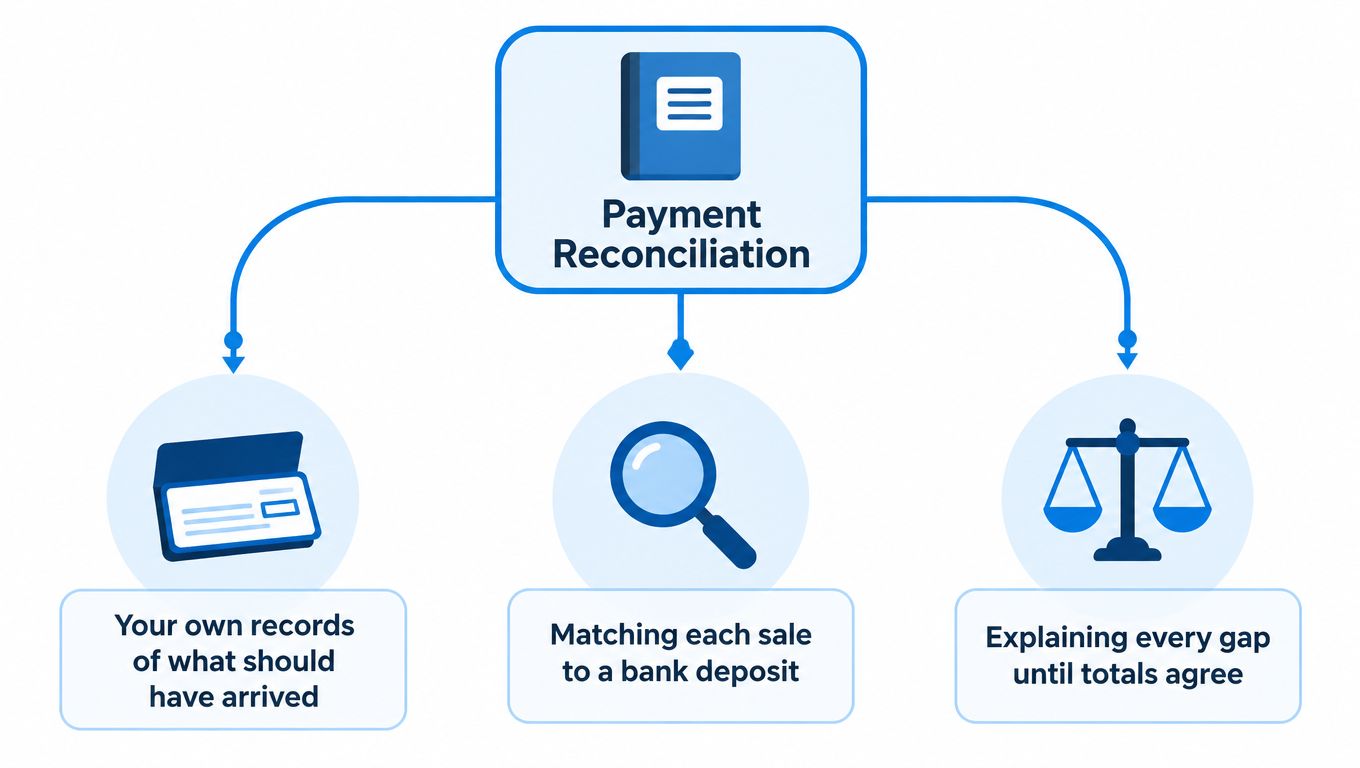
What gets compared
A sound control checks more than the checkout total:
- Internal transaction records: Orders, invoices, payment attempts, captures, refunds, and subscription events.
- Provider records: Authorizations, captures, settlement batches, provider fees, disputes, and payout adjustments.
- Bank and accounting records: Deposits, bank fees, cash accounts, journal entries, and the general ledger.
The process must distinguish gross amounts from net settlement. A customer may pay the full order value, while the provider deposits a lower amount after fees, refunds, chargebacks, or other adjustments. It must also distinguish a timing difference from a genuine break. A sale captured before period-end but settled afterward may be normal. A duplicate capture, missing posting, wrong fee, or short payout needs investigation.
The definition finance and engineering can share
Payment reconciliation answers two separate questions: did money move, and was that movement correctly attributed in the merchant's books?
A payment can be settled successfully yet remain unreconciled if the remittance data doesn't identify the invoice or order it paid. Oracle's payment-management documentation shows why multiple dates matter, including payment disbursement, bank settlement, bank-file upload, and export to the accounting system. Oracle's payment reconciliation documentation reflects the operational reality that transaction activity and cash movement don't necessarily happen together.
The Transaction Lifecycle Behind Every Reconciled Line
A customer clicking Pay creates a chain of events, not one accounting line.
First, the provider receives the payment request and returns an authorization result. Authorization means the bank approved or declined the requested transaction. It doesn't necessarily mean the merchant has received funds. The payment may then be captured, which records the merchant's instruction to collect the authorized amount.
The processor later groups captures into a settlement batch. It calculates fees, applies refunds or disputes, converts currencies where necessary, and sends a payout to the merchant's bank. Each stage can have a separate timestamp, identifier, status, currency, and report.
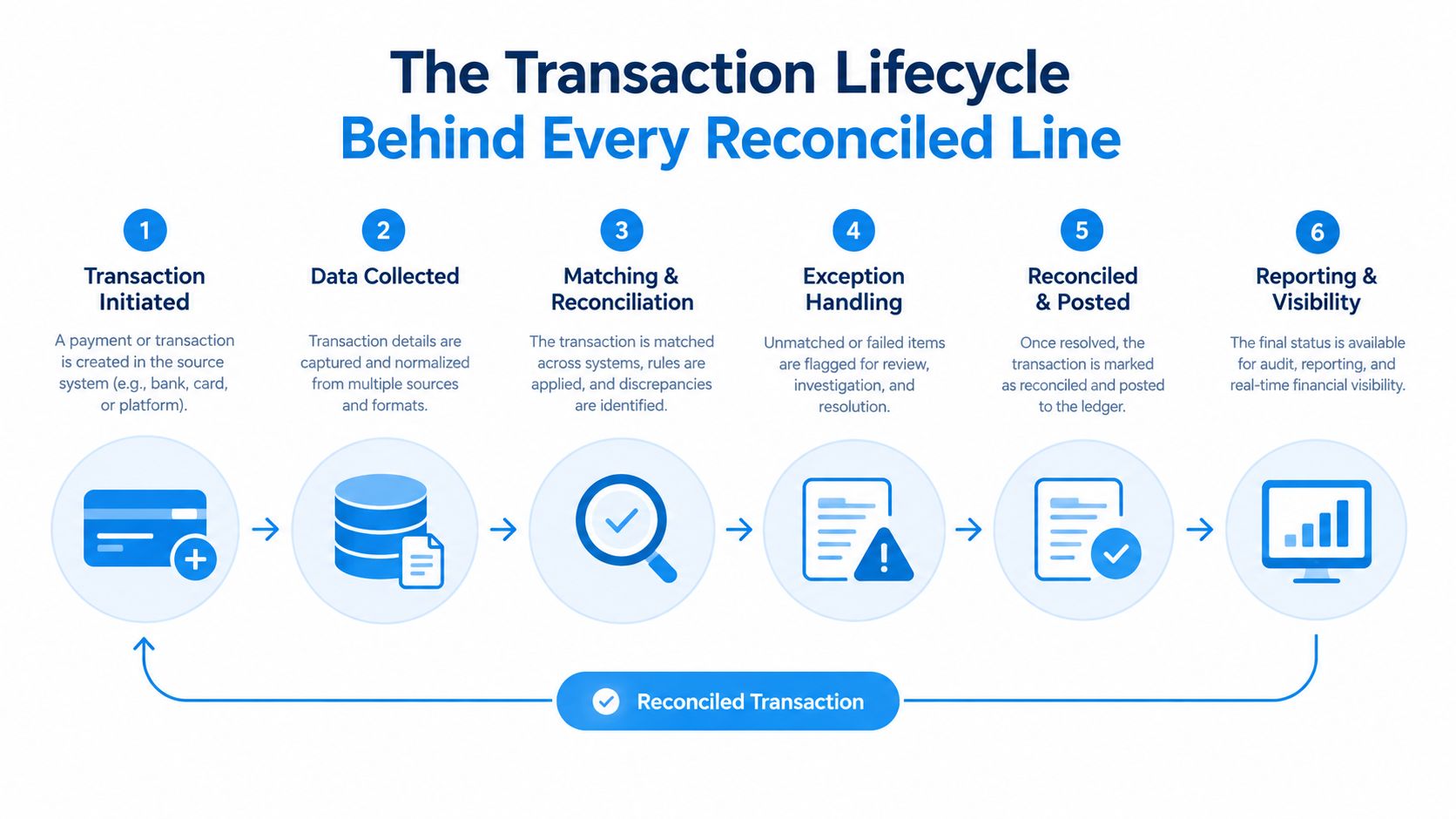
One payment, several financial events
Consider a card sale followed by a partial refund. The order system records the sale and later the refund. The processor records the original capture, the refund instruction, and the resulting settlement adjustment. The bank may show only the net funding movement, while the ledger needs both the sale and refund entries.
A cross-border transaction adds currency conversion and potentially separate settlement currencies. The amount charged to the customer, the amount reported by the provider, and the amount deposited can differ because the records describe different points in the lifecycle. EY's analysis of ISO 20022 explains that insufficient statement and remittance data often causes unmatched items, while structured information supports more reliable automated matching.
Preserve the payment lineage
Your data model should retain a canonical payment ID alongside the provider transaction ID, order or subscription ID, authorization and capture timestamps, settlement batch ID, currency, gross amount, fee components, net amount, refund references, dispute references, and accounting journal mapping.
The matching logic also needs to support one-to-one, one-to-many, and many-to-one relationships. One payout may contain many captures. One payment may produce several adjustments. The system must connect those events without treating each provider line as a new customer payment.
The following video provides a visual introduction to the lifecycle:
The Three Records Every Reconciliation Must Compare
Many merchants compare checkout totals with bank deposits and stop there. That skips the processor layer, which is where fees, reserves, refunds, chargebacks, and batch-level adjustments often become visible.
A complete control makes three comparisons:
| Reconciliation comparison | What it confirms | What it can expose |
|---|---|---|
| Sales activity against the processor batch | The provider processed the expected transactions | Missing captures, duplicate records, wrong statuses, and unexpected adjustments |
| Processor batch against bank funding | The provider funded the expected net amount | Fee changes, withheld amounts, short payouts, and settlement timing differences |
| Bank deposit against the general ledger | The accounting system posted the cash movement correctly | Duplicate journal entries, missing deposits, and incorrect cash balances |
Why the middle layer matters
Suppose the order system records a successful sale and the bank receives a payout. A direct comparison may look correct. The processor batch could still show a fee deduction, a chargeback debit, or a refund that the ledger never recorded. Without the batch report, the finance team sees a smaller deposit but lacks the evidence needed to explain it.
Merchant identifiers also matter. A merchant ID explained in this FloPay guide helps distinguish which account, provider relationship, or settlement stream owns a transaction. That becomes important when a business has separate entities, currencies, brands, or payment routes.
The control should produce an explanation
The outcome isn't merely “matched” or “unmatched.” A useful reconciliation record says why the amounts differ:
- Timing difference: Captured before settlement and expected in a later funding cycle.
- Provider adjustment: Fee, refund, dispute, reserve, or currency conversion recorded by the provider.
- Accounting break: Deposit or adjustment reached the bank but wasn't posted correctly.
- Payment break: Capture, payout, or refund is missing, duplicated, or incorrectly attributed.
This three-layer model gives finance, payments, and engineering a shared language. It also prevents the common mistake of treating a net bank deposit as proof that every underlying transaction was correctly recorded.
Why Multi-Gateway Setups Quietly Break Reconciliation
Adding Stripe, PayPal, Adyen, Klarna, wallets, and local payment methods can improve acceptance and payment resilience. It also multiplies the reconciliation problem. Each provider may use different transaction IDs, settlement cutoffs, fee structures, currencies, report formats, refund timing, and dispute workflows.
That trade-off is manageable only when the merchant keeps one canonical payment record. Without it, finance teams end up joining spreadsheets by approximate amounts and dates. That approach can hide duplicate attempts, lose the final settlement outcome, and make it difficult to identify which provider or decline type is costing revenue.
Reconciliation pain points
Recent survey evidence identifies several barriers reported by payment firms:
| Reconciliation factor | Share of payment firms |
|---|---|
| Cross-currency transactions | 23% |
| Multiple payment channels | 22% |
| Transaction volume | 20% |
| Exception management as a substantial burden | 32% |
These figures come from Kani Payments' 2025 reconciliation and reporting survey. The lesson is straightforward: adding routes without adding payment lineage creates more operational work, not more control.
Month-end is too late for some exceptions
A gateway timeout is a live payment-control problem, not just a later accounting discrepancy. If the first provider has an unknown outcome and the system immediately retries through another route, the customer could be charged twice. The finance team may not discover the duplicate until the next reconciliation cycle.
Payment orchestration software should therefore support lifecycle-level visibility. The merchant needs to connect every attempt, provider reference, token, settlement event, refund, dispute, and accounting outcome to the same internal payment identity.
A large payment network illustrates the scale of the issue. The ACH Network processed 35.19 billion payments worth $93.00 trillion in 2025, including 8.08 billion business-to-business transactions, according to ECO's payment reconciliation guide. At that scale, even a hypothetical 0.1% exception rate would create approximately 35.19 million records for review. The calculation is illustrative, but the operating principle applies to any high-volume merchant: exception handling must be designed into the payment flow.
The Two Pitfalls That Hit Hardest With Multiple PSPs
Multiple PSPs can improve resilience, but orchestration doesn't automatically create control. Two failure patterns appear repeatedly.

Pitfall one is retrying an unknown outcome
A gateway times out after the customer submits payment. The merchant doesn't know whether the provider received the request, authorized it, or captured it. A naive retry sends a second request through the same or another provider.
That can create a duplicate charge. It can also create conflicting ledger states: one internal payment marked failed, one provider payment later settled, and a second attempt recorded as successful. The issue isn't solved by retrying harder. The system must reconcile the unknown outcome before cascading into another attempt.
The design rules are clear:
- Keep one internal payment identifier across every attempt.
- Use provider idempotency keys so a repeated request does not become a second charge.
- Wait for provider evidence where the outcome is unknown, including status checks, webhooks, or settlement references.
- Record the reason for every retry, including the original provider response and timing.
This protects both customer experience and accounting accuracy. A subscription renewal shouldn't create two charges just because the first provider's response arrived late.
Pitfall two is fragmented operational evidence
A finance team using separate dashboards for Stripe, PayPal, Adyen, and wallet providers may be able to find each transaction. The harder task is connecting those records into one explanation of the customer payment.
Cross-provider spreadsheets are especially weak here. Manual matching can obscure which gateway, route, retry, or decline type is costing revenue. It also makes it harder for engineering to reproduce an issue and for operations to distinguish a genuine payment failure from a missing webhook.
The better operating view includes:
- Transaction status: Authorized, captured, settled, refunded, disputed, reversed, or failed.
- Routing decisions: Which provider and payment method handled the attempt.
- Retry history: Why the system retried and what happened next.
- Webhook events: Which provider notifications arrived, failed, or were replayed.
- Settlement references: Which batch and payout contained the transaction.
- Reconciliation data: How the payment mapped to the order and ledger.
That single record doesn't remove every exception. It makes exceptions traceable, assignable, and resolvable before they become unexplained cash differences.
A Practical Reconciliation Workflow That Closes the Books
A reliable workflow begins with connected data, not a spreadsheet assembled at month-end. Ingest transaction, settlement, bank, refund, dispute, and ledger records into a model that preserves the identifiers and relationships created throughout the payment lifecycle. This gives finance one view across gateways, PSPs, and accounting systems, so a missing settlement or duplicate attempt cannot hide between platforms.
Run matching continuously, then sign off deliberately
Automated matching should start with the canonical payment ID, then use the provider transaction ID, order or subscription ID, amount, currency, dates, status, and adjustment type. Rules must also handle aggregated payouts and separate fee, refund, reversal, and chargeback lines.
Use this operating rhythm:
- Ingest source records: Pull payment events, provider reports, settlement files, bank activity, and accounting entries.
- Match normal relationships: Clear exact matches automatically, including one-to-one, one-to-many, and many-to-one patterns.
- Classify exceptions: Assign reason codes for timing differences, missing references, duplicate attempts, fee variances, and settlement breaks.
- Route ownership: Give every unresolved item an accountable owner and an aging target.
- Preserve evidence: Keep source records, event history, decisions, corrections, and approvals.
- Re-run the population: After correction, run affected records again. Do not close an exception solely because someone approved a workflow step.
The QueryChart payment reconciliation process emphasizes immutable evidence, ownership, aging targets, and approved resolutions. Apply those controls to turn reconciliation into an auditable payment safeguard, not informal finance clean-up.
Separate processing from review
The person who accepts payments, issues refunds, or closes batches should not be the only person deciding that transactions reconcile. The University of Maryland payment-card procedure requires reconciliation by someone not directly involved in processing, with documented work reviewed, signed, and dated by the preparer and an administrator. Its procedure requires the control at least once per calendar month, with more frequent reviews where operational risk justifies them. The University of Maryland payment-card procedure offers a clear separation-of-duties model.
Refunds and reversals need explicit linkage. Connect the original transaction, refund instruction, provider outcome, and ledger adjustment, and document what a payment reversal is and how it differs from a refund. Chargebacks require the same discipline. Federal Reserve research found an average of 1.6 chargebacks per 10,000 sales by transaction count and 6.5 chargebacks per 10,000 dollars of sales value for Visa and Mastercard transactions. Roughly 70% to 80% were resolved as merchant liability, and fraud represented about 50% of chargebacks, according to Federal Reserve payments research. Reconcile each dispute with the original transaction, order, refund history, representment activity, and settlement adjustment.
Reconciliation as the Foundation for Payment Resilience
Reconciliation is where payment operations, finance, and revenue protection meet. It tells you whether a provider outage created failed payments, whether a retry created duplicate risk, whether a fee changed, whether a refund reached the customer, and whether a settled transaction was posted to the right account.
That makes reconciliation part of payment resilience. A merchant can keep Stripe as a processor while avoiding a Stripe-only continuity strategy. Processor concentration risk becomes more manageable when the business can route through multiple providers, retain a canonical payment history, and reconcile every outcome without losing the link to the customer order.
Portability starts with saved payment methods
If saved cards exist only as gateway-scoped tokens inside one provider, a processor change or fallback route can become an engineering and revenue problem. A processor-neutral, PCI-compliant card-on-file layer can make supported saved payment methods more portable while keeping raw card data out of merchant systems. Flo Vault is designed for this kind of vault-backed payment flow, alongside payment orchestration, checkout, and provider routing.
The same foundation matters for recurring revenue. A prepaid card may approve an initial purchase but fail on a later rebill. A transaction-not-allowed response may need a different recovery path than a temporary issuer decline. Reconciliation gives smart dunning and payment recovery the evidence needed to distinguish those outcomes instead of retrying blindly.
Agent-assisted commerce raises the standard further. Human or AI agents need constrained payment permissions, traceable authorization, and records connecting the agent action to the customer, order, payment instrument, and final settlement. A reconciled payment lineage provides the audit foundation for those delegated flows.
The practical takeaway: payment reconciliation confirms both the movement of money and the correctness of its attribution. Start by mapping every payment event from checkout to settlement, identify who owns each exception, and check whether your saved payment methods can support more than one provider.
FloPay brings checkout, payment orchestration, provider routing, and secure vault-backed payment data into one operating layer, giving teams a clearer record to reconcile across sales, retries, refunds, and settlements. Visit FloPay to explore payment orchestration and Flo Vault, or book a review of where your payment data and processor dependencies sit today.