What Is an EFT Account? A Guide for Modern Merchants
What is an EFT account? Learn how EFT accounts work, the rails behind them, and what they mean for routing, reconciliation, and recurring billing.
An EFT account isn't a special type of bank account. It's a checking, savings, prepaid, or similar asset account that can be debited or credited through an electronic fund transfer, while the EFT itself is the individual movement of money.
The common advice to “open an EFT account” skips the decision merchants need to make: which payment network will move the money, under what authorization, and with what settlement and return rules? Getting those answers right affects checkout design, recurring revenue, cash forecasting, and the time your team spends investigating payments.
Table of Contents
- What an EFT Account Actually Is
- How Money Moves Through an EFT Account
- The Major EFT Rails and How They Differ
- Why an EFT Is a Lifecycle Not a Success Flag
- How Merchants Accept EFT Payments in Practice
- Choosing How to Handle EFT Alongside Cards
- Key Takeaways and Your Next Step
What an EFT Account Actually Is
Treating an EFT account as a distinct banking product is the wrong starting point. The account holds the funds; the electronic fund transfer supplies the instruction to move them.
In the United States, Regulation E, which implements the Electronic Fund Transfer Act, defines covered accounts and electronic transfers. Its definition includes transfers initiated through an electronic terminal, telephone, computer, or magnetic tape to authorize a financial institution to debit or credit a consumer's account. That definition describes a transfer mechanism, not a universally standardized account product. The distinction comes directly from the Regulation E definitions and scope.
An EFT account is the funding account. An EFT is the electronic movement into or out of it.
A bank or payment provider may use “EFT account” as a setup label. Don't assume that label tells you which transactions the account supports, which network processes them, or what information your integration needs.
Separate the account from its capabilities
The account categories below show why the label alone isn't enough to scope an integration.
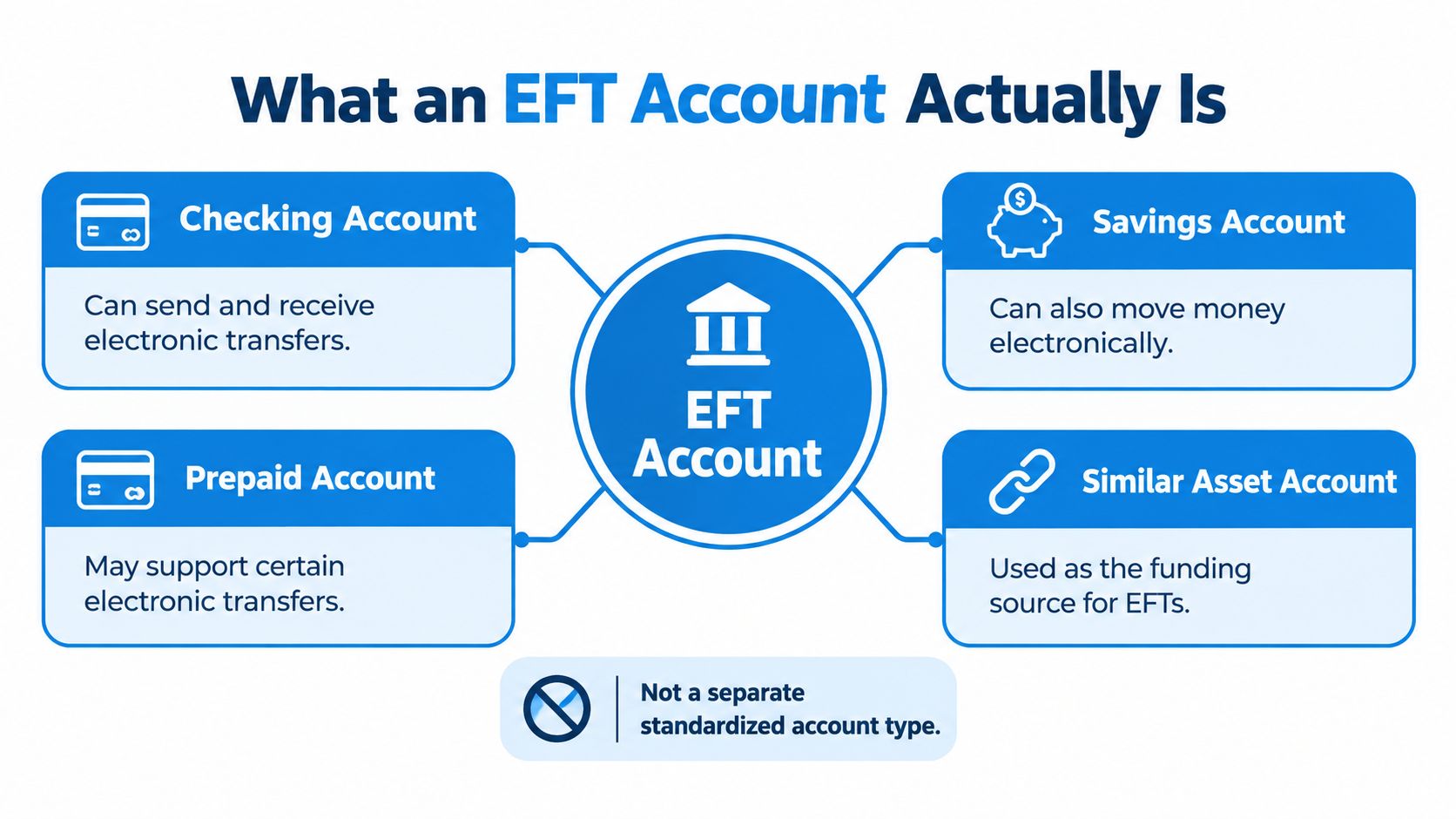
For a merchant, the useful questions are more specific:
- Funding source: Which customer or business account will receive the credit or fund the debit?
- Supported mechanism: Which transfer types can your provider initiate against that account?
- Account purpose: Is this a consumer account or a corporate operating account?
- Operational ownership: Who investigates a rejected instruction, missing credit, or disputed debit?
These questions prevent an expensive design shortcut: representing every account-based payment as the same payment method.
For example, your checkout team may only need to display a bank-payment option. Engineering still needs to know how that option is authorized, and finance needs enough detail to match the eventual movement to the invoice. A generic account label doesn't satisfy either requirement.
The practical answer to “what is an EFT account?” is therefore about capability, not branding. Start with the underlying account, then identify the payment mechanism you intend to use.
How Money Moves Through an EFT Account
Consider an employee receiving payroll by direct deposit. The transfer credits the employee's account, increasing its balance.
Now consider a subscriber who authorizes a merchant to collect a monthly fee through an Automated Clearing House, or ACH, debit. That instruction debits the subscriber's account. The account can be the same kind of checking account in both examples, but the direction and initiation of the payment differ.
The CFPB's electronic fund transfer FAQs explain the breadth of covered transfers and the consumer-account context. A conventional account can support direct deposits, electronic withdrawals, debit-card purchases, and other covered activity, rather than requiring a separate account for each use.
Follow the direction of the money
The illustration distinguishes money arriving in an account from money collected from it.
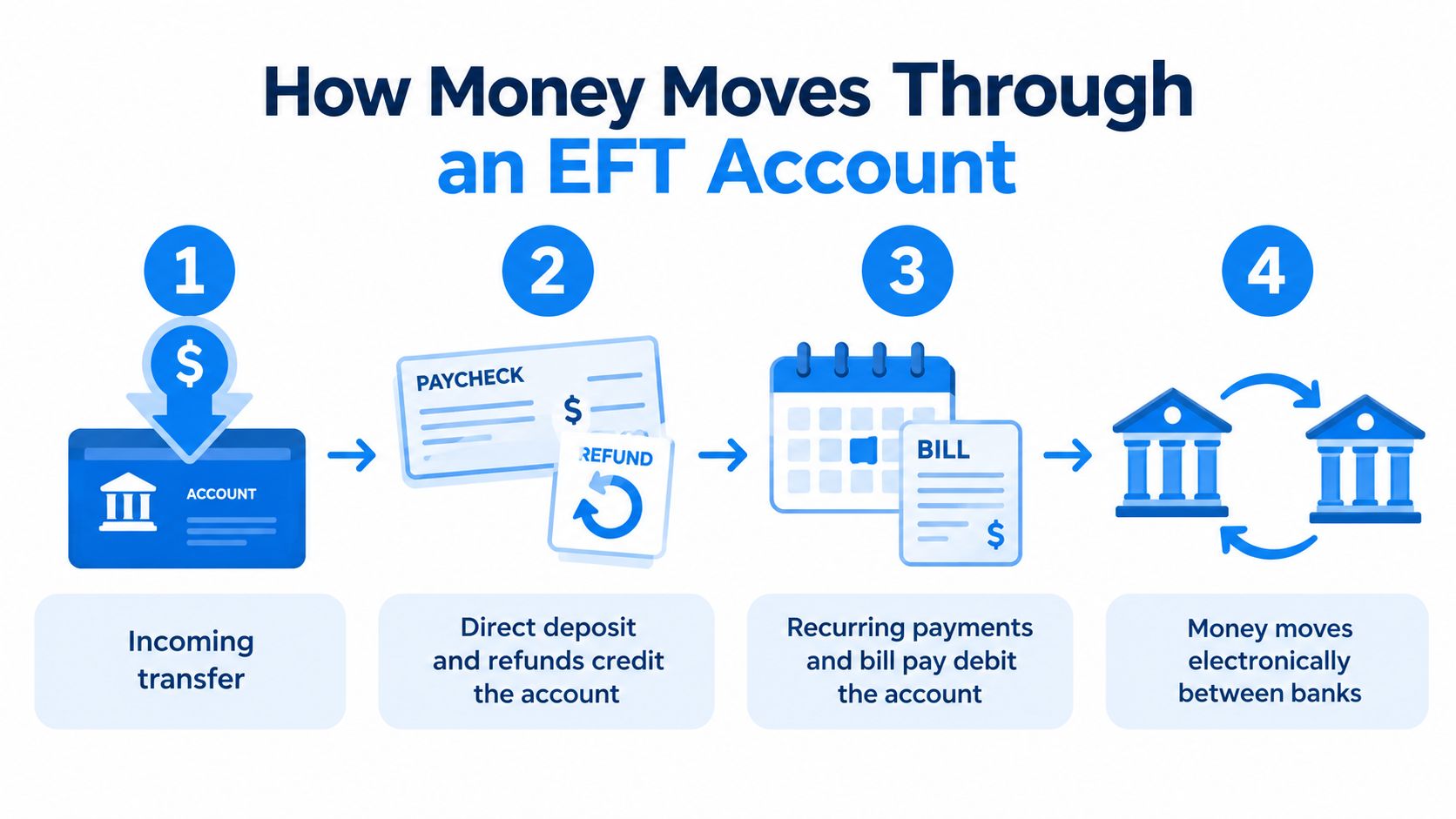
For a subscription debit, the operating flow is:
- Customer permission: The account holder authorizes the collection under the applicable payment arrangement.
- Merchant initiation: The billing system submits the debit instruction through its payment provider.
- Network processing: The relevant institutions process the instruction through the selected rail.
- Account posting: The account reflects the debit, while the merchant tracks the associated payment outcome.
Authorization is the customer's permission to initiate the payment. It isn't the same thing as the merchant receiving settled money, and the checkout should avoid suggesting otherwise.
That distinction belongs in your broader ecommerce payment process. The customer-facing confirmation, billing record, and finance ledger should describe the same transaction without confusing permission, submission, and receipt.
Check whose account you're handling
Regulation E primarily concerns consumer accounts used for personal, family, or household purposes. A business shouldn't assume its corporate operating account carries the same consumer protections.
For a marketplace, this means reviewing customer collections and business payouts separately. They may share infrastructure, but that doesn't make their account purpose, authorization requirements, or legal treatment identical.
Map each flow from the account holder's perspective. “Customer pays merchant” is too vague for implementation; “merchant initiates an authorized debit against a consumer account” is a useful starting point.
The Major EFT Rails and How They Differ
EFT is an umbrella category, not a routing instruction. Telling an engineer to “support EFT” leaves the most consequential integration decisions unresolved.
Regulation E identifies point-of-sale transfers, ATM transfers, direct deposits or withdrawals, telephone-initiated transfers, and debit-card transactions among its examples. The regulatory description of covered electronic transfers makes clear why EFT coverage extends beyond bank-to-bank payments alone.
An ACH debit, a debit-card purchase, and a wallet-initiated payment can all fit within the broad category while requiring different processing and exception handling.
Common EFT Rails Compared
| Rail | Primary Region | Typical Use Case | Operational Characteristic |
|---|---|---|---|
| ACH | United States | Payroll, subscriptions, recurring bills, supplier payments | Banking-day processing and return handling matter |
| SEPA account transfers | Europe | Account-based collections and payments | Identify the specific scheme and applicable mandate requirements |
| BECS direct entry | Australia | Account-based recurring collections and payments | Confirm local authorization and processing requirements |
| Debit-card networks | Multiple regions | Consumer purchases and recurring billing | Follow card-specific authorization and dispute processes |
| Wallet-initiated transfers | Varies by wallet and funding source | Mobile and online payments | The wallet interface alone doesn't identify the underlying rail |
Use this comparison to organize provider discussions, not as a substitute for a scheme-specific implementation review. For SEPA and BECS in particular, ask the provider to identify the supported payment flow, local requirements, and exception process before committing to a checkout design.
Store the rail, not just the category
Your internal payment object should preserve operational differences even if the checkout presents a simple choice.
- Actual rail: Record the mechanism used, rather than only “EFT.”
- Account type: Retain the relevant funding-account classification.
- Authorization method: Make it possible to establish how the customer consented.
- Transaction status: Preserve the provider's outcome and your normalized internal status.
The distinction is especially useful when comparing account-to-account payment flows with card or wallet flows. Similar checkout wording doesn't mean the same back-office behavior.
For revenue operations, this detail makes failed-payment reporting more actionable. A report grouped only by EFT tells you little about whether the problem concerns account details, authorization, processing availability, or a particular provider.
Simplify the customer experience, not the payment record. Finance and engineering need the detail that the customer doesn't need to see.
Why an EFT Is a Lifecycle Not a Success Flag
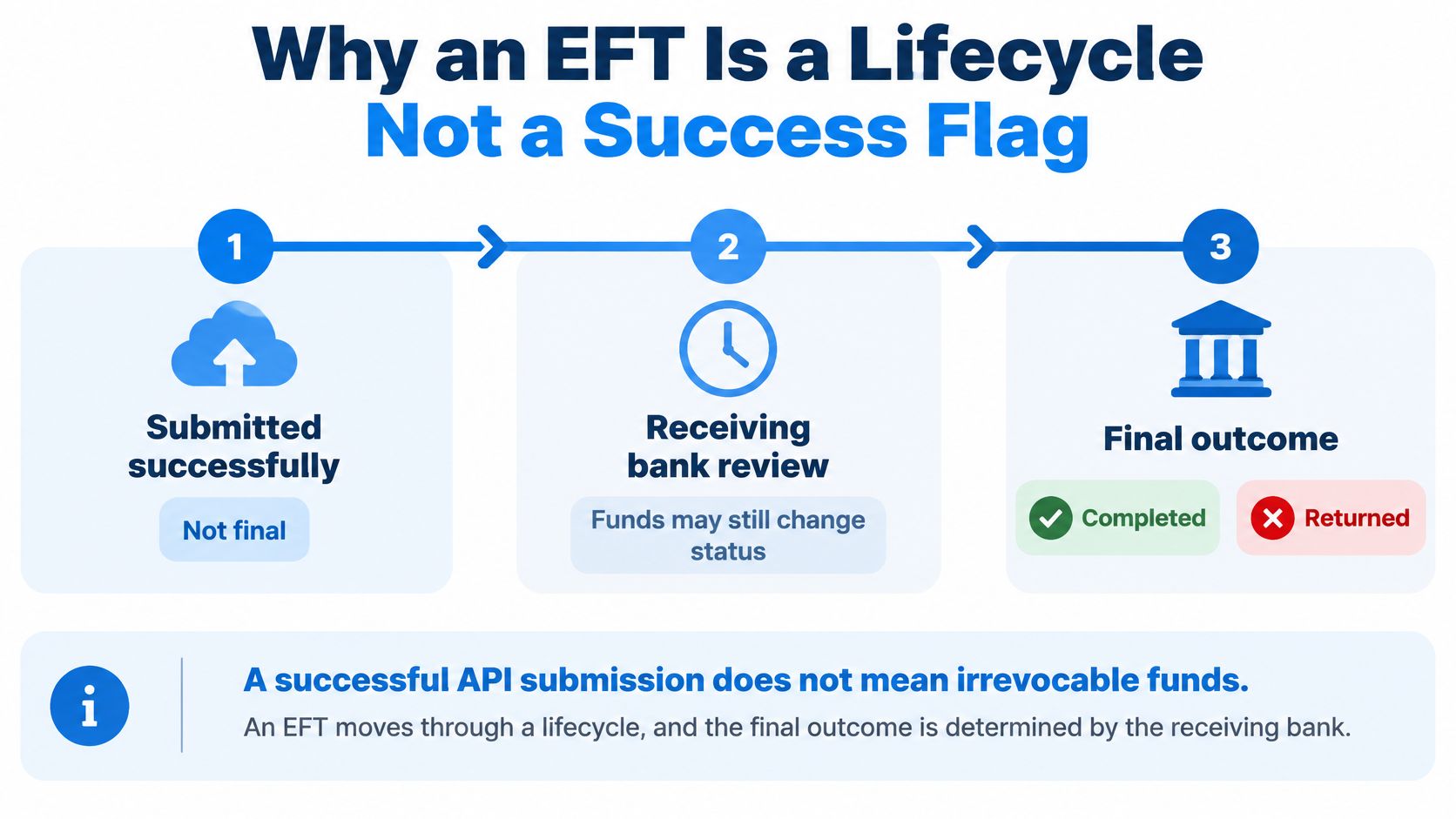
A successful application programming interface, or API, submission means your system submitted an instruction successfully. It doesn't necessarily mean the merchant has irrevocable funds.
A receiving bank may later return an ACH debit because of insufficient funds, an invalid account, or an unauthorized transaction. Treating submission as final success can therefore create a gap between delivered services, expected collections, and actual cash.
Processing availability affects your promise
ACH timing depends on network windows and banking-day availability. The relevant operating figures from Nacha's explanation of ACH processing are:
- Network availability: The ACH Network operates for approximately 23¼ hours each business day and settles four times per day, with weekends and federal holidays excluded from Federal Reserve settlement availability.
- Typical settlement: About 80% of ACH payments settle in one banking day or less under regular and Same Day ACH processing.
- Same Day ACH: Eligible transactions can settle within hours, with a limit of $1 million per payment.
These figures describe processing capabilities, not a universal promise for every transaction. Your provider's cutoff, the relevant time zone, cash-availability policies, and reconciliation timing still affect what your business can safely communicate.
The lifecycle illustration highlights the gap between submission and a bank outcome.
Make status changes explicit
A useful internal model distinguishes created, submitted, accepted, settled, returned, and reversed. Map each provider's terminology to those states carefully, and preserve the original events so support and finance can reconstruct what happened.
Operational rule: Don't let an API response make a fulfillment or cash-availability decision that your risk policy hasn't approved.
A digital subscription business might choose to grant access while collection remains pending. That can be a reasonable commercial decision, provided the team explicitly accepts the exposure and knows what to do if the debit returns.
This isn't a niche infrastructure problem. The Federal Reserve processed 20.1 billion commercial ACH transactions in 2024, according to its payment-system oversight report. At that scale, merchants need repeatable status handling, not manual interpretation of payment confirmations.
Forecast collections separately from available cash. Otherwise, finance may count money that operations still needs to recover.
How Merchants Accept EFT Payments in Practice
Start with the authorization and evidence your team will need later, not just the fields required to submit a debit. A payment form can collect valid account details while leaving the merchant unable to explain why a particular collection was permitted.
Regulation E establishes disclosures, error-resolution procedures, and rules concerning unauthorized transfers. For merchants, the practical response is to retain a clear payment history that supports investigation. The CFPB's Regulation E framework provides the consumer-protection context for that work.
Build an acceptance checklist
Use the workflow below to review the complete collection process before launch.
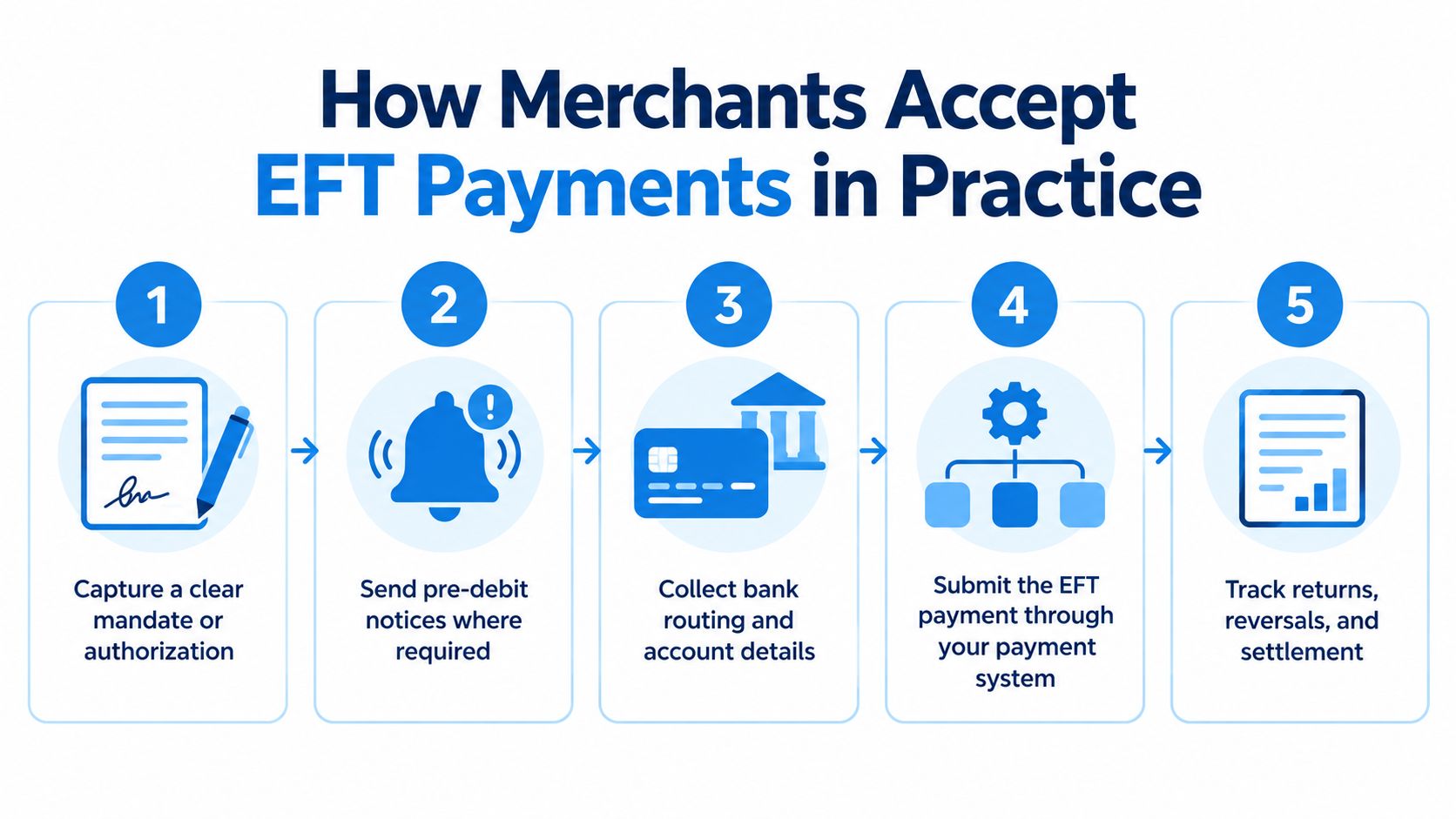
- Capture clear authorization: Connect the customer's consent to the payment arrangement and the account being charged.
- Confirm notice requirements: Send pre-debit notices where the applicable rail or jurisdiction requires them.
- Collect the required account details: Follow the selected provider's requirements rather than assuming a universal EFT field set.
- Retain an audit trail: Record the payment method, authorization event, amount, date, and transaction outcome.
- Reconcile exceptions: Link returns and reversals to the original collection, customer, and invoice.
For recurring billing, retain the relationship between the original authorization and later collection attempts. A support agent should be able to identify which consent supports the debit without piecing together unrelated screenshots and processor records.
Separate payment stops from subscription cancellation
Consumers can stop preauthorized recurring EFTs, but stopping a payment doesn't necessarily cancel the underlying merchant contract. The customer may need both actions, and your support process should distinguish them.
Consumers generally have 60 days after the bank sends the statement showing an error to notify their bank, which normally must investigate within 10 business days, with temporary-credit and extended-investigation procedures in some cases. The OCC's checking-account consumer guidance explains these protections.
Clear cancellation handling is a payment control, not merely a customer-service preference.
If a customer asks to end a subscription, don't leave billing active while separately noting a blocked payment method. Confirm the contract status, future collection status, and any unresolved balance through distinct records.
Likewise, don't treat every returned debit as a retry opportunity. Investigate the return reason and authorization position before attempting another collection. Recovery efforts should preserve a legitimate customer relationship, not turn an unresolved cancellation into repeated payment attempts.
Choosing How to Handle EFT Alongside Cards
Treat account-based EFT rails as part of a multi-rail strategy, not as a blanket replacement for cards. Payroll, recurring bills, supplier payments, and account-to-account collections have different requirements from a consumer buying a digital product at checkout.
The choice should reflect the transaction and your operating model, not a broad claim that one method is always faster, cheaper, or safer.
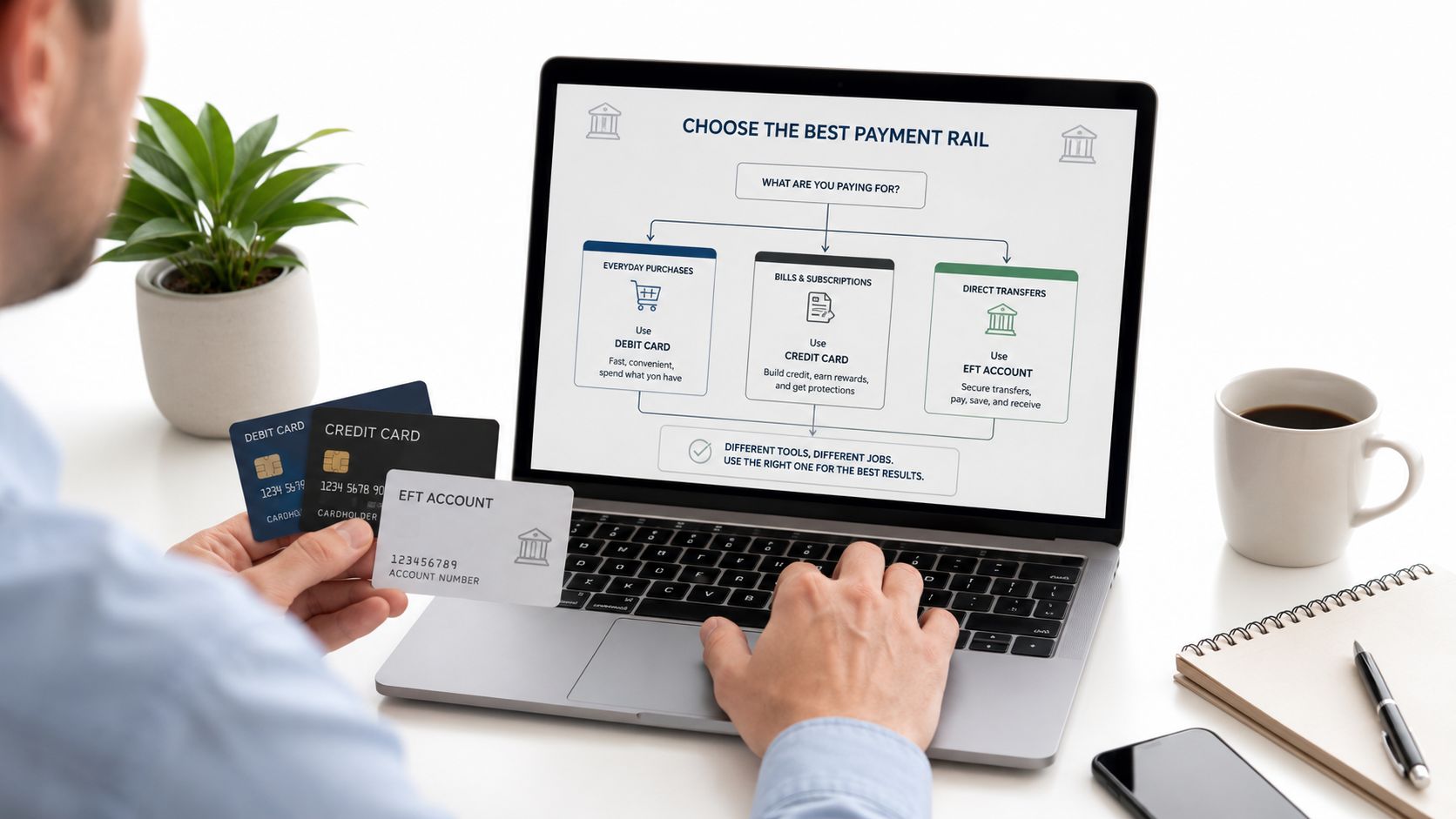
For consumer checkout, cards remain useful when the purchase flow depends on an immediate authorization decision. For account-based collections, decide whether the processing calendar and return exposure fit your fulfillment policy. Compare provider pricing and operational workload directly rather than assuming the EFT label establishes either.
Distinguish rail choice from provider dependency
Adding payment methods doesn't automatically improve resilience. If every saved method and operational workflow depends on the same provider, you may still have a single point of failure.
Stripe is a strong processor. Keep Stripe as a processor, but don't make Stripe your entire payment continuity strategy. Ask where saved payment methods live and whether you can use them across supported providers without asking customers to enter their details again.
One option is FloPay, which combines checkout, payment routing, and secure payment data vaulting through a single software development kit, or SDK, and API. Flo Vault provides a processor-neutral, PCI-compliant card-on-file layer, making saved payment methods portable across supported providers.
That card-on-file capability shouldn't be confused with universal bank-payment portability. Confirm ACH support, authorization handling, and migration requirements with the relevant provider; a card vault doesn't automatically make an EFT mandate transferable.
Evaluate control before adding complexity
A payment orchestration software evaluation should establish which routing and retry decisions the platform can support, which records remain accessible, and how provider failures affect ongoing billing. Routing and recovery tools are designed to improve acceptance, but outcomes still depend on banks, customer behavior, fraud controls, and provider rules.
The demonstration provides another way to evaluate the checkout and orchestration approach.
Portable saved payment methods can reduce processor concentration risk today and help prepare for agent-assisted commerce later. Neither benefit removes the need for explicit authorization, secure payment handling, or rail-specific controls.
Build fallback around supported capabilities, not assumptions. More providers only help if your team can use them when needed.
Key Takeaways and Your Next Step
An EFT account is the account capable of electronic debits and credits; an EFT is the movement of money. For merchants, that distinction becomes useful when it changes how you build and operate payments.
The essential consequences are straightforward: rails differ, settlement requires lifecycle tracking, and authorization records support investigations. A clean checkout can hide that complexity from customers, but your internal systems still need to preserve it.
Check your current payment stack
- Identify your rails: List the actual networks and providers behind each customer-facing payment option.
- Inspect your records: Check whether you retain the rail, account type, authorization method, and meaningful transaction status.
- Test the exception path: Make sure support can trace a returned payment to its original authorization and invoice.
- Review portability: Establish where saved payment methods live and what moving to another supported provider would require.
Start with a recurring payment flow and trace it from customer consent through collection, settlement, and a possible return. If engineering, finance, and support can't explain the same transaction consistently, fix that visibility gap before adding more routing complexity.
For subscription businesses, checking saved-payment portability is a practical next step. A Vault Risk Review can help turn that question into a concrete continuity plan.
FloPay offers unified checkout, payment orchestration, and a processor-neutral card-on-file layer for merchants reviewing payment resilience. Visit FloPay to discuss your account-based payment requirements alongside cards and request a Vault Risk Review of your saved-payment portability.