What Is Card Tokenization? A Plain-English Guide
What is card tokenization? A plain guide to how tokens replace card numbers, reduce PCI scope, and protect recurring billing.
Card tokenization replaces the full card number (PAN) with a substitute value called a token, so merchant systems hold a reference instead of the card number. You're probably already using it. A customer saves a card at checkout, your subscription renews next month, and your team never sees the actual number again. That convenience hides an important question. If that saved card lives only inside one provider, can you still use it elsewhere?
Table of Contents
- What Card Tokenization Means in Plain English
- How a Token Replaces the Card Number in a Payment
- Why Tokenization Protects Revenue as Well as Data
- Three Kinds of Tokens and Why They Are Not Interchangeable
- Where Tokenization Fits in Payment Orchestration and Agent Vaults
- What Tokenization Does Not Fix and What to Check
What Card Tokenization Means in Plain English
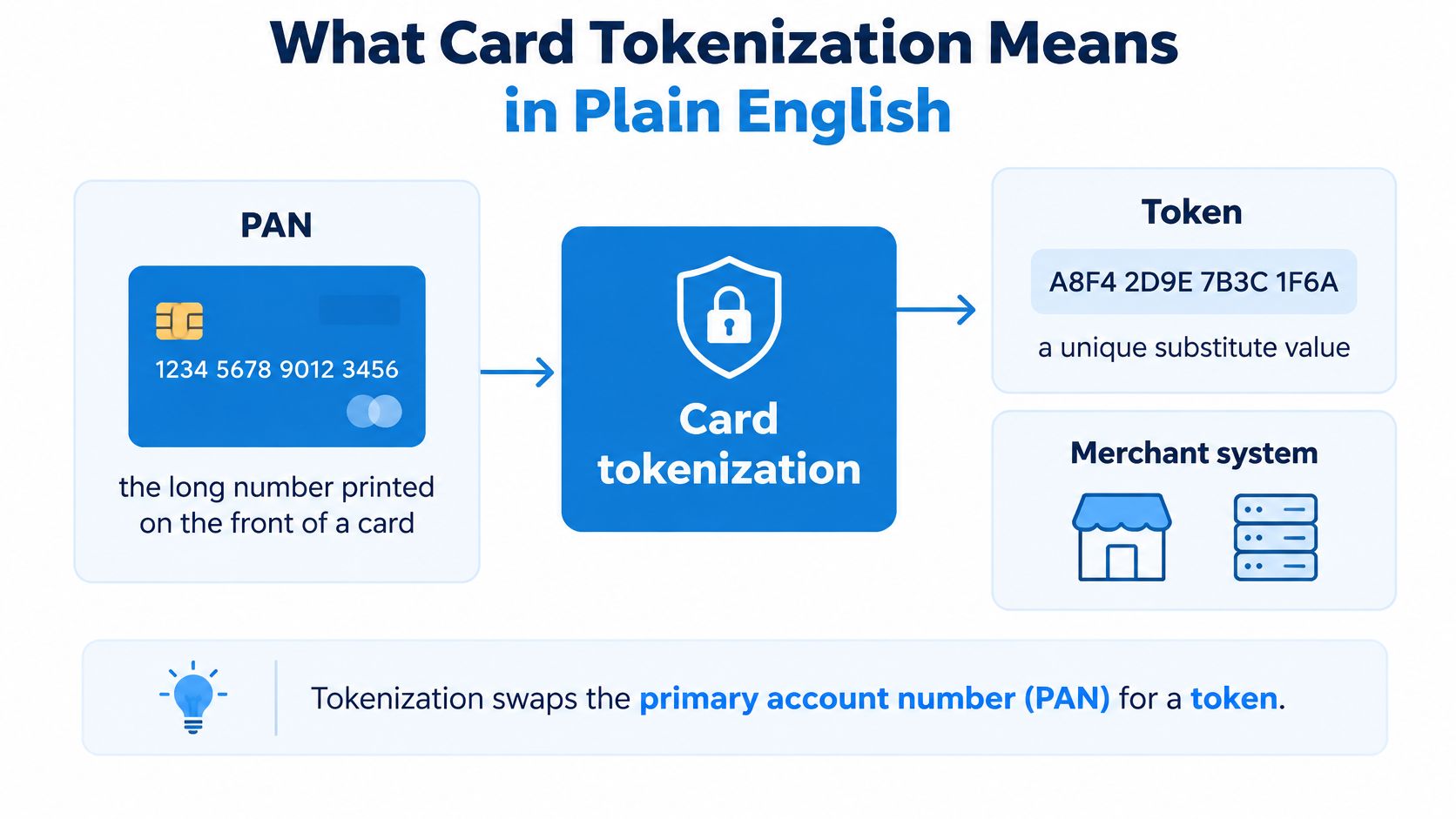
If you're asking what is card tokenization in practical terms, start with two terms. The PAN is the full card number printed on the card. The BIN is the first digits of that number, used to identify the issuing bank and card type.
Tokenization swaps the PAN for a unique substitute value. Think of a coat check. You hand over your coat and get a ticket. The ticket works only at that cloakroom, and losing the ticket is far less damaging than losing the coat itself.
Why a token isn't encrypted card data
Encryption scrambles the card number with a key, so anyone holding that key can reverse it. A token has no mathematical link to the PAN. Its meaning sits in a protected vault that maps token to card.
The PCI Security Standards Council guidance on payment tokens describes tokenization as replacing the PAN with a surrogate value, reducing the amount of valuable card data stored in merchant systems. Properly implemented tokens can also be restricted to a merchant, device, channel, or transaction type, often with a dynamic cryptogram or domain controls.
| Property | Raw card number (PAN) | Encrypted card number | Payment token |
|---|---|---|---|
| What it is | The full card number printed on the card | The card number scrambled with a key | A substitute value mapped to the card in a protected vault |
| Can it be reversed? | Already readable | Yes, by anyone holding the key | No mathematical link, mapping kept in the vault |
| Usable outside the merchant? | Yes, anywhere the card is accepted | Yes, if the key is exposed | Restricted to the context it was issued for |
| Where it sits in merchant systems | Ideally nowhere | Often in databases and backups | Token only |
For your business, that means order, billing, and support systems work with a reference. They don't need the raw number to charge, refund, or recognize a returning customer.
How a Token Replaces the Card Number in a Payment
The flow matters because it decides which systems ever touch a PAN. Done well, the card number stops early and never spreads into your database, logs, or support tools.
The seven steps
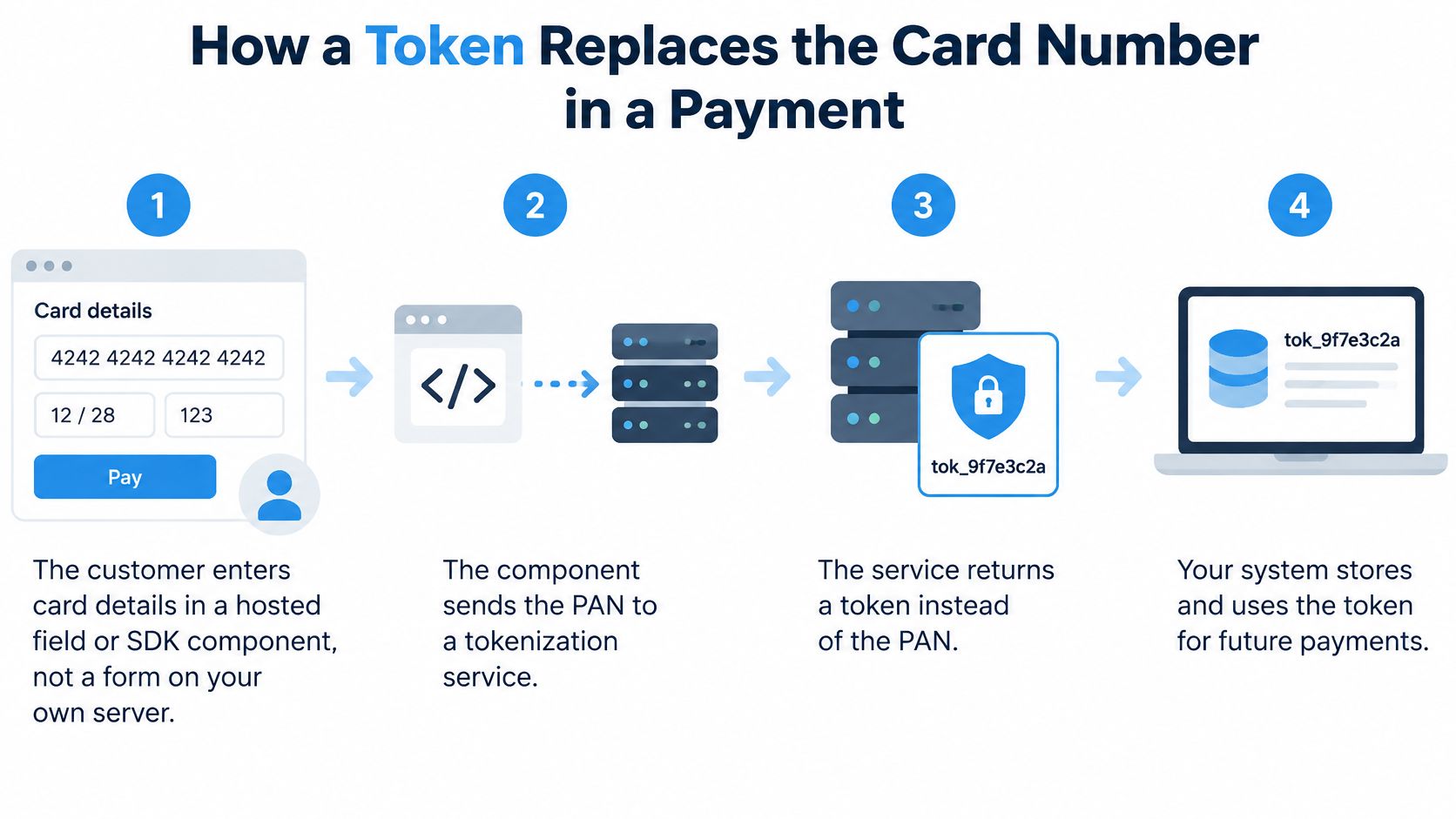
- Customer enters details in a hosted field or SDK. The component sits in your checkout but isn't a form posting card data to your server. That's the quickest fix for most integration problems, because direct server collection adds compliance burden and attack surface.
- The component sends the PAN to a tokenization service. Your ordinary systems are bypassed, so the number doesn't land in application logs.
- The service returns a token. You store the token plus display details such as card brand and last four digits, enough for customers to recognize the card.
- Repeat purchases send the token. A renewal or one click checkout uses that reference, not a card number retyped by the customer.
- The token service maps it back. Only a privileged service detokenizes and passes card data to the processor or network for authorization.
- The result returns to you. Approval or decline reaches your system, and the token stays in place for next time.
- Refunds reuse the same token. Support teams can refund the original payment method without handling card data.
Control point to check: Detokenization should be restricted, audited, and separated from merchant facing token identifiers, so a compromise of checkout or orchestration doesn't directly reveal PANs.
The PCI tokenization product security guidelines cover token generation, retention, storage, and attack vector mitigation. That's why this is a security architecture, not a database format change. Walk your own flow and list every system that ever sees a full number. If you can't name them, that's your first gap.
Why Tokenization Protects Revenue as Well as Data
Security gets the budget discussion started. Revenue usually finishes it. Three commercial effects matter most.
Scope, renewals, and authorization
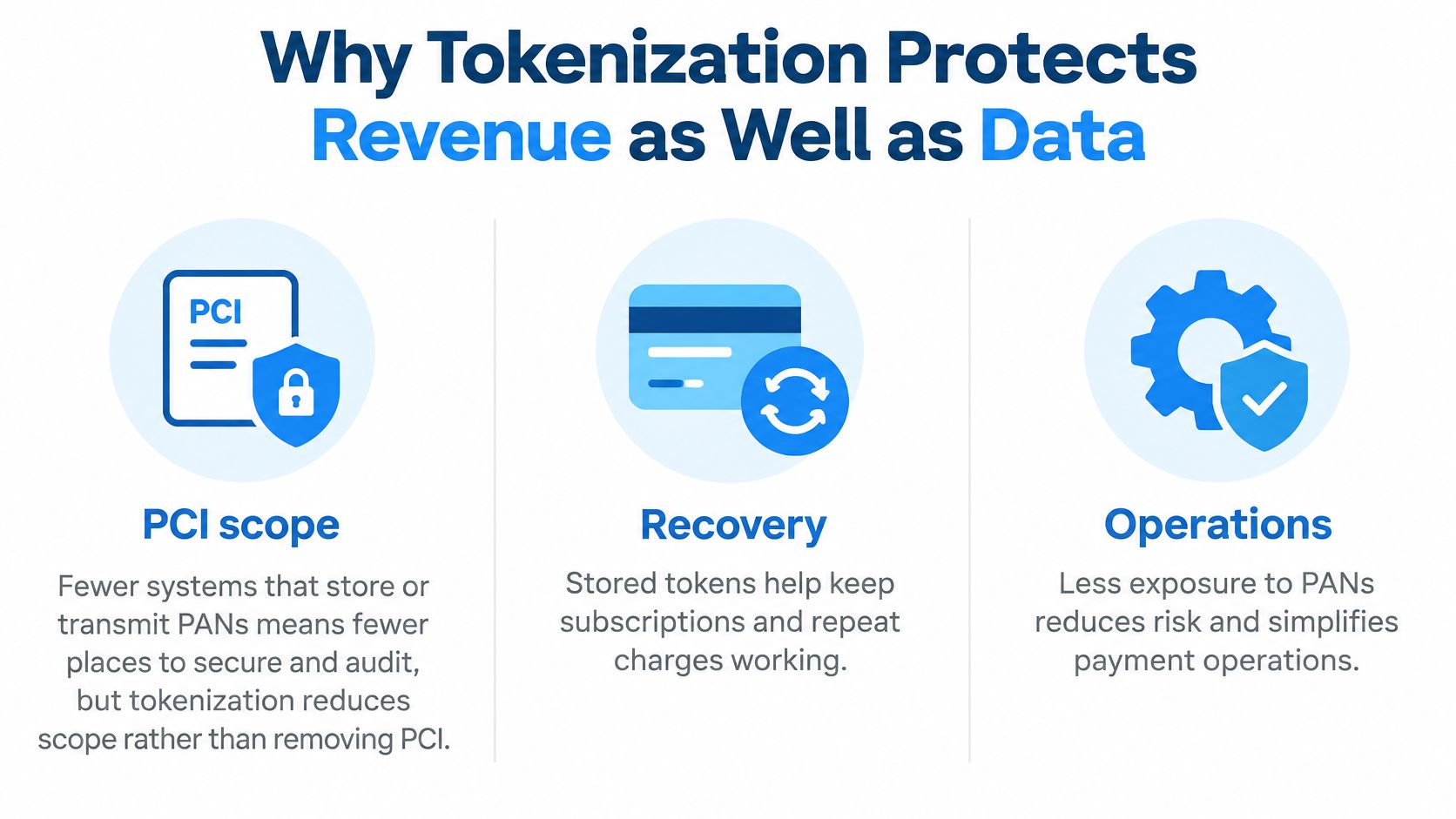
PCI scope shrinks when fewer systems store or transmit PANs. You have fewer places to secure and audit. Tokenization reduces scope, it doesn't remove PCI obligations for systems that still handle or connect to card data.
Recurring billing depends on a stored credential. A token lets a rebill run as a merchant initiated transaction, or MIT, when the customer isn't present. That matters when a renewal fails but the customer still wants the service. You can retry under your dunning rules without asking them to re-enter details they may not have to hand.
Authorization and fraud are where network data is useful context. Visa's tokenization reporting states that globally 50% of e-commerce transactions were tokenized, tokenized transactions showed a 4.8% authorization-rate increase compared with transactions using non-tokenized primary account numbers, and tokenized credentials had a 39.4% lower fraud rate in its cited global fiscal-year data. Visa's 2024 token announcement reported Visa tokens generated more than $40 billion in incremental global e-commerce revenue and saved $650 million in fraud during the preceding year.
| Metric | Figure | What it compares | How to read it |
|---|---|---|---|
| Share of global e-commerce transactions tokenized | 50% | Tokenized transactions vs all e-commerce | Visa global report, not one merchant |
| Authorization-rate difference | 4.8% higher | Tokenized transactions vs non-tokenized PANs | Varies by market, issuer mix and implementation |
| Fraud rate | 39.4% lower | Tokenized credentials vs non-tokenized credentials | Visa fiscal-year network data, not a chargeback guarantee |
| Incremental e-commerce revenue | More than $40 billion | Visa tokens in the year before the 2024 report | Network total, not a single merchant |
| Fraud dollars saved | $650 million | Visa tokens in the preceding year | Network total, no verified merchant lift |
These are Visa reported network results, not a promise for your checkout. Still, a few points of authorization across a large subscription base is real money, because each recovered renewal is revenue you didn't need to reacquire. Ask which revenue lines stop if one saved credential stops working. That answer tells you how strategic this decision is.
Three Kinds of Tokens and Why They Are Not Interchangeable
Tokenized doesn't automatically mean portable. That's the mistake that costs merchants during a provider change. The word token covers different credentials with different reach.
A gateway or PSP vault token generally works only inside the provider that created it. An EMV network token is issued through card schemes and linked to the underlying account, with lifecycle updates when a card is reissued. Independent vault tokens sit in a processor neutral vault and work across providers that vault supports.
The EMVCo tokenization quick reference guide distinguishes merchant or gateway tokens that may be meaningful only inside one provider's system from EMV payment tokens designed to travel from merchant to acquirer, across the network, and to the issuer. That distinction decides portability, security, and operational risk.
| Token type | Issued by | Where it works | Survives processor change? | Survives card reissue? |
|---|---|---|---|---|
| Gateway or PSP vault token | The processor or gateway | Inside that provider's system | Usually no, unless exported | Only with that provider's updater |
| EMV network token | Card scheme, requested by a merchant or wallet | Across merchant, acquirer, network and issuer | Designed to travel through the ecosystem | Usually, through lifecycle updates |
| Independent vault token | Independent PCI-compliant vault | Across providers the vault supports | Yes, if the target gateway is connected | Only with updater support |
| Recurring credential reference | Provider that ran the first transaction | Recurring charges through that provider | Only with a migration plan | Only with that provider's updater |
Tokenization arrived as fraud moved into card not present commerce, so it complements EMV chip rather than replacing it. Before you sign or renew, demand a token inventory that separates network tokens from proprietary references. Our explainer on how a credit card vault stores saved payment methods covers what that inventory should contain.
Where Tokenization Fits in Payment Orchestration and Agent Vaults
A renewal is declined, and the merchant's payment provider cannot process it. Payment orchestration can route a transaction to another compatible provider, but a saved payment credential may still be tied to the original provider. Routing flexibility depends on how the payment method was tokenized and whether another provider can use it.
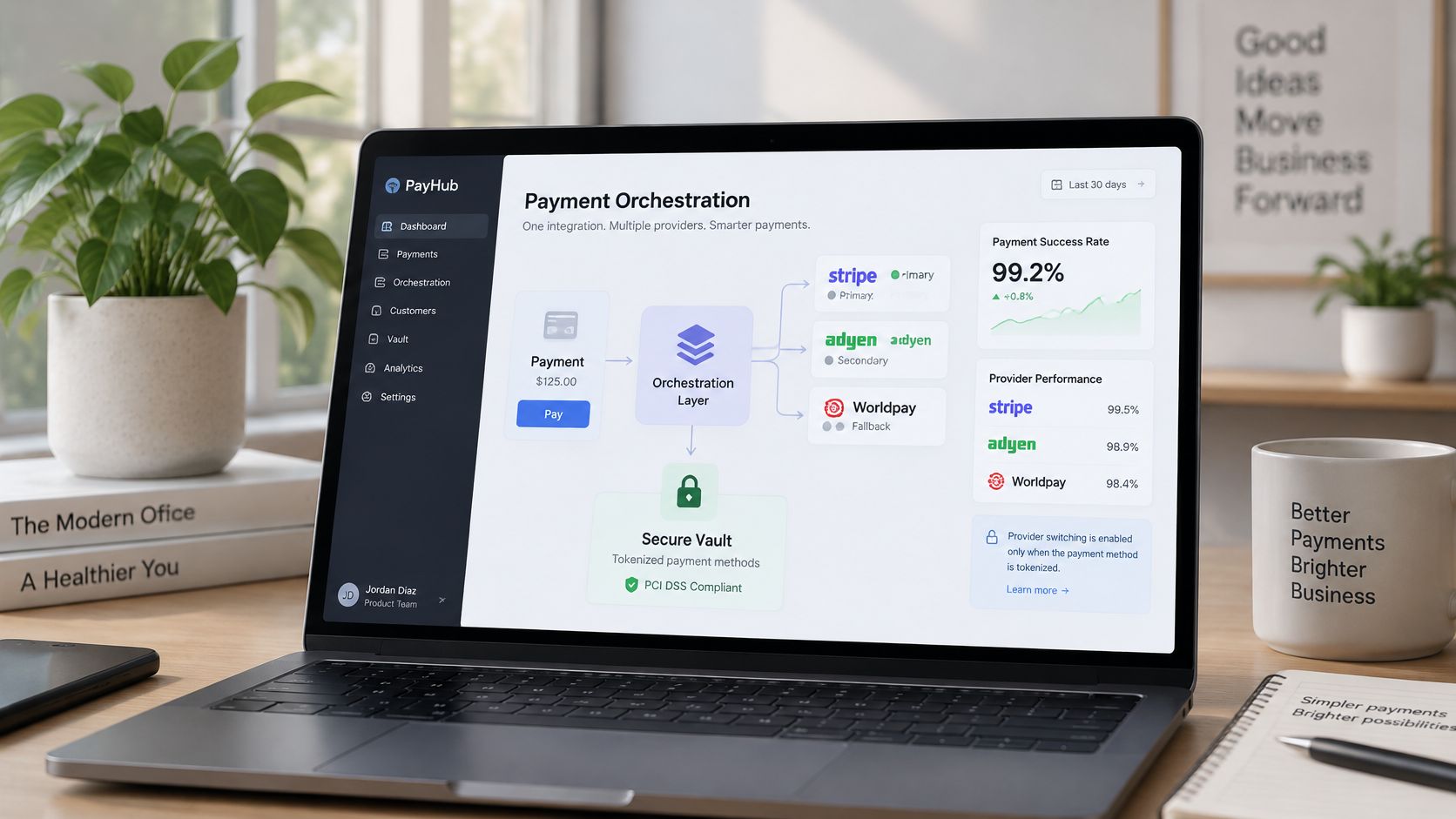
If a subscriber's renewal fails for insufficient funds, a merchant-controlled vault token may allow an eligible retry through another supported gateway or acquirer, without asking the customer to enter their card again. The merchant might also offer a lower-priced package rather than lose the subscriber. These options can support recovery, but they do not guarantee a successful payment or a particular revenue result.
Tokens and routing rules need to work together. EMVCo's payment tokenization overview describes tokens that can be constrained to a merchant, device, or payment scenario, then used through the acquirer and payment networks for issuer authorization. In practice, merchants also need to account for token provisioning, lifecycle updates, and fallback when a token is suspended or replaced. Routing must use providers that support the token. A guide to payment orchestration software and provider routing explains how routing rules can direct transactions among providers.
The short video below illustrates orchestration concepts.
Watch a short video on payment orchestration concepts
Agent authority is a separate layer
An Agent Vault Token represents permission for an agent to use a stored payment method under defined rules. It is distinct from the card itself and from a provider's vault token. A person can set limits for total spending, each transaction, approved merchants or categories, currency, purpose, validity period, and revocation.
For accountability, each attempt should record the principal, agent, merchant, consent, policy decision, and outcome. If human approval is required, payment can return to a hosted flow. FloPay supports payment vaulting, tokenization, and agent-assisted commerce through its platform; its Agent Vault is designed to let merchants control delegated payment access and retain an auditable record of agent transactions. These capabilities do not make every saved credential portable: portability still depends on the token type and the providers that can accept it.
What Tokenization Does Not Fix and What to Check
A token cuts how many systems see a PAN. It doesn't make your business PCI free, guarantee authorization, or stop every fraud attempt and chargeback on its own. Those limits aren't footnotes. Each one has a commercial cost if you plan as though it doesn't exist.
Limits that still sit with you
Compliance remains. Systems that store, process, transmit, or connect to card numbers stay in PCI DSS scope. Access control, monitoring, secure integration, and evidence for your assessment still sit with you. Tokenization can reduce the sensitive data ordinary systems handle, because raw card data goes to a PCI compliant vault and those systems keep only a token. It doesn't remove obligations.
If that distinction is new to your team, read our breakdown of the attestation of compliance and what it actually proves before you promise a lighter audit internally.
Approvals stay probabilistic. Issuers still weigh funds, risk signals, authentication, and account status. A token can't fix an empty account, a wrong postal code causing an AVS mismatch, or a customer who abandons a 3DS challenge. AVS is address verification used by some banks. 3DS is bank authentication, often by app approval, SMS, or biometric confirmation. Retrying harder isn't always the answer either, especially when a decline code tells you the transaction isn't allowed.
Fraud control stays layered. A constrained token is less useful if stolen, but account takeover, friendly fraud, and disputed subscriptions need separate controls. Chargeback prevention tooling is still early in rollout for many providers, so don't accept a chargeback reduction claim without verified before and after data for merchants like you.
A saved card that only works through one gateway isn't resilience. It's a single point of failure with better encryption around it.
The lock in problem
The PCI Security Standards Council small merchant guide explains that merchants may use tokens for subsequent transactions and refunds while the processor retains the underlying card details and uses the token to retrieve them. It also makes the operational catch clear. A token is generally tied to the provider or environment that created it, so moving processors may require portability, account updater support, or a controlled migration.
Stripe is a strong processor and a useful part of many stacks. Keep Stripe as a processor if it performs for you. Don't make Stripe your entire payment continuity strategy. A Stripe only card on file base is processor concentration risk. An account restriction, outage, or price change can stall renewals when there's no export path and no second route ready.
That's why card on file portability belongs in procurement, not in an emergency migration. By the time renewals are failing, customers won't all re-enter card details just because you changed providers.
Six checks to run in order
- Inventory every saved credential. List each store of saved cards and recurring references, plus the provider that issued each one. Include legacy billing tools and support payment links, not just main checkout.
- Count single gateway dependency. Work out how many active subscriptions depend on one gateway. Put a revenue figure next to that count, because leadership responds to exposed renewals faster than to token counts.
- Ask about export and exit. Get written answers on which tokens can be exported, in what format, under what timeline, and at what cost. Check token requestor identity too, since it can affect whether network tokens remain usable after a move.
- Separate network tokens from proprietary references. Mark each credential clearly and confirm updater coverage for reissued and expired cards. Don't assume a vault token and a network token are the same record.
- Keep consent and credential linkage. Retain proof of consent and the original credential reference so later rebills link back to the first customer approved charge. That record matters for disputes and for clean MIT processing.
- Never keep the CVV after authorization. Not in a database, not in logs, not even encrypted. If you find it, treat removal as urgent remediation with your compliance adviser.
If step two covers most of your base, don't start with a rushed migration. Start with a Vault Risk Review, map the export path, and test a small cohort through a second supported provider. You'll learn whether your tokens, updater, consent records, and retry logic travel together before revenue depends on the answer.
Tokenization is worth doing because it keeps raw card data out of merchant systems and supports saved payment methods customers expect. It's worth doing carefully because the wrong token setup can reduce data exposure while increasing provider dependency. Check where your saved payment methods live, who can use them, and what happens on the day you need another route. Those three answers tell you whether you bought security, portability, or only the first one.
If your recurring revenue depends on saved cards held by a single gateway, explore Flo Vault as a processor neutral card on file layer that supports portable tokenized payment methods across supported providers. Book a Vault Risk Review to map your token inventory and migration path, then visit FloPay to talk through payment orchestration for your current stack.