Payment Retries: Which Declines to Retry, When, and How Many Times
Payment retries without repeat declines: which failed payments to retry, which to stop, how to time retries inside the billing cycle, and how many to allow.
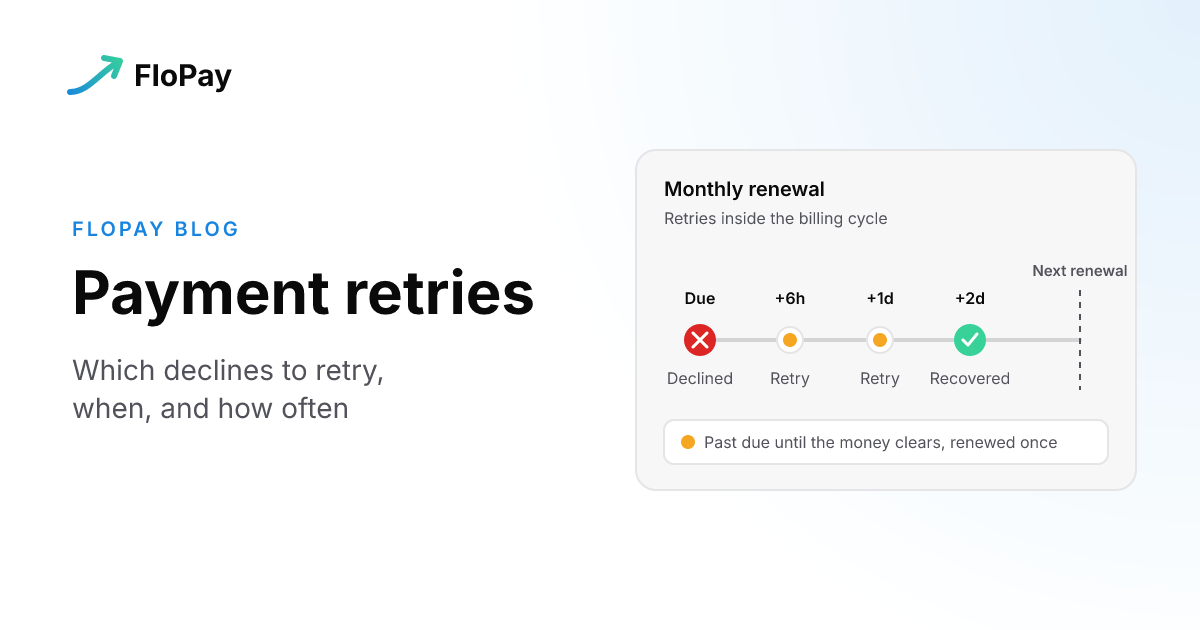
A payment retry is another attempt to collect a payment that failed. For a business that bills subscriptions, sending the retry is the easy part. The hard part is everything around it: which failures deserve another try, when to make it, how many times, and what your systems should believe while it runs.
This guide sets out the policy FloPay runs on failed renewals, with the schedule and the limits written down, so you can hold your own setup up against it. If you're looking at a single decline right now, start with Payment Was Declined: Immediate Steps to Fix It.
What a retry is, and what it isn't
A retry charges the same payment again later, because the reason it failed may have cleared by then. Sending the payment to another gateway straight away, or asking the customer for a different card, are different fixes for different failures. Payment Was Declined covers when each one fits.
A renewal retry also runs with no customer present. It charges a saved card, so nobody is there to fix a typo or answer a bank's challenge. Every rule below follows from that.
Which declines to retry: three outcomes, not two
Splitting declines into soft ones you retry and hard ones you don't misses one case, and it's the case that causes double charges. FloPay sorts every failed renewal into one of three outcomes.
| Outcome | What it covers | What FloPay does |
|---|---|---|
| Retry later | A decline with no terminal evidence: insufficient funds, a generic decline such as do-not-honor, or no eligible saved method right now | Schedules the next retry inside the billing cycle |
| Set the card aside | Terminal evidence: a lost, stolen, expired, invalid or restricted card, revoked authorization, failed required authentication, a do-not-try-again response, or a transaction not allowed | Stops using that card for the rest of the campaign and tries the customer's other saved methods |
| Prove what happened | A timeout or a technical error | Stops, and proves whether the charge went through before it charges anything again |
Decline labels can mislead. A generic do-not-honor can be retryable, while a do-not-honor that comes with lost-card evidence is terminal for that card. So the decision follows the provider's evidence, not only the label. Why do-not-honor says so little is covered in Do Not Honor Meaning for Merchants.
The third row matters most. Why a timeout must never be charged again blind is in our recurring billing software guide. Here's what FloPay does about it: it checks that exact operation with the provider, up to five times within six hours. If the answer is still unknown, it stops the campaign and holds it for review instead of guessing, as the subscriptions guide sets out.
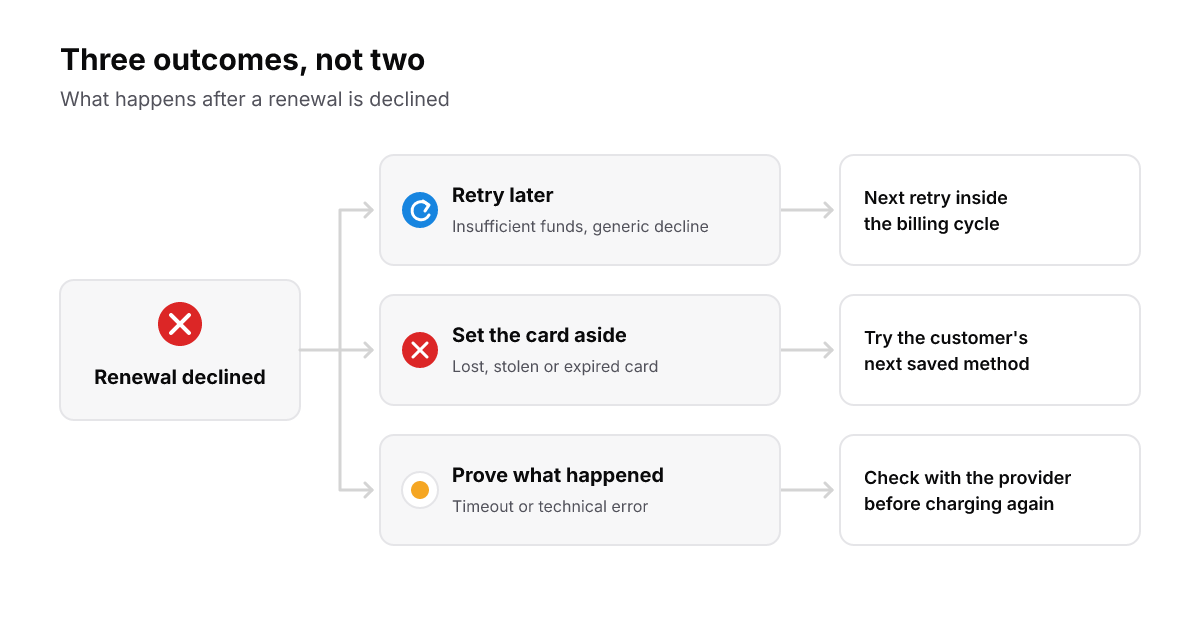
Three outcomes, not two. A timeout is neither a soft nor a hard decline, so it gets its own path.
Stripe draws a similar line for its own product. Its Smart Retries documentation lists hard decline codes it won't retry automatically, among them lost_card, stolen_card, incorrect_number and transaction_not_allowed.
When to retry: inside the billing cycle
Every retry lands strictly before the next billing date, so a retry never runs into the next renewal. The window follows the plan's length:
| Plan | Default retries after the due time | Last retry |
|---|---|---|
| Daily | +1h, +3h, +7h, +13h, +20h | Within 20 hours |
| Weekly | +2h, +8h, +1d, +2d, +4d, +6d | Day 6 |
| Monthly | +6h, +1d, +2d, +4d, +8d, +14d, +21d, +27d | Day 27 |
| Annual | +6h, +1d, +2d, +4d, +8d, +16d, +32d, +60d | Day 60 |
Longer intervals scale the same way, so a two-week plan retries through day 12. The early retries come hours apart and the later ones days apart, and none crosses the next billing date.
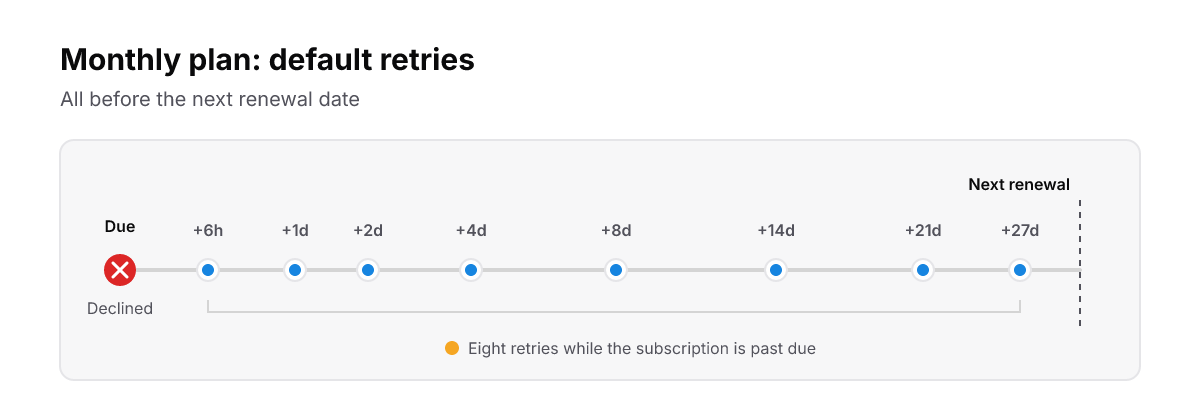
A monthly plan's eight default retries, all before the next renewal date.
The schedule isn't only a fixed table. Measured evidence from the merchant's own last 90 days can move the time of a single retry. It does so only when the new slot and the default each have at least 100 observations and the new slot recovers at least five percentage points more. Evidence never changes the number of retries, which declines qualify, or the cutoff. Once a campaign starts, its schedule is frozen, so a later edit to the subscription can't move a campaign that's already running.
How many times to retry
The plan's cadence sets the limit, and the decline decides whether to retry at all. FloPay allows up to 5 scheduled retries for a daily plan, 6 for weekly, 8 for monthly and 8 for annual. The failed original attempt doesn't use one up. A card that has been set aside isn't retried at all, however many rounds are left.
For comparison, Stripe's Smart Retries default for new accounts is up to 8 retries within 2 weeks, and its custom schedule allows up to three retries. Stripe counts retries over a period you choose. Ours are tied to the billing cycle, so the window grows and shrinks with the plan.
Bank debits get fewer
Stripe documents its ACH Direct Debit retries as insufficient funds only, up to 2 retries within 40 days, on the same Smart Retries page.
Our rule for bank debits is tighter. A failed debit is retried at most once per renewal period, only for a recoverable reason such as insufficient funds, and never after a revoked mandate or a closed account. A customer who is briefly short of funds gets one more chance, and failed debits don't pile up. Whichever processor collects your debits, ask it which limit it applies.
What each retry charges
A retry is only as good as the card it uses. Each scheduled retry looks up the customer's saved methods again and uses the freshest eligible one, so a card the customer updated mid-campaign can pay the renewal, while a card already set aside stays set aside. The retry then takes the same path as an ordinary renewal: the card goes to each of the merchant's eligible gateways, in the order fixed for that payment, before an older card is tried. That cascade, the one-time token refresh from the vault and the stop at a bank challenge are covered in our authorization rate guide.
Here's how that plays out. This is an illustration, not a customer's case: a monthly renewal is declined for insufficient funds at the due time and goes past due. The retries at +6h and +1d fail. Before the +2d retry, the customer updates their card. That retry picks up the new card, clears, and the subscription renews once, counted from the original billing date, so the customer's next renewal date doesn't shift.
Which processors a retry can reach depends on where the saved card lives. What a credit card vault is explains why.
What your systems should see while it runs
While retries run, the subscription and invoice stay past due and the paid-through date doesn't move. The webhook events tell your systems where the campaign stands:
| Moment | Events, in order |
|---|---|
| First failed renewal | invoice.payment_failed, then subscription.updated (past_due) |
| Each later failed retry | invoice.payment_failed, and no renewal event |
| Recovered | subscription.updated (active), invoice.created, invoice.paid, subscription.renewed, item.purchased |
| Retries run out | invoice.payment_failed, then subscription.expired |
| Outcome unknown | subscription.updated (past_due), then no failure, renewal or expiry event while it's reviewed |
The rule to build on: close access only on subscription.expired, never on the first failed payment. One billing cycle can send several invoice.payment_failed events, each with its own eventId, so deduplicate on that. The event reference is in the webhook docs.
Your team sees the same story. The subscription's timeline shows the next scheduled retry instead of a normal upcoming renewal, and the recovery history lists every round. How recovered renewals show up in reporting is in the recurring billing software guide. The three dunning emails (first failure, retry failed, final notice) follow the campaign's own rounds, as the emails guide describes.
In testing, we caught what this rule guards against. A bank debit returned after the next renewal was paid would have expired a paid-up subscription, and recovering it would have moved the billing date backwards. Both were fixed before release.
How we got here
We didn't start with a static schedule. On August 18, 2026, renewals moved under FloPay with no automatic retries, and merchants kept their own recovery process until decline-aware recovery shipped on August 24, 2026.
When the emails for failed renewals were built, we ruled out a fixed 3, 7 and 14-day email calendar. The emails should follow the campaign's own retry rounds, and a frozen calendar would have contradicted them and been hard to undo.
We don't publish a recovery rate yet, so you won't find one here.
Can you set your own retry schedule?
Not yet. Today every merchant runs on the same defaults: there's no API or Dashboard setting to change retry windows, attempt counts, which declines qualify, or retry times. Merchant-level policies are planned, and the platform's safety limits and honest-lifecycle rules will stay mandatory when they arrive.
What a merchant does get now is retry timing tuned on their own recent recovery data, when the evidence is strong. Subscriptions their provider manages keep that provider's own retries, and FloPay doesn't add to them: see the Stripe and PayPal connector guides.
The short version
- Sort every failed renewal into three outcomes: retry later, set the card aside, or prove what happened.
- Keep every retry before the next billing date, and let the plan's length set the window.
- Cap retries by cadence, and don't count the failed original attempt.
- Let data move a retry's timing only on strong evidence, and never let it add retries.
- Keep the subscription past due until money clears, and close access only when it expires.
See how FloPay recovers failed renewals, read the subscriptions guide, or visit FloPay.